
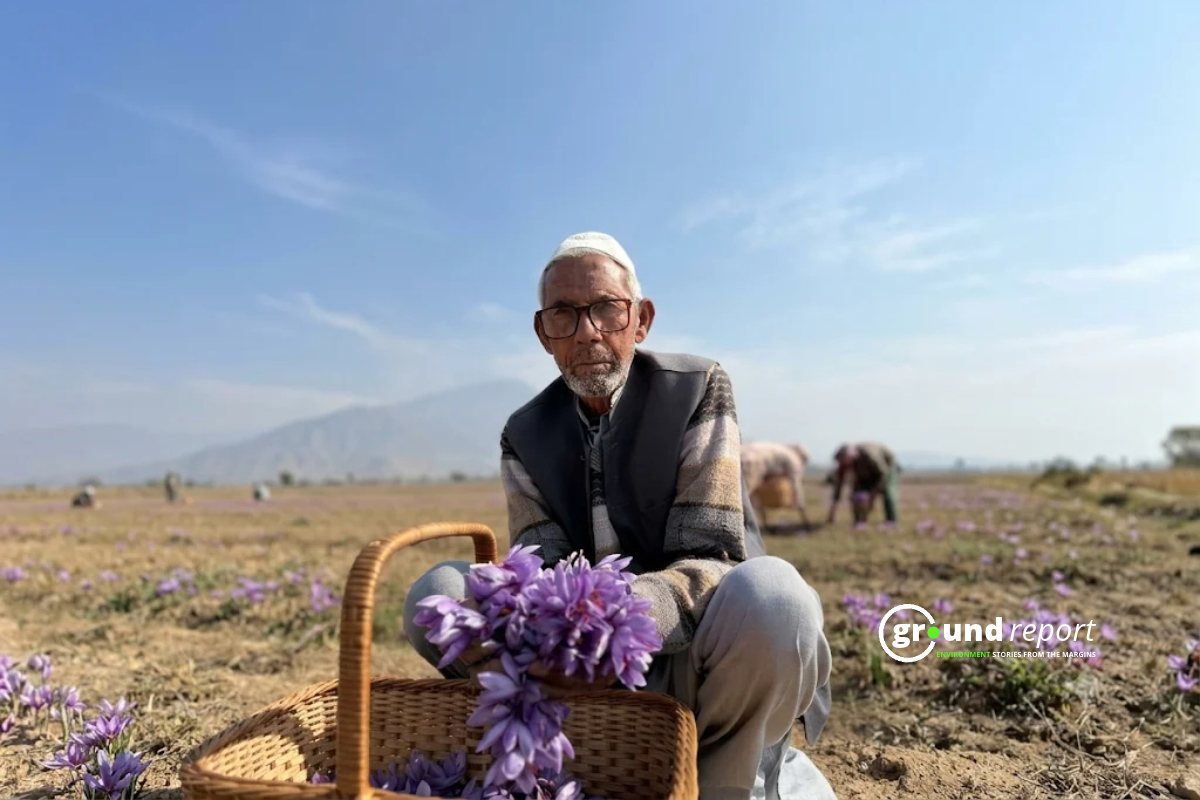
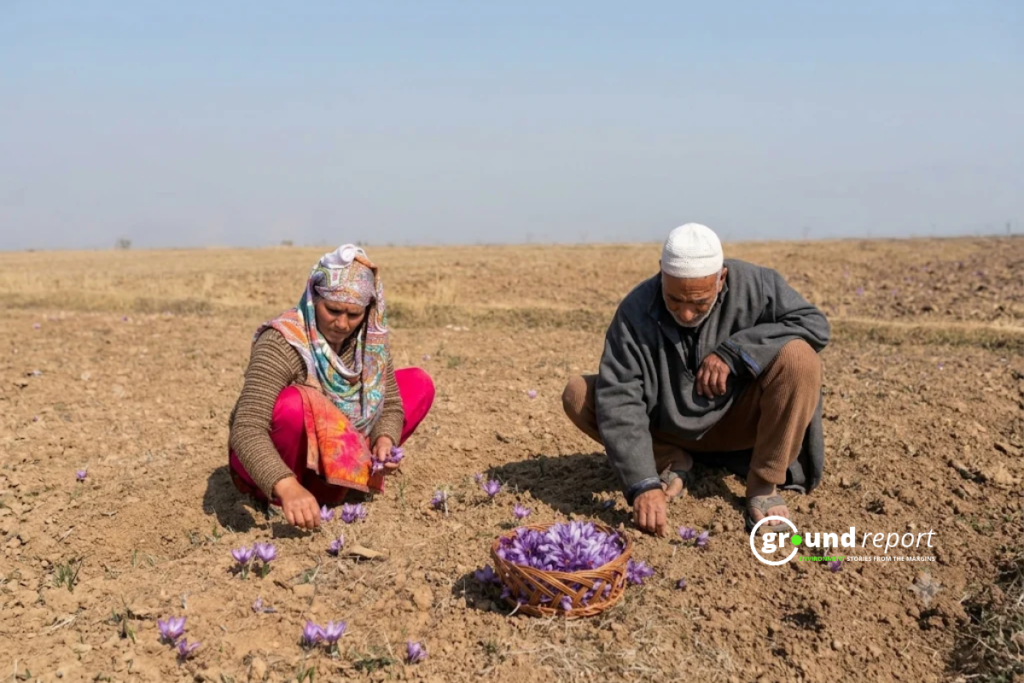
Noor Mohammad Bhat, 80 years-old, a saffron farmer from Lethipora in Pampore, has worked the fields since 1947. Known as Kashmir’s Saffron King, he carries on a family tradition and still tends his land at his age.
He rolled a crimson thread through his cracked fingers. He said working among the flowers gives him peace and ties him to his family’s farming past. Though falling rain and long dry spells now worry growers.
Researchers say changing weather patterns are also affecting saffron cultivation. Studies have found that rainfall between August and September plays an important role in the crop’s flowering and development of its underground stems, known as corms. A lack of rain during this period can disrupt corm development and reduce flowering, while excessive rainfall can also affect yields.
The Saffron Growers Association said that this year’s saffron harvest looks better than last year’s, when production fell to about 15 per cent of normal. “This year, the crop is comparatively better,” Bhat told Ground Report.
But long-term trends are down; saffron production has fallen from eight tonnes in 2010-11 to 2.6 tonnes in 2023-24, a 67.5% decline, a provisional estimate presented in the Lok Sabha.
The government launched the ₹400-crore National Saffron Mission in 2010 to rejuvenate the saffron fields and improve yields. The scheme focused on addressing water scarcity through sprinkler irrigation, improved planting material, and scientific farming practices.
However, more than a decade later, farmers in Pampore say the promised irrigation infrastructure remains largely non-functional, leaving them dependent on increasingly erratic rainfall. Climate change is adding to these pressures. Prolonged dry spells and rising temperatures reduce soil moisture, which further stresses saffron crops. Experts say reviving the crop will require more than financial investment, with functional irrigation systems and climate-resilient farming practices central to sustaining cultivation.
Warmer Winters, Erratic Rain
In Pampore, in Pulwama district, farmers cultivate saffron on karewas — elevated plateaus formed from ancient lake deposits — at altitudes of 1,600 to 1,800 metres above sea level. The district accounts for most of the crop’s land, with smaller areas in Budgam, Srinagar and Kishtwar, with an estimated 20,000–25,000 families dependent on it.
A 2022 DNA study traced the crop’s first cultivation to Greece or Persia about 3,500 years ago. Saffron now flavours kahwa, a Kashmiri tea, and wazwan, the multi-course feast. Since 2020, a Geographical Indication tag has allowed only growers in limited areas to sell it as Kashmiri saffron.
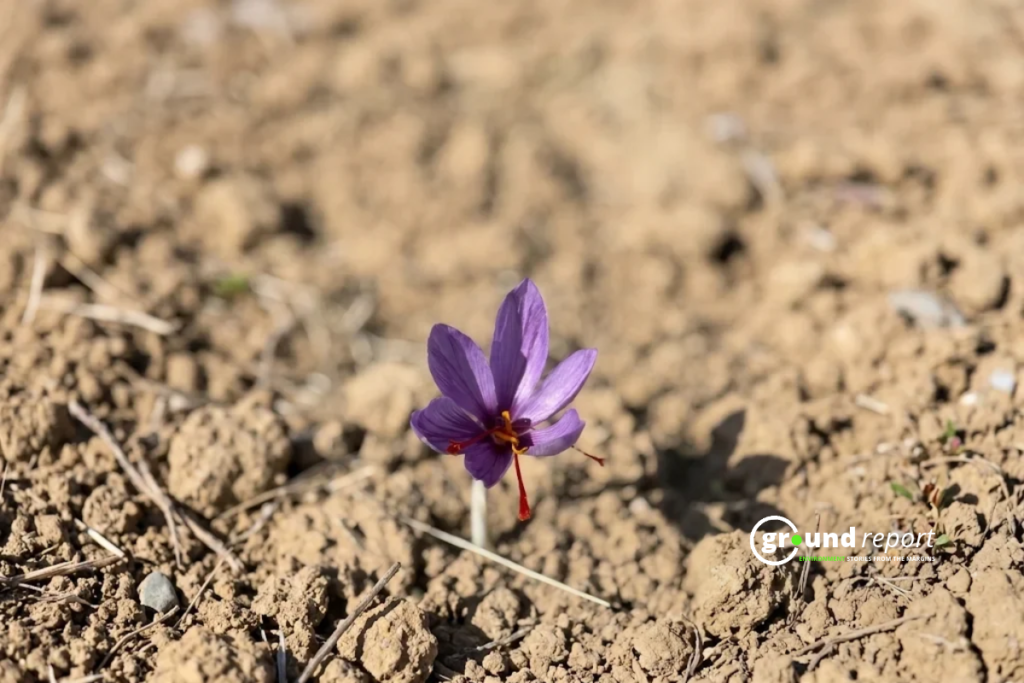
Saffron grows from corms, the plant’s underground stem bases. Each purple flower holds three crimson stigmas, and those threads are the spice. Families pick the flowers by hand before sunrise, then separate and dry the stigmas. It takes about 4,000 flowers to make one ounce.
The harvest runs from late October into November. The flowers open in waves, so growers pick up to four times in about 15 days.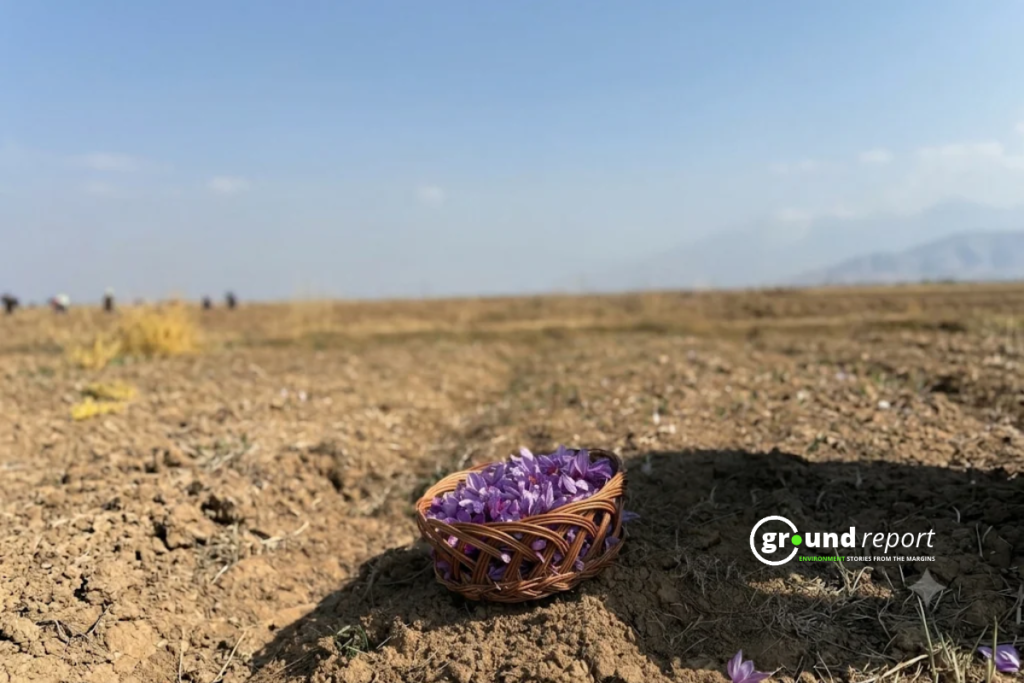
A 2026 study in Molecular Biology Reports looked at what the crop needs during flowering. Saffron quality improved when the minimum temperature reached 10°C between October 1 and November 10, and rainfall stayed between 240 and 265 mm. Rain and minimum temperature had the strongest effect on crocin, the compound that gives saffron its colour.
Sameera Qayoom, a professor and head of agrometeorology at SKUAST-Kashmir, says the rain now falls in a shorter window. She says there is “a decrease in the time period during which we are receiving the rainfall.”
Across the Himalaya, snow cover from November 2025 to March 2026 was 27.8 per cent below average, the lowest in more than two decades.
“Less snow means less water available for irrigation in spring,” Qayoom says.
Dr Mukhtar Ahmad, director of the India Meteorological Department’s Srinagar centre, says December and January have stayed mostly dry since 2018, except in 2020 and 2021. Heat added to the strain in October. Srinagar reached 31.2°C on October 4, 5.7°C above normal, the station’s second-highest October reading.
Ahmad expects the coming winter to be mild and dry.
Thin Harvests, Falling Income
Many Pampore fields stayed bare into late October. Rain then arrived at regular intervals, and flowering improved. Sartaj Ahmad Shah, Director of Agriculture, Kashmir, said on November 6 while visiting the International Kashmir Saffron Trading Centre (IIKSTC) in Dusoo, Pampore. He said last year’s drop came from a long dry spell.
A better season does not make up for earlier losses. For families like Bhat’s, who sort saffron in their own shops, a poor harvest means less produce to process and sell, and consequently lower earnings.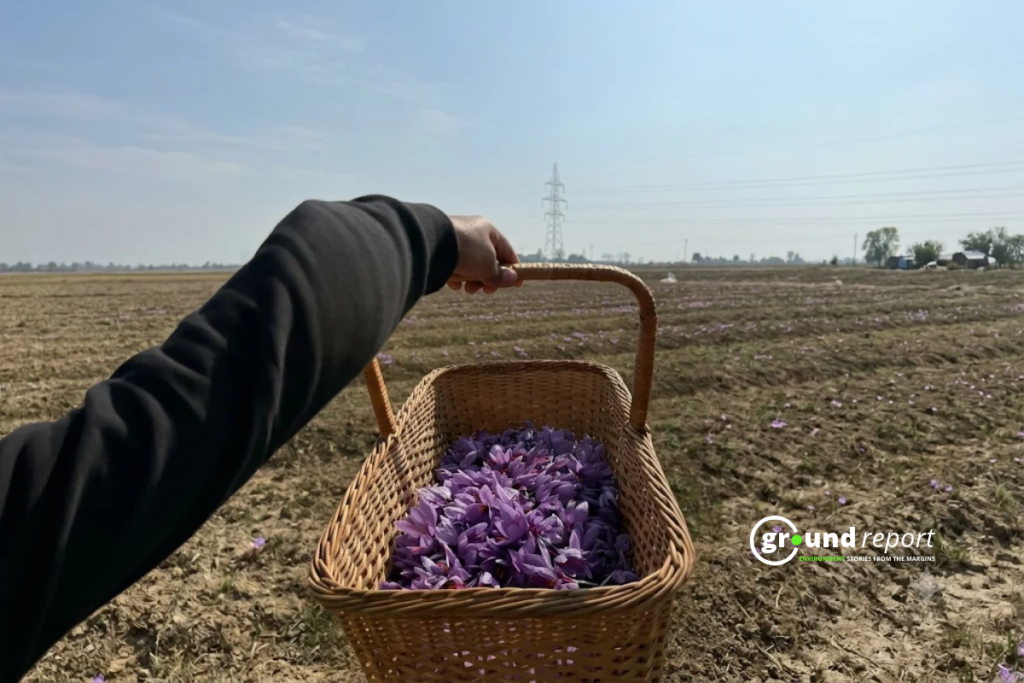
The government launched three measures to protect Kashmir’s saffron. The Saffron Act 2007 barred owners from converting saffron land to other uses. The National Saffron Mission began in 2010 to raise production and quality through irrigation, machines, dryers, and market support.
But saffron land has shrunk, as official data noted a decrease from 5700 hectares in the late 1990s to 3665 hectares in 2025.
A Mission Under Review
The National Saffron Mission promised water, healthy corms, and better prices. It planned 124 community borewells, each to water about 30 hectares through sprinklers. It also planned public nurseries for corms and a saffron park to cut out middlemen.
In February 2024, the Lok Sabha was informed that officials had connected 73 borewells to sprinkler systems covering 2,187 hectares. In February 2026, the J&K government told the Assembly that only eight of the 124 borewells work. Another 77 have stood idle for a long time, and 39 are still pending. The government blamed weak interest in tenders, land disputes, and farmers’ reluctance to pay for running and repairs.
Agriculture Minister Javid Ahmad Dar admitted this month that the mission failed to raise production. He said each borewell serves about 600 kanals, which is hard to manage. His department is now working with SKUAST scientists on a revival plan.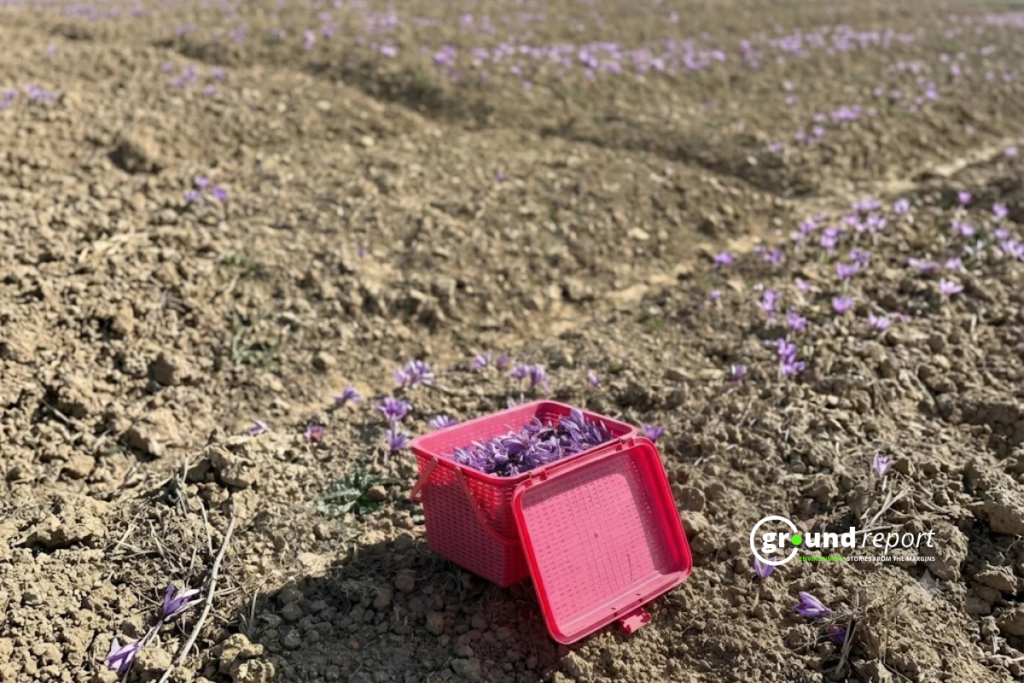
Growers say water fails when the flowers need it. Last autumn, the Saffron Growers Association blamed dry spells, weak irrigation and poor corms. It asked for steady water, regular field checks and good planting material. One farmer says thieves stole the pipes. Pampore’s legislator, Hasnain Masoodi, has called the mission a failure.
Scientists are now testing indoor growing. Early research found steady flowering and crocin retention in controlled rooms.
Bhat is in his 80s and still goes to the field.
Tufail Ganie, a freelance journalist, contributed reporting.
Support Us To Sustain Independent Environmental Journalism In India.
More Ground Reports
Madhya Pradesh’s e-Vikas 2.0 Fertiliser System: Why Are Farmers Still Queuing?
Smart Meter Consumers May Save on Electricity Bills With Time-of-Day Tariffs