
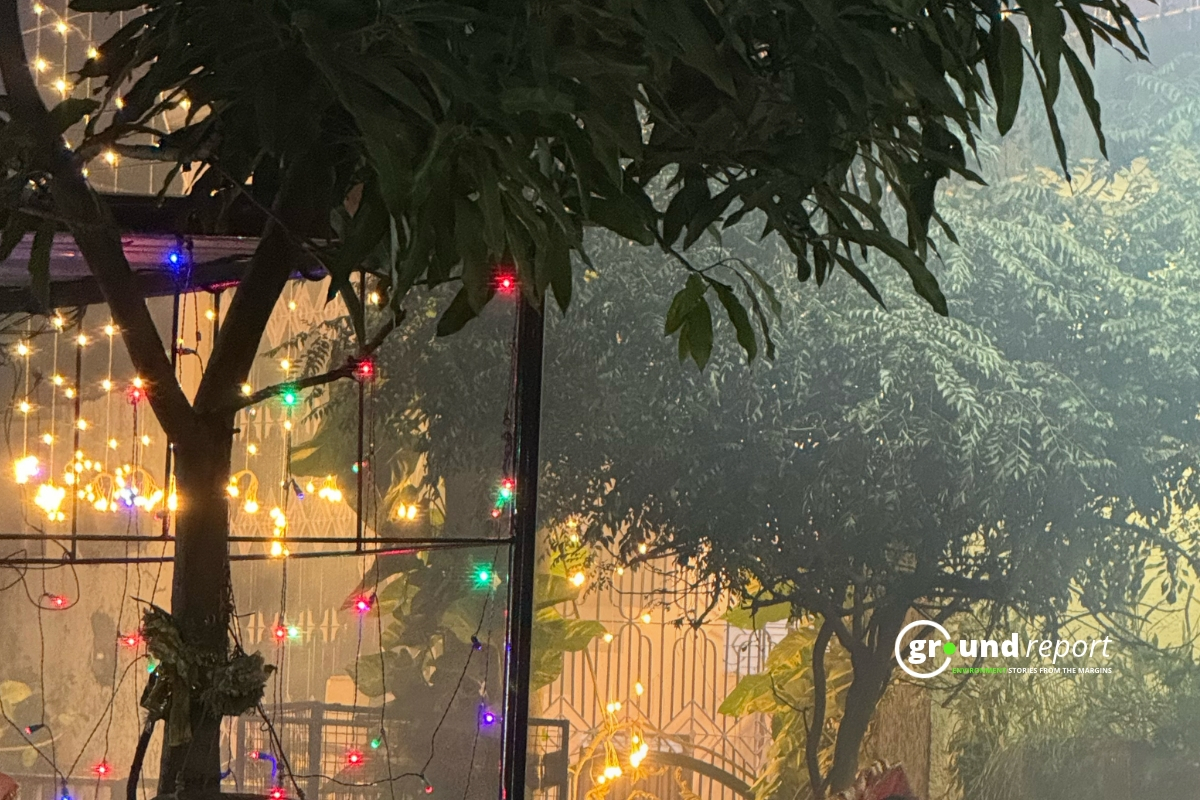
Air pollution rose across Madhya Pradesh after Diwali celebrations on November 8, with seven cities recording an Air Quality Index (AQI) above 300. Ujjain recorded the highest reading at 412, followed by Bhopal at 404, according to Madhya Pradesh Pollution Control Board (MPPCB) data.
Indore recorded 386, Gwalior 377 and Jabalpur 345. Mandideep and Dewas recorded 318 and 308, respectively. The readings cover the 24-hour period from 6 pm on November 8 to 6 pm on November 9.
Under the Central Pollution Control Board’s national AQI scale, readings between 301 and 400 fall in the very poor category, while 401 to 500 are classified as severe. Ujjain and Bhopal entered the severe category.
A separate set of MPPCB readings, covering 5 am on November 8 to 5 am on November 9, recorded an AQI of 363 at Gwalior’s Deendayal Nagar, 338 at Indore’s Chhoti Gwalitoli and 328 at Jabalpur’s Marhatal. The same Indore and Jabalpur stations appear in the 6 pm dataset with higher figures because the monitoring periods do not match.
Bhopal’s Aqi More Than Doubles Overnight
At Bhopal’s TT Nagar monitoring station, the AQI rose from 150 at 10 pm to 314 at 3 am, according to hourly monitoring data.
Particulate matter also increased during the night. PM2.5 measured 42 micrograms per cubic metre at 6.15 pm before reaching 829 at 9 pm. PM10 peaked at 864 at 10 pm, while PM2.5 reached another peak of 839 at 4 am on November 9.
The 5 am to 5 am average AQI at TT Nagar was 355, compared with 313 after Diwali last year. Paryavaran Parisar recorded 296 against 259 in 2025. The Collectorate area recorded 301, slightly below the previous year’s 304.
Some monitoring records had gaps. TT Nagar recorded an AQI of 785 at midnight before reporting no further data until 5 am. The Collector’s Office station stopped reporting after 12.15 am and resumed at 2 pm.
Nitrogen oxides rose from 14.8 parts per billion at 6.15 pm to 65.9 at 1 am. Sulphur dioxide increased from 15.5 micrograms per cubic metre in the evening to 49 at 2 am.
Satish Kumar Chouksey, regional officer at the Pollution Control Board in Sagar, pointed to winter conditions. “With winter setting in, rising humidity, falling temperatures and stable atmospheric conditions restrict the dispersion of pollutants, keeping them concentrated near the ground,” he said.
Indore Records Sharp Particulate Matter Spikes
Indore also recorded high particulate matter concentrations at night. At the Regal monitoring station, PM10 increased from 76 micrograms per cubic metre at 5 pm to 1,000 by midnight. PM2.5 reached 1,000 at 1 am.
At Meghdoot Park, PM10 rose from 24 to 984 between 5 pm and midnight. At Residency, both PM10 and PM2.5 reached the monitoring limit of 1,000 by midnight.
Dilip Waghela, an environmental scientist and former Pollution Control Board official, said weather conditions contributed to the build-up. “Cold temperatures and slow winds kept pollutants trapped,” he said. “Air pollution levels in Indore during Diwali were alarming.”
Readings also varied across stations. Indore’s 386 came from Maguda Nagar, while Chhoti Gwalitoli recorded 381. Jabalpur’s 345 came from Marhatal, compared with 304 at Gupteshwar and 303 at Suhagi.
Doctors Explain Health Risks As Mayor Responds
Dr Pramod Jhanwar, a chest physician and asthma specialist, said firecracker smoke releases gases such as sulphur dioxide, nitrogen dioxide and carbon monoxide, along with particulate matter.
He said PM2.5 particles travel deep into the lungs, and some enter the bloodstream, increasing the risk of inflammation. People with asthma, bronchitis and chronic obstructive pulmonary disease face a higher risk of breathing difficulties and attacks.
Eye specialist Dr OP Agarwal said high pollution levels cause dryness, irritation and allergies. He said cities also need to address road dust, vehicle emissions and traffic congestion.
Indore Mayor Pushyamitra Bhargava responded to criticism over the city’s post-Diwali pollution. “We should definitely care about the environment, but don’t measure the joy of Diwali by the AQI,” he said in a social media video.
He said municipal teams used water cannons and carried out cleaning work overnight. “Indore celebrated yesterday, and today the city is clean again,” he said.
More Than 1.2 Crore People Live In 5 Districts
The five districts have a combined population of around 1.21 crore, according to Census 2011 figures. Indore has 32.76 lakh residents, Jabalpur 24.63 lakh, Bhopal 23.71 lakh, Gwalior 20.32 lakh and Ujjain 19.86 lakh.
These figures give district-level population context. They do not show how many people experienced the pollution levels recorded at individual monitoring stations.
The pollution was not limited to Madhya Pradesh. Delhi recorded an average AQI of 376 on Diwali, its most polluted Diwali in five years. The Central Pollution Control Board put the city at 370 on Monday morning, with some areas above 400. Chennai stood at 206 in the poor category, while Mumbai, Bengaluru and Kolkata recorded lower readings.
Neither MPPCB reporting period shows how long pollution levels stayed above 300 after the monitoring windows ended.
Support Us To Sustain Independent Environmental Journalism In India.
More Ground Reports
Madhya Pradesh’s e-Vikas 2.0 Fertiliser System: Why Are Farmers Still Queuing?
Smart Meter Consumers May Save on Electricity Bills With Time-of-Day Tariffs