The 18th BRICS Summit was held in New Delhi on 12-13 September. Leaders voiced concern about food security and sudden shortages of fertiliser. The Delhi Declaration stressed drought-tolerant seeds and climate-friendly farming.
Three months earlier, Indore in Madhya Pradesh became a hub of global diplomacy. From 9 to 13 June, the city hosted the 16th BRICS Agriculture Ministers’ Meeting under India’s chairmanship. Representatives from more than 20 countries discussed how to keep the world fed.
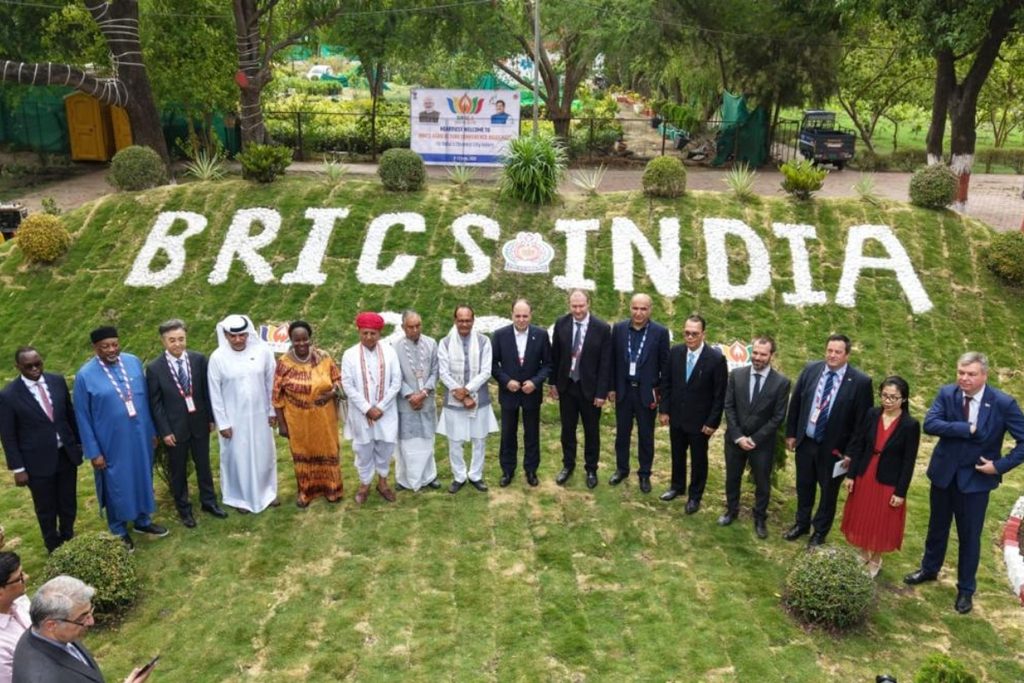
Union Minister Shivraj Singh Chouhan said that 87 percent of India’s farmers are small and marginal. “Unless we empower them, especially women and young farmers, inclusive growth and future food security are not possible,” he said.
After two days of talks, the countries agreed on the Indore Declaration. Four global initiatives were also launched: BRICS Agrin, the Digital Agri Network, a Centre of Excellence for Agroecology, and the Global Forum on Farmers’ Rights in Seed Systems. The forum is meant to bring together traditional farming knowledge, policy, and seed conservation. These decisions were strengthened further in Delhi, where the declaration backed drought-tolerant seeds and climate-friendly farming.
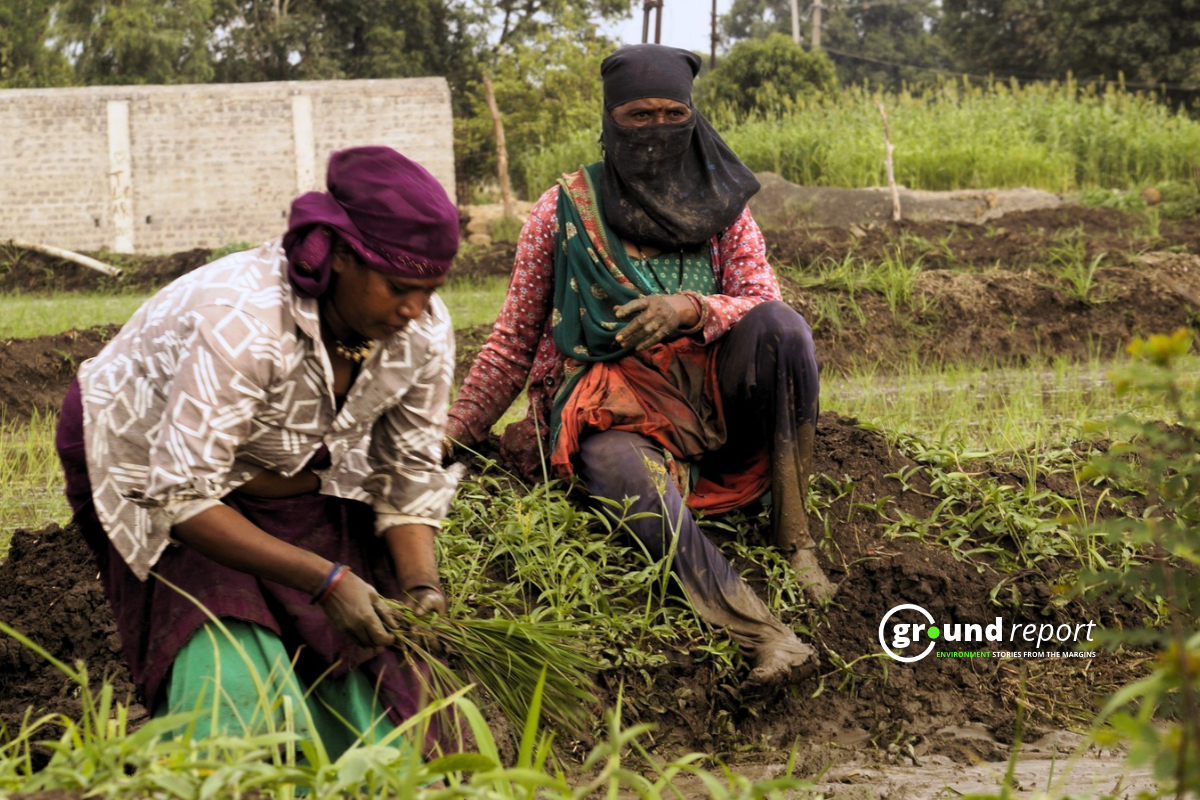
But there is a deep gap between these bold promises and the reality of Madhya Pradesh’s villages. The gap is widest where men have migrated to big cities for work. The responsibility for farming has fallen on the women left behind.
Environmentalist and researcher Ranjan Panda raises a serious question. “All the policies revolve around corporate farming and technology,” he says. “In reality, farming in India is becoming rapidly feminised. Unless women farmers’ land ownership is made a condition, goals like those of BRICS will remain on paper.”
Emptying villages, women left in the fields
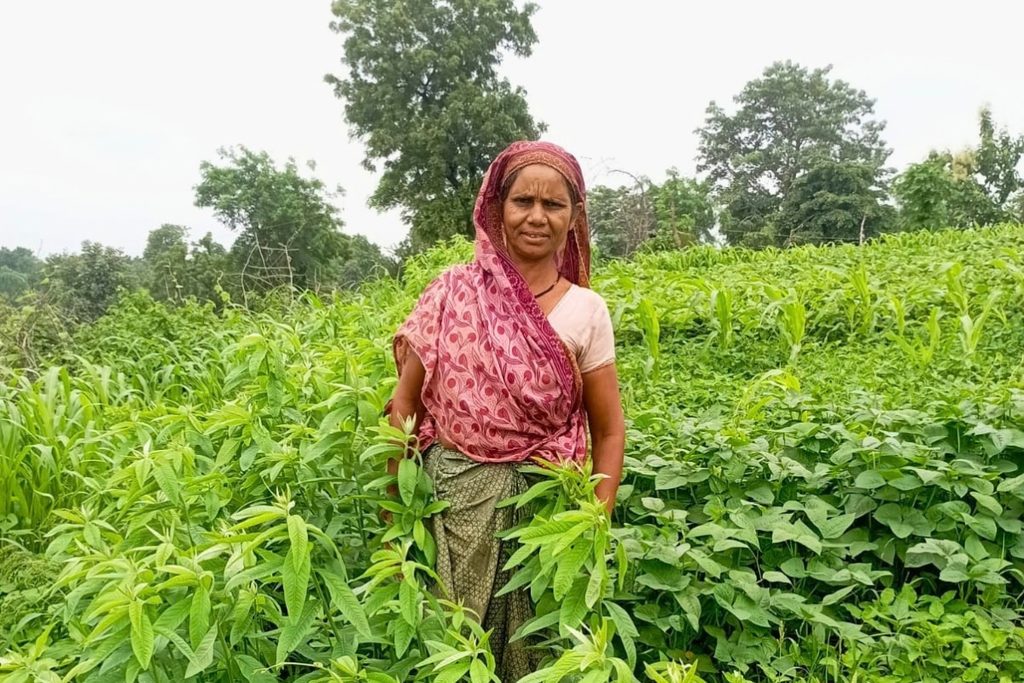
Lalpur village lies in Amarpur block of Dindori district. In Mukaddam Tola lives 53-year-old Bhagwati Bai. She knows nothing about the BRICS meeting in Indore.
On the morning of 7 August, the sky is clear, and Bhagwati is cutting fodder for her cattle. Asked what work she does, she smiles and says, “Nothing much, I just look after the house.”
She wakes at 4 am and works until 10 pm. On paper, her husband is the farmer, but three months ago he left to work in a factory in Gujarat. In the last week of July, they sowed soybean and other pulses as mixed crops on two bighas of land. Now Bhagwati handles everything alone: weeding, fertiliser, disease control and irrigation.
This is not just the story of Lalpur. The same picture appears from the tribal belt of western Madhya Pradesh (Jhabua, Alirajpur, Dhar and Barwani) to Bundelkhand (Tikamgarh, Chhatarpur, Panna and Damoh). These regions depend on rain. Once the sowing is done, the men leave for Gujarat, Maharashtra or Delhi-NCR. The women stay behind and look after the home, children, elders, and the farm.
Harishankar Pawar of the Sampark Samaj Sevi Sanstha in Jhabua has watched this change closely. “When a man goes to the city, he is called a labourer,” he says. “When a woman manages the entire farm, she is not considered a farmer. Her work is treated as ‘household work’ instead of farm labour.”
The same gap appears between the work done on the farm and the identity the government gives her.
Running the farm, yet not a “farmer”
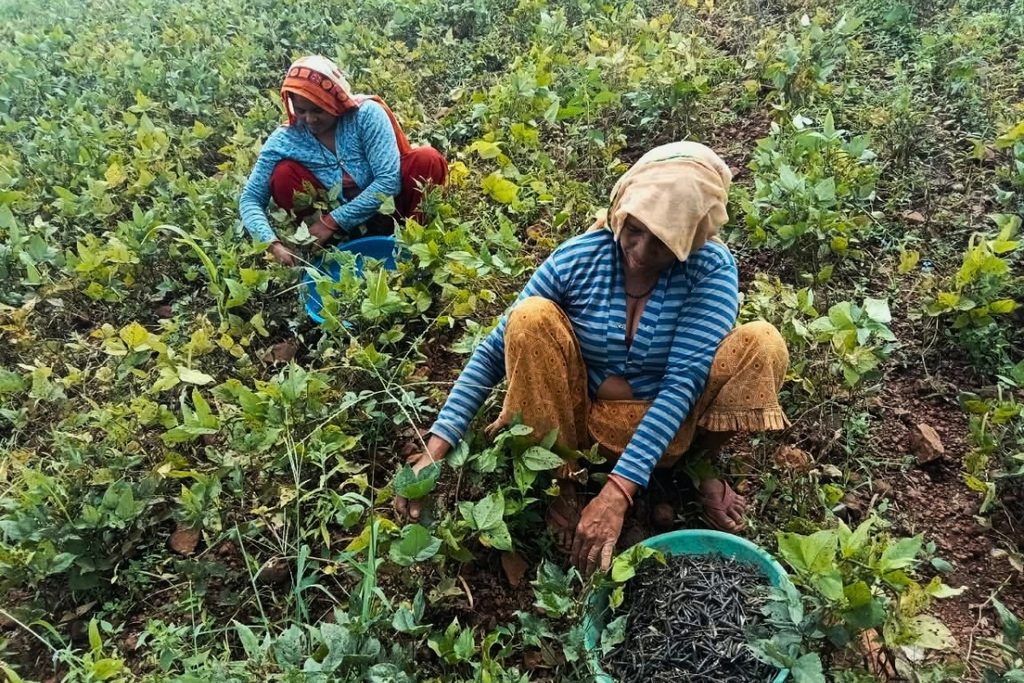
Official numbers often hide how much women actually do. A systematic review published in April 2026, titled “Women’s Contributions, Opportunities and Challenges in Indian Agriculture,” shows this clearly. It says more than 80 percent of economically active women in rural India depend on farming. Women do up to 75 percent of the physical labour in crop production and up to 95 percent in animal husbandry.
Even so, the National Family Health Survey (NFHS-5) shows that Madhya Pradesh is among five states where women’s land ownership has stagnated or fallen.
Economist Bina Agarwal’s research gives a wider picture. Among rural families that own farmland in India, about 14 percent of women hold land rights. Together they hold about 11 percent of the country’s farmland. In Madhya Pradesh, only 5 percent of adult women have land recorded in their own name.
Not having your name on the land papers is more than a statistic. Without a name on the patta or khatauni (land records), banks and cooperative societies refuse crop loans, because land is treated as the security for a loan. Applications for the Kisan Credit Card and crop insurance are valid only if the applicant is registered as the landowner. Seed and fertiliser subsidies, and compensation for disasters or crop loss, are also decided in the name recorded in the revenue records.
Farmer leader Kedar Sihori explains the result. “When the patta is in the name of the husband, father-in-law or husband’s elder brother, banks, cooperatives and agriculture officials do not legally treat women as farmers.”
The pain of 45-year-old Shobhana Tai from Tikamgarh makes this clear. Her husband died when she was 35. Since then, she has been managing four bighas of land, but the land is still in her father-in-law’s name. Both her sons work in a textile factory in Gujarat. For her, running the farm and proving she is a farmer are two separate battles.
“We have been wearing ourselves out in this soil for years,” Shobhana says. “When the patwari (village land officer) comes, he asks for the man’s name. The bank won’t give us a loan because our name is not on the paper.”
Too little rain or uneven rain, the burden falls on women
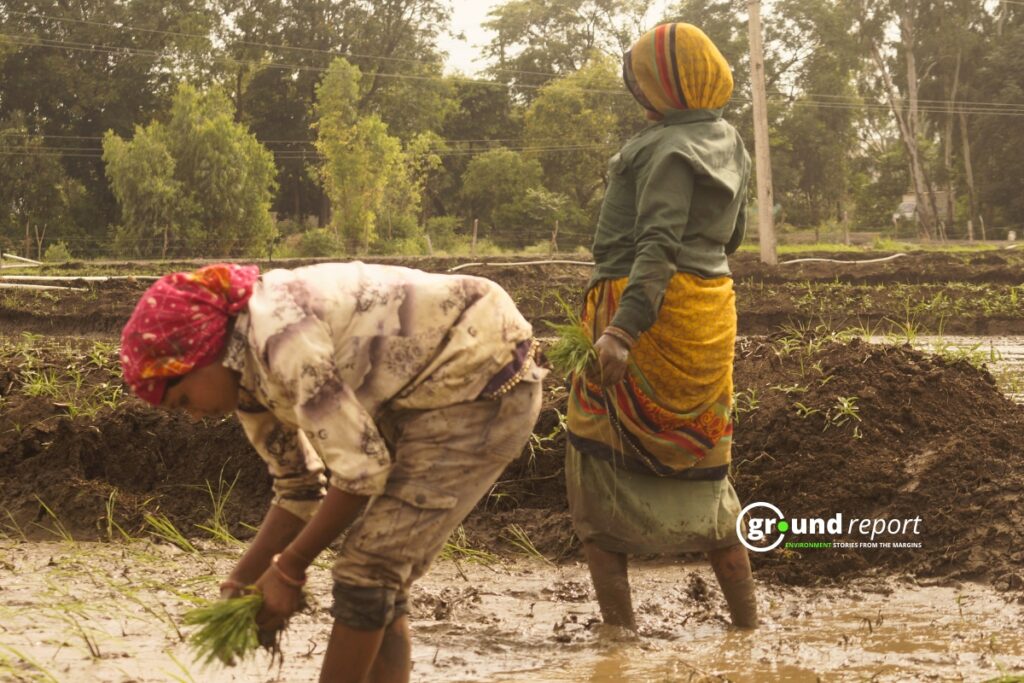
The 2026 kharif season has brought the crisis of uneven rainfall. The monsoon has been weak since the start. By August, 42 percent of the country’s districts had received less rain than normal. In the Malwa-Nimar region of Madhya Pradesh, there was no significant rain for weeks, while Bundelkhand was hit by sudden heavy downpours.
Soil scientist Ranjeet Singh Raghav explains why this matters. “The total rainfall figure may look normal,” he says. “But a long dry spell during critical stages of a crop, such as flowering in soybean, causes heavy damage.”
When rain stops, farmers have to irrigate more to keep moisture in the soil, which adds to their costs. Sihori says that farm electricity is usually supplied between midnight and 2 am.
On 20 July, Sena Mahesh Patel, the MLA from Jobat in Alirajpur, raised this issue in the Madhya Pradesh Assembly. Energy Minister Pradyumn Singh replied that power is supplied for about 6 hours in the day and 4 hours at night on average. He added that supply is sometimes disrupted by technical problems, maintenance, and natural disasters.
The issue is not only whether electricity is available, but when. Night-time power is hard even for male farmers. But when the men have migrated, the same system adds extra labour and safety risks for women. Solar pumps can irrigate fields during the day and reduce dependence on night-time power.
Solar pumps are a solution, but for whom?
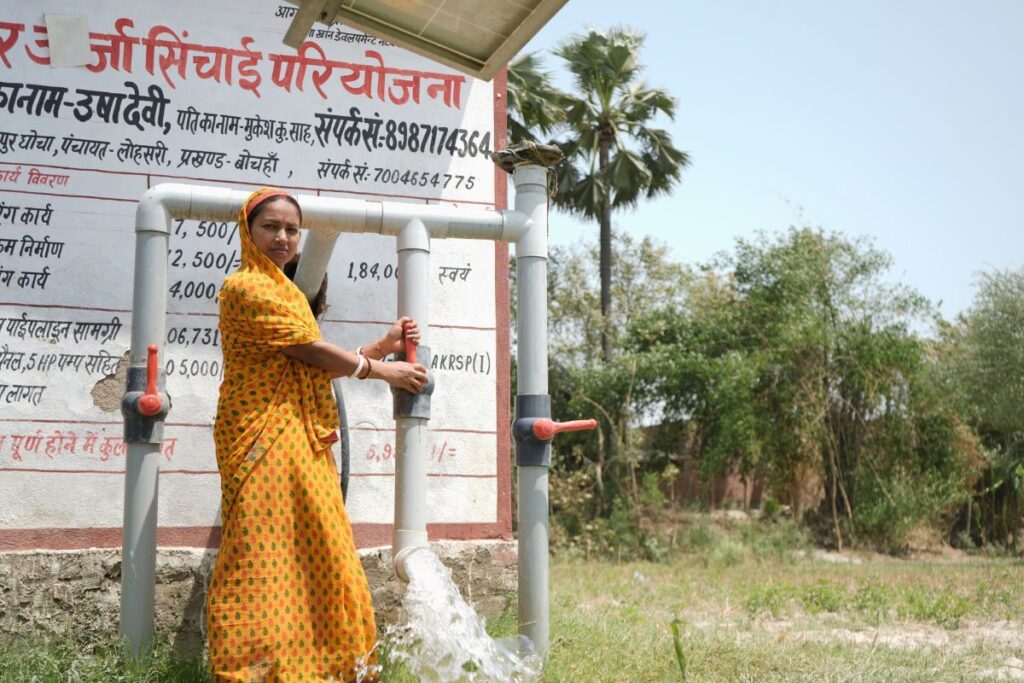
Under Component B of the PM-KUSUM scheme, more than 13 lakh solar pumps have been approved across India. Of these, 11,49,988 have been installed, while 12,02,142 grid-connected farm pumps have been solarised.
In Madhya Pradesh, 59,400 solar pumps have been approved so far, and 24,682 have been installed. The state’s 2026-27 budget aims to install 1 lakh solar pumps.
But the question remains: is the scheme reaching the woman who actually irrigates the field? PM-KUSUM’s own official guidebook admits the problem. Women’s access is limited because they own so little land.
Santra Bai of Jhabua stands in this gap. She has worked the fields since childhood, but the land has never been in her name. Last year, she heard about the solar pump scheme through the panchayat. Because the land was in her husband’s name, she could not apply.
Her husband works in a textile factory in Gujarat and comes home only once or twice a year. “He comes during festivals,” Santra Bai says. “Government offices are closed then, and the paperwork is complicated, so we never manage to apply.”
There may be a way forward. The official PM-KUSUM FAQ allows farmer groups, water user associations, cooperative societies, panchayats, farmer producer organisations and community irrigation systems to join the scheme. Harishankar Pawar suggests the same. “This can become an option for women and small farmers who do not have land in their own name or enough resources,” he says.
Conclusion
Before the Indore meeting in June, the BRICS agriculture working group spent about three months on four themes. The first was food security, nutrition and livelihoods. The second was agricultural trade and cooperation. The third was spreading regenerative and eco-friendly farming. The fourth was using investment and new technology to build future food systems.
All four of these global agreements are built around “the landowner.” Yet the heaviest blow of climate change is falling on women who run the farms after the men migrate but are not recognised as farmers on paper.
Whether it is the Digital Agri Network or the seed conservation plan, these schemes do little for women like Bhagwati and Shobhana. Without ownership, the system simply does not recognise them. Unless policies are designed around “the one who tills the land” instead of “the one who owns the farm,” these promises will remain hollow.
Summing up the gap between these challenges and the global agreements, Kedar Sihori says, “Climate-resilient farming will reach the ground only when the women running the farms get access to irrigation, technology and government schemes.”
This is the second part of the five-part series ‘Roti, Kheti aur Duniya’ (Bread, Farming, and the World).
Note: This report has been prepared in collaboration with Hands of Transition.
The first part of this series: Crisis in the Fields, Impact on the Plate—Is Our Food Dependent on West Asia?
Support Us To Sustain Independent Environmental Journalism In India.
More Ground Reports
He Was Married as a Child, Now Manish Dangi Helps Stop It for Others
Despite The Ban, How Gutkha Became MP’s Most Common Household Habit
Stay Connected With Ground Report For Underreported
Author
Support Ground Report to keep independent environmental journalism alive in India
We believe climate change should be the basis of current discourse, and our stories attempt to reflect the same.
Connect With Us
Send your feedback at greport2018@gmail.com
Newsletter
Subscribe our weekly free newsletter on Substack to get tailored content directly to your inbox.
When you pay, you ensure that we are able to produce on-ground underreported environmental stories and keep them free-to-read for those who can’t pay. In exchange, you get exclusive benefits.
Your support amplifies voices too often overlooked, thank you for being part of the movement.