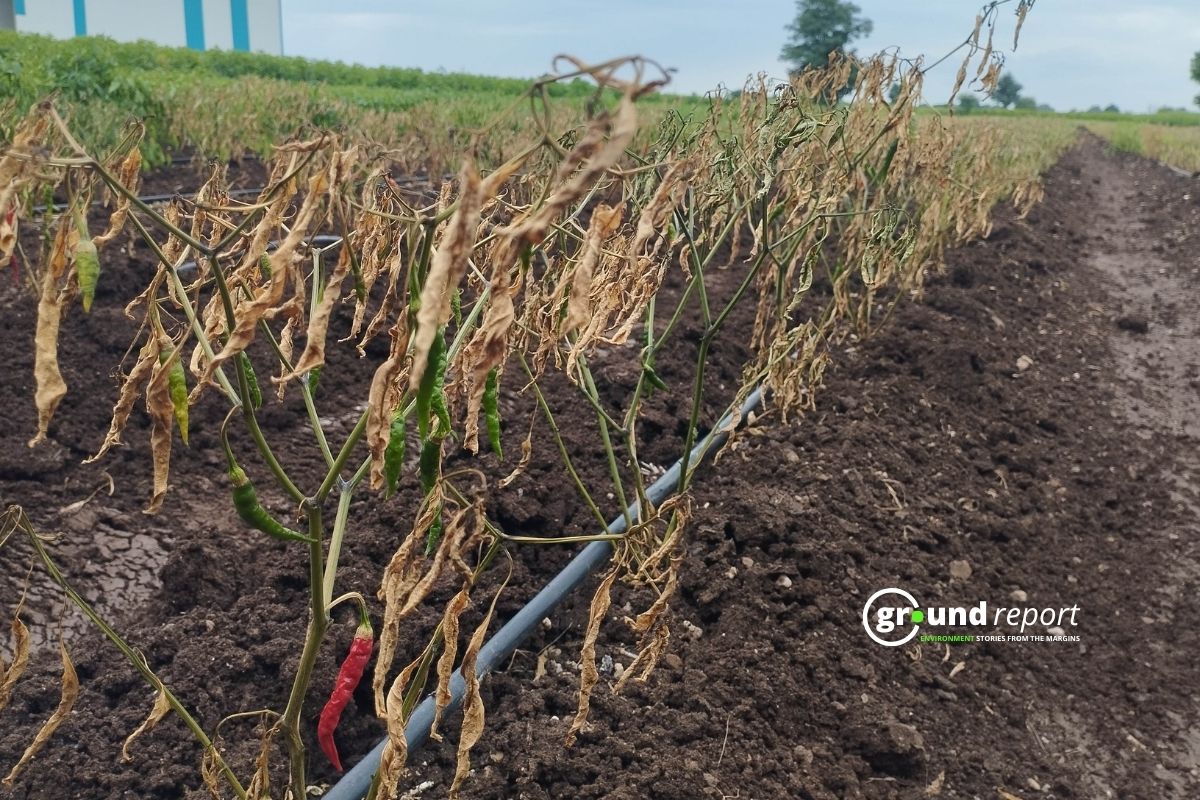
Khargone | After learning about Farmer Producer Organisations (FPOs), Balkrishna Patidar, a young farmer from Dalki, became interested in the model. He was already farming, but after learning more about FPOs, he formed the Nimar Fresh FPO along with a group of farmers.
Through the FPO, they began cultivating chilli. The first crop produced good yields, and they hoped to access better markets. They sent five lots of chilli produced by five farmers for export. However, after testing, all five lots failed to meet the required standards and were rejected for export.
The tests found that the chilli contained residues of chemicals harmful to human health above the permissible limits.
Recently, China refused to accept consignments of Indian red chilli, reportedly due to methamidophos residues. The development came as a setback for Indian exporters.
They tried again, this time after ensuring that farmers had access to quality organic seeds.
This time they succeeded. And, in 2021–22, around 55 tonnes of red chilli were exported to Mexico through Nimar Fresh FPO. This was followed by the export of 120 quintals of chilli to Dubai. Importantly, the chilli was completely residue-free.
While the exported quantity remains small compared with the district’s total chilli production, it marks an important step forward, highlighting both the challenge of pesticide residues and a potential solution.
The Need for Reliable Farm Inputs
Under the One District One Product (ODOP) scheme, chilli is one of the Khargone district’s key products. An estimated 45,000 hectares are under chilli cultivation in the district, producing around 157,500 metric tonnes. Khargone received a ‘Runner-Up Certificate’ for its performance in achieving the targets under the ODOP scheme for 2024–25.
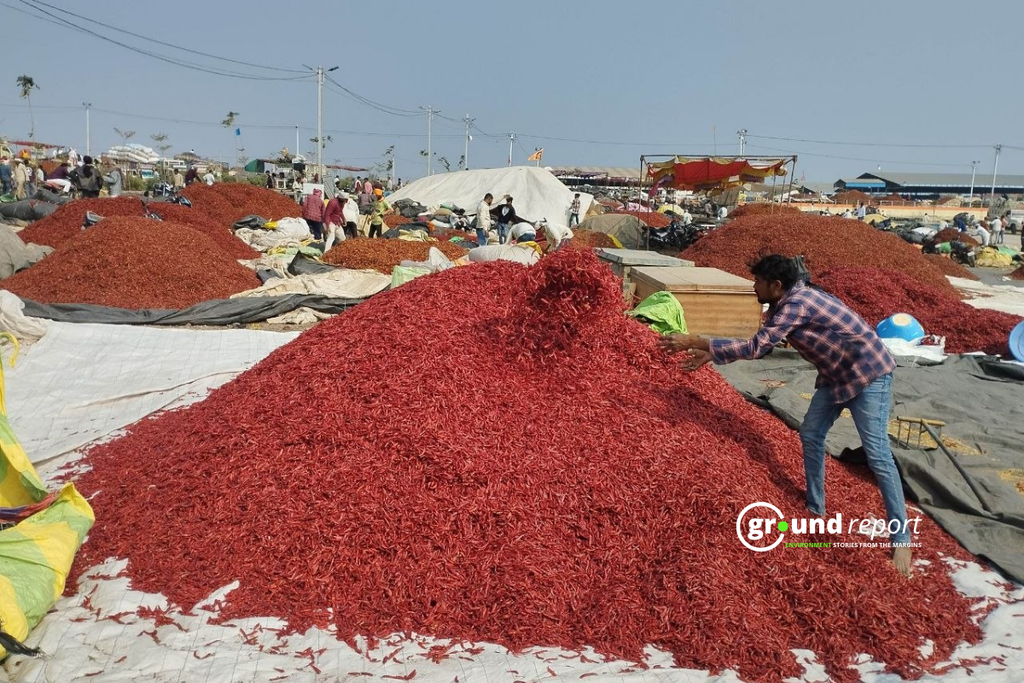
The district is primarily known for producing red chilli powder from dried chilli.
The village of Bedhiya is home to what is considered Asia’s second-largest chilli market. Traders from across India, besides local buyers, come here to purchase chilli. Local workers remove the stalks and grade the chillies. This is known as dandi-cut chilli. After grading, the chilli quality improves, and farmers can fetch a higher price.
Balkrishna recalled that when five farmers sent five separate lots for testing, all five failed.
“When we investigated the issue in detail, we found that one of the biggest problems was that farmers were buying products from some local companies that were marketed as organic, bio or biological products and using them on their crops,” he said.
Although the products carried those labels, they contained chemical residues that posed a serious challenge to residue-free cultivation. These included residues of chemicals such as emamectin benzoate and monocrotophos.
Balkrishna realised that simply telling farmers to adopt organic farming, use bio-products or produce residue-free crops would not be enough. “Unless farmers have access to the right and reliable inputs, it will be difficult to make residue-free farming successful on the ground,” Balkrishna said.
He discussed with reliable companies to provide products and technical support compatible with residue-free and IPM-based cultivation. With support from these companies, farmers were given appropriate products, technical guidance, and better crop-management practices.
“We prepared again, continuously monitored the farmers, and improved the entire process. Today, the result is in front of you,” Balkrishna said proudly.
Through Nimar Fresh FPO, around 15 million chilli seedlings have been supplied to farmers so far. Farmers have been advised to follow scientific recommendations while cultivating the crop.
Six clusters have been created to make things easier for farmers, covering around 2,500 farmers. Twelve young people with Bachelor of Science degrees in agriculture-related fields have been brought in to advise farmers. They speak to farmers every week and guide crop management.
The FPO also supplies pesticides and other farm inputs. By purchasing these in bulk, farmers get them at lower prices than those available in the market. It also helps prevent unnecessary pesticide use. As a result, farmers who previously spent between ₹100,000 and ₹150,000 on pesticides are now spending less than ₹100,000. This has helped reduce their input costs.
Reliance on Agrochemical Sellers for Pest and Disease Management
Kuldeep Mishrilal, a farmer from Dabhad, planted chilli on four acres in May. In August, he said that good rainfall had meant relatively less impact from pests and diseases.
Mishrilal sprayed different pesticides once or twice a week “for pests such as thrips (Thrips parvispinus), spider mites, mosquitoes, whiteflies and caterpillars,” he said.
He also sprayed fungicides and other chemicals to control root-knot nematodes and wilt. In addition, he applied different fertilisers to promote plant growth.
In other words, from the beginning of the crop cycle to the end, he relied heavily on chemicals to deal with different problems. The estimated cost comes to ₹50,000–60,000 per acre.

Similarly, a room in the house of farmer Arvind Patidar from Gawson is filled with boxes of agricultural chemicals. He cultivated chilli on three acres and sprayed different chemicals every three to four days.
He relied on local pesticide retailers for advice on which chemical to spray and when.
Dr R.K. Singh, a scientist at the Krishi Vigyan Kendra (KVK) in Khargone, however, said farmers should not repeatedly use the same type of pesticide on chilli. After each chemical spray, they should use a biological pesticide such as neem oil.
He said farmers can also identify pests and diseases themselves, which can make control measures easier.
Whiteflies attack the plants. When thrips attack, the leaves curl upwards, while spider mite infestation causes the leaves to curl downwards. Farmers can therefore identify some pests themselves.
Pesticides should be applied at seven- to 10-day intervals, he said.
In many cases, farmers use pesticides meant for different pests together even when only one pest is present. This can result in residual effects on the crop.
Farmers can also control pests through IPM practices. These include installing yellow and blue sticky cards, planting one row of marigold flowers after every 10 rows of chilli, and planting two rows of maize along the field’s edges.
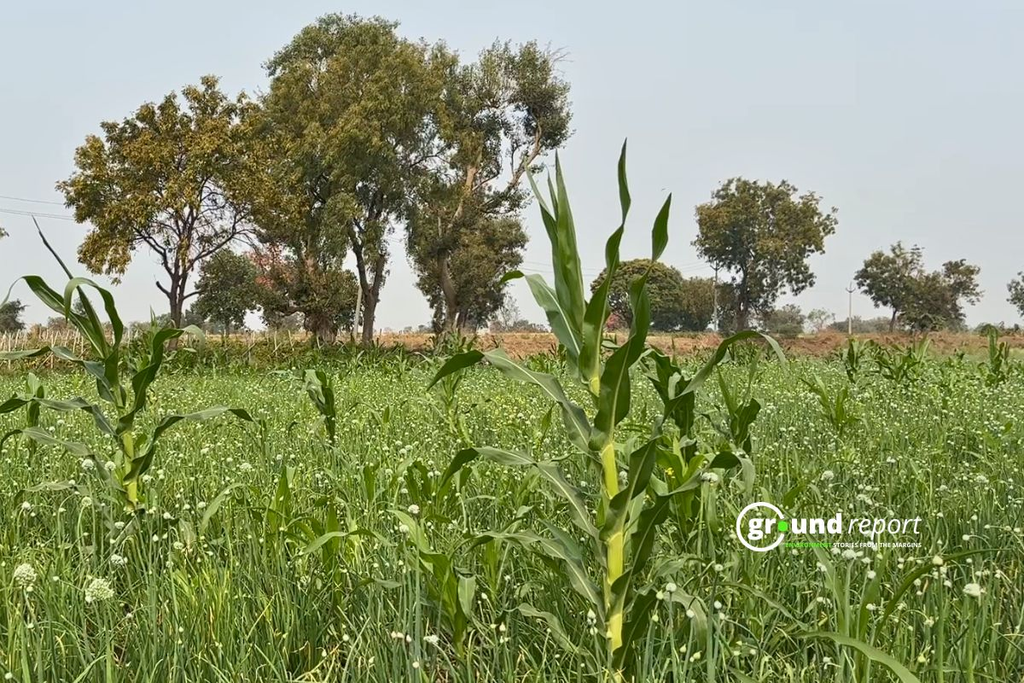
Singh said whiteflies are attracted to yellow cards, while thrips are attracted to blue cards and become stuck to them. Marigold flowers also attract pests. Singh added that because maize plants are taller, they can prevent some low-flying insects from reaching the chilli plants.
By adopting IPM techniques, farmers can reduce their dependence on chemicals and lower cultivation costs. This can also help prevent excessive chemical residues and produce chilli suitable for export.
Nimar Fresh is helping farmers produce chilli with lower chemical residues and improve its export suitability. Farmers can also seek alternative pest-management solutions from the Krishi Vigyan Kendra. Singh said farmers can visit the Krishi Vigyan Kendra or even send photographs of their crops to seek advice on pest and disease management.
However, farmers such as Arvind Patidar continue to rely almost entirely on pesticide retailers for advice on chemical use. This makes it important to expand the reach of such interventions so that more farmers can produce chilli that meets export standards.
Support Us To Sustain Independent Environmental Journalism In India.
More Ground Reports
He Was Married as a Child, Now Manish Dangi Helps Stop It for Others
Despite The Ban, How Gutkha Became MP’s Most Common Household Habit