
When Sangeeta Malviya arrives with her drone to spray pesticides, the work does not begin immediately. She first lifts the machine carefully out of its box, unfolds its arms, and fills the tank with liquid fertilizers and pesticides. She follows a sequence each time: checking the battery, calibrating the system, and marking the field’s boundaries.
Only then does she begin. Through the controller, Sangeeta guides the drone as it lifts, hovers briefly, and then moves in straight, measured lines, releasing a fine mist over the crops.
Sangeeta joined a self-help group in 2018 under the rural livelihood mission in the Maa Gauri Aajeevika self-help group in Bichholi Village, Ichhawar Tehsil. She was already working closely with farmers, advising them on soil testing, fertilizer use, and ways to improve crop yields across nearby villages. In 2022, when the government introduced the Namo Drone initiative under the National Rural Livelihood Mission, her name was put forward. She was selected by National Fertilizers Limited and trained in Indore, where she learned to operate and manage the drone before bringing it back to her village.
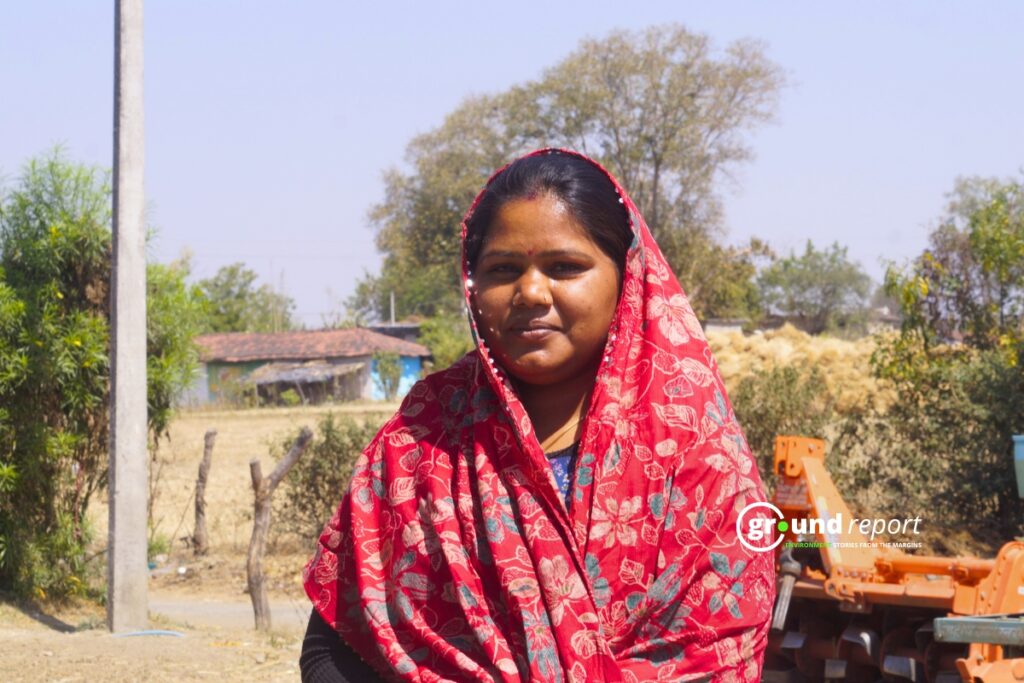
And, approx 150 kms from Sangeeta’s village, lives Vandana Kewat in Raisen. She joined a self-help group under the rural livelihood mission in 2016. In 2024, the opportunity to train as a drone pilot came suddenly, almost at midnight. She was told she had to travel for training—there was little time to prepare or even ask questions. She agreed to go without hesitation.
Sangeeta had seen drones before—at weddings, in videos—but always as something distant. “It felt like… only highly educated people could fly them,” she says. Now, standing at the edge of the field with the controller in her hands, she feels a quiet pride.
Both women feel proud that such an expensive asset—often costing around ₹10 lakh— has been trusted with them, without direct payment. Training is provided. Initial support comes through the self-help group network. And yet there are obvious challenges with servicing and the battery. Battery replacement is expensive. Additional equipment, like generators and vehicles, is often not provided, leaving women to decide whether to invest further or limit their work.
The Scheme
The Union government’s “Namo Drone Didi” scheme aims to bring new technology into farming while creating jobs for rural women. Under the scheme, women’s self-help groups are provided with drones with an 80 percent subsidy, up to ₹8 lakh, along with training to operate them. The plan, with a total outlay of ₹1,261 crore over 2023-2026, aims to distribute 15,000 drones across the country.
The drone package includes 15 days of pilot training for SHG members and 5 days of assistant training for their family or group members. The package also includes an additional 4 spare battery sets, one spare propeller set, a nozzle set, a dual-channel fast battery charger, and a battery charger hub.
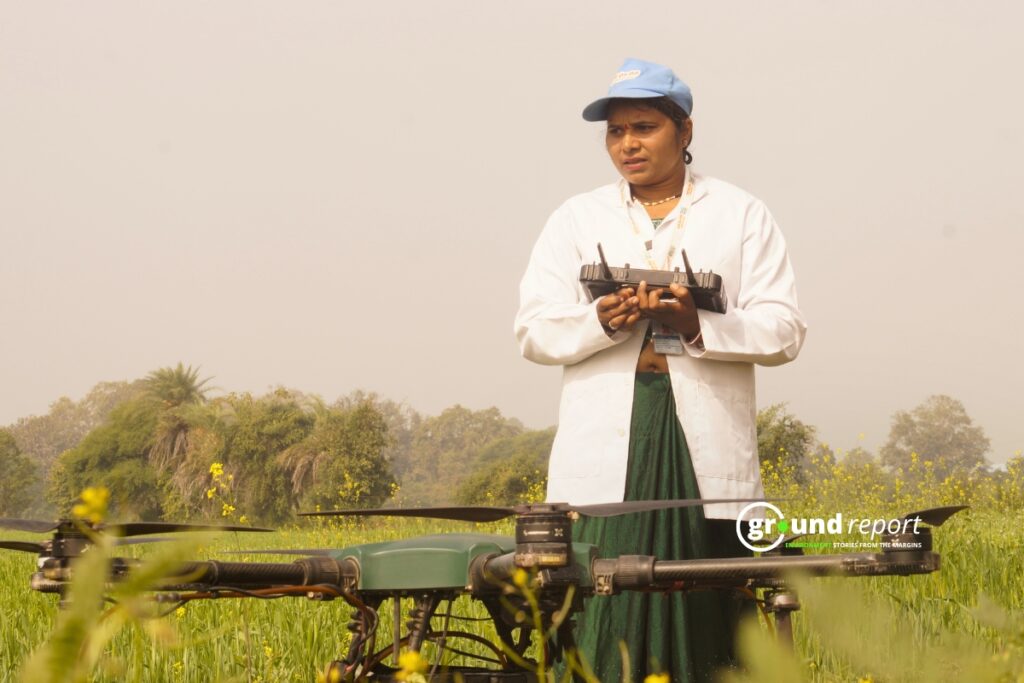
1066 drones have been allocated in Madhya Pradesh, and another 89 have already been distributed.
Dharmendra Upadhyay, who works with the rural livelihood mission in Ichhawar, says they were looking for women who showed both interest and the ability to take on a technical task.
During Sangeeta’s first training session in Indore in 2022, she was afraid the drone might veer toward her. Her trainer reassured her that proper calibration would prevent that. He also explained that, like an aircraft, a drone cannot be flown just anywhere—it relies on GPS and operates within defined zones. “Earlier, I thought it could be flown anywhere,” she says. Learning to calibrate the drone and understand these invisible boundaries—the different zones in which it can fly—was part of the process.
Benefits
Vandana’s phone rings regularly during the cropping season. Farmers would call to book spraying, often expecting quick service. And, managing this demand requires coordination—deciding which fields to cover first, arranging transport, and ensuring the drone is ready.
Unlike Sangeeta, Vandana got a vehicle and extra batteries from Indian Farmers Fertiliser Cooperative Limited (IFFCO). The vehicles allow travel long distances with the drone and other equipment, which is a hassle for Sangeeta.
But getting farmers to trust the technology was not immediate. “It’s very difficult to convince farmers,” Vandana says. Farmers were used to traditional methods—manual spraying, familiar fertilizers—and were cautious about both the drone and the inputs it carried. Much of Vandana’s work involved explaining, demonstrating, and building that trust over time.
“The benefits that were being seen were that in agriculture, when there is a shortage of urea and the kind of panic that follows, spraying nano urea was benefiting farmers,” Upadhyay said.
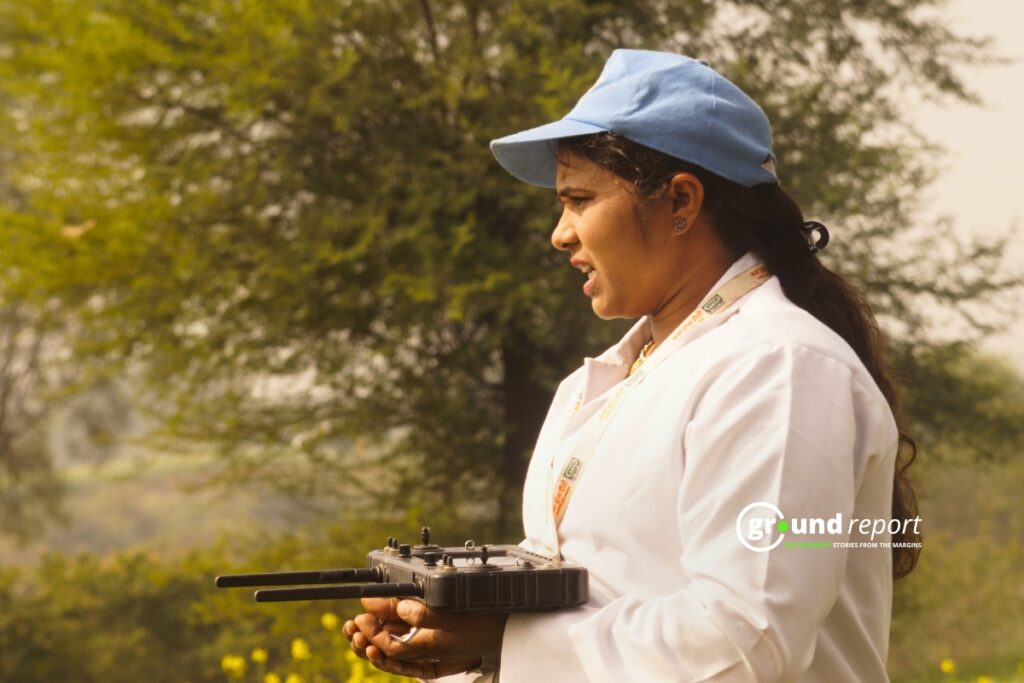
These drones can spray crops much faster than manual methods—covering an acre in just a few minutes. This would help reduce labour, save time, and make farming more efficient. “We don’t have to walk through the fields anymore,” Sangeeta says, noting that this also prevents damage to standing crops. The drone uses significantly less water and chemicals—sometimes reducing pesticide use by nearly 30 percent—while allowing more precise application.
It also limits farmers’ direct exposure to chemicals, lowering health risks. In crops where timing is critical, the speed of spraying can make a difference, especially during short weather windows.
She sprayed about 80 acres of maize and soybean fields, earning around ₹16,000–₹17,000 in a month. Her family began to describe her differently. “Our daughter-in-law is a drone pilot,” she says.
Challenges
In the early months, the problems were not with demand but with the technology itself. Sangeeta recalls that her drone’s GPS malfunctioned once. “If there’s no GPS… the drone can crash,” she explains. While the issue was eventually fixed, it took 10 to 15 days for technicians to arrive. Such delays, she says, can disrupt work during peak spraying periods, when even a few lost days mean missed income and lost trust with farmers.
The drone is heavy and requires assistance to transport and set up. It needs water, chemicals, and space. Often, it requires a vehicle just to reach the fields. “It’s difficult to transport,” Sangeeta says. 42.68% of Drone Didis faced transport issues—the highest in the South (78.82%)—while 68.66% said hiring vehicles was expensive.
Apart from the transport, the battery is another constraint for Sangeeta.
Each battery lasts only about 16 to 17 minutes in total—including calibration—with actual flying time limited to 8 to 9 minutes. After that, it takes nearly two hours to recharge, and even before charging, the battery must cool down for about 30 minutes. This makes continuous work difficult, especially during peak seasons when farmers need a quick turnaround. The problem worsened when her battery began making unusual sounds and stopped functioning altogether.
With the warranty period over, replacing it would cost ₹40,000–₹50,000—an expense she has not yet been able to afford, leaving her drone grounded for months. A vehicle could cost several lakhs. Together, the additional investment could cross ₹5 lakh—far beyond what she has earned so far.
Solutions
“To address the drone transport issue, a provision has been made under Sub-Mission on Agricultural Mechanization (SMAM) to provide financial assistance @ 80% to the Women SHGs identified under Namo Drone Didi scheme for the purchase of Multi-utility machines, which are also used as drone transport,” Minister of State for Agriculture and Farmers Welfare said in Lok Sabha.
Similarly, solutions are suggested in the case of the battery systems. Upadhyay sees this as a structural issue. If battery backup were stronger, he says, the service would expand more rapidly. The demand exists, but the system supporting the technology is still catching up.
“We haven’t earned enough to be able to invest that much money,” Sangeeta says.
Since December 2025, her drone has remained unused. Though Farmers who had earlier used her services still reach out, asking if the machine is working again. She has to tell them it is not.
Upadhyay describes this phase as one of “learning by doing,” in which both officials and participants are identifying challenges as they arise. Feedback is being sent upward, and there is recognition that improvements are needed.
Even as the work expanded, the conditions around it remained shaped by social expectations. Vandana is rarely sent alone to the fields. Either her husband or another male relative accompanies her. The reasons are practical—negotiating with farmers, managing equipment—but also social. “People say all kinds of things,” Vandana’s husband says, referring to the scrutiny that can come with a woman traveling and working independently in rural spaces.
For Sangeeta and Vandana, the drone has already changed something fundamental. “We are pilots,” Sangeeta says simply. And, Vandana said, we can do much more if and when there is an opportunity.
Support Us To Sustain Independent Environmental Journalism In India.
More Ground Reports
He Was Married as a Child, Now Manish Dangi Helps Stop It for Others
Despite The Ban, How Gutkha Became MP’s Most Common Household Habit
Stay Connected With Ground Report For Underreported Environmental Stories.
Authors
Support Ground Report to keep independent environmental journalism alive in India
We believe climate change should be the basis of current discourse, and our stories attempt to reflect the same.
Connect With Us
Send your feedback at greport2018@gmail.com
Newsletter
Subscribe our weekly free newsletter on Substack to get tailored content directly to your inbox.
When you pay, you ensure that we are able to produce on-ground underreported environmental stories and keep them free-to-read for those who can’t pay. In exchange, you get exclusive benefits.
Your support amplifies voices too often overlooked, thank you for being part of the movement.