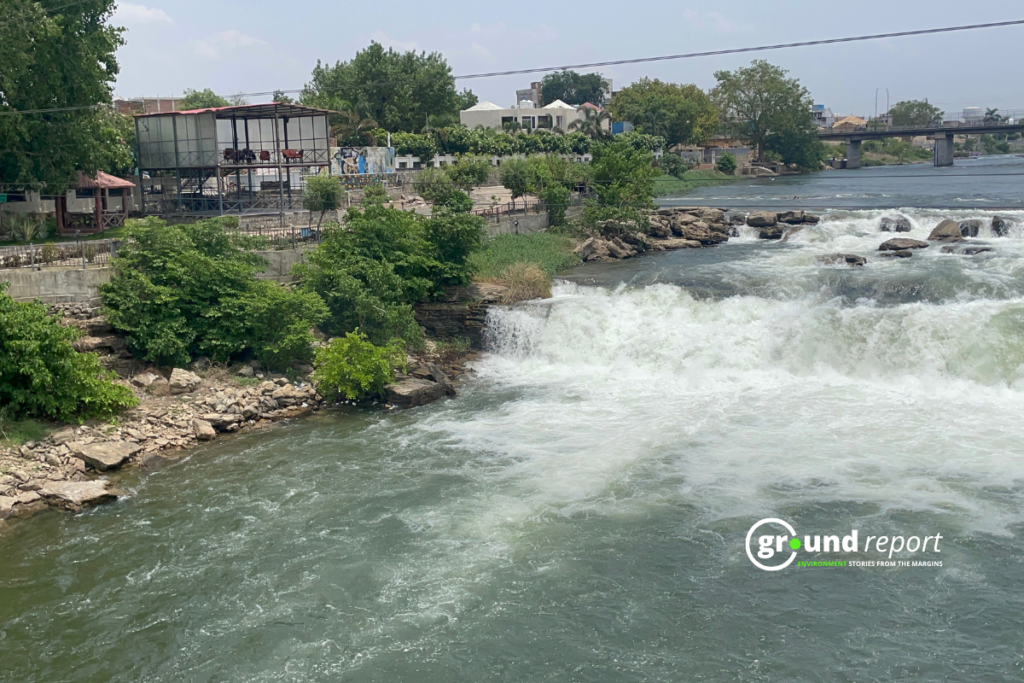
An eco-park built on an island in the Beehar River in Rewa, Madhya Pradesh, has come under scrutiny over alleged violations of environmental rules and contradictions in official construction records.
Documents obtained under the Right to Information (RTI) Act, along with an assessment by resident Amit Singh Baghel, point to a wide gap between the project approved on paper and what was ultimately built on the ground.
Historical Google Earth imagery reinforces those concerns. Images from 2014, 2018, and 2025 show a dramatic transformation of the island. In 2014, it was densely covered with trees. By 2018, the vegetation had largely disappeared. The 2025 imagery shows permanent structures occupying what Baghel says was a protected green belt where such construction was never intended.
Construction in the river’s catchment
The paper trail begins in January 2010.
That month, the Town and Country Planning office in Rewa informed the forest department that Khasra numbers 156, 157, 159, and 160 in Nipania village, along the Beehar River, were classified as water bodies. Khasra number 158, it said, was designated as afforestation land.
Another record from the same period listed 35 trees identified for compensation during the acquisition of Khasra number 158/1. These included mango, mahua, kahua, babool, and guava trees. Several had trunk diameters of up to 60 centimetres. Yet all 35 trees were collectively valued at only Rs 1,349.
In July 2010, the state’s Housing and Environment Department wrote to the Divisional Forest Officer (DFO) in Rewa regarding a proposed land-use change for an eco-tourism project on the island.
The department warned that hotels or food establishments could pollute the river and said the site should be limited to recreational facilities rather than permanent buildings that serve food.
Five years later, in 2015, the Urban Development and Environment Department approved a land-use change for 3.646 hectares in Nipania village. The sanctioned plan proposed a park with a suspension bridge, a water park, an herbal garden, and a snack counter. It earmarked 1.55 hectares within 50 metres of the Beehar River for recreational use, while the remaining land was designated for commercial purposes.
The approval also reiterated a key planning condition: under the Rewa Development Plan, a 50-metre-wide strip along both banks of the river was to remain open for social forestry and tree plantation.
A concession agreement for the Beehar-Rewa Eco-Tourism and Adventure Park had already been signed on 25 November 2014 under a public-private partnership (PPP) model.
Baghel said the layout he proposed largely respected the 50-metre river buffer and kept construction outside it in most places. The project, he said, was intended to involve only limited, low-impact development.
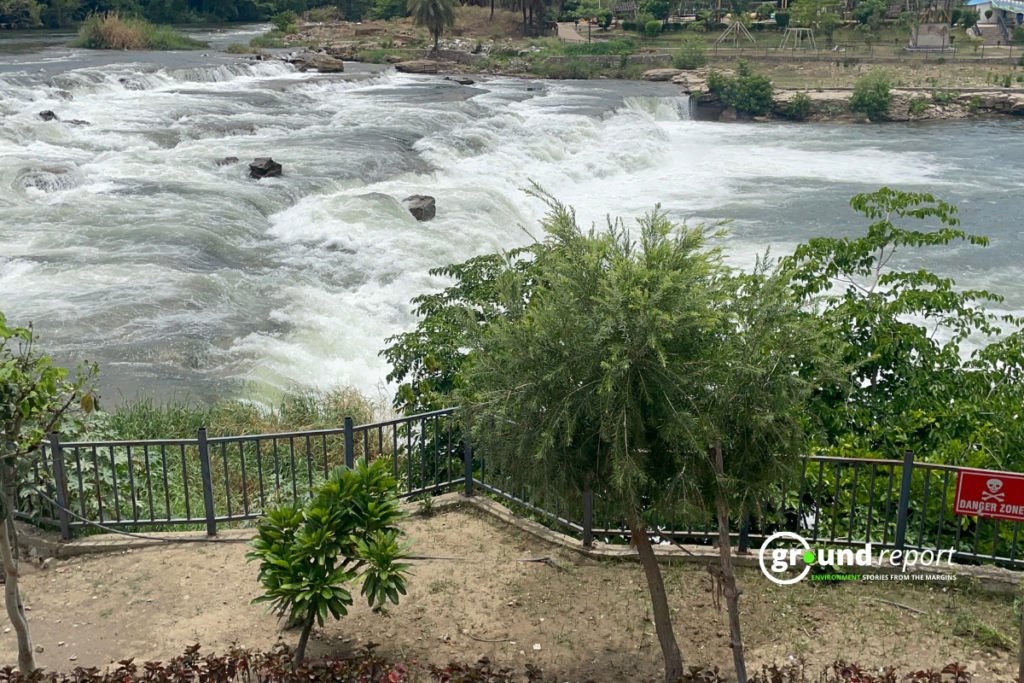
Instead, he alleges, the implementing agency departed from the approved design, and officials certified the work regardless.
What the ground actually shows
The concession agreement required the developer to complete 13 minimum works, including a suspension bridge linking the two islands, toilets, a staff hut, an interpretation centre, a butterfly park, a cafeteria, a treehouse, and various adventure sports facilities.
An updated project status report from January 2022 tracked 28 individual components. It marked 27 as complete, including the butterfly park, cafeteria, treehouse, archery ground, paintball area, artificial rock-climbing wall, and Burma bridge.
The report also listed a meditation and yoga centre and a musical fountain as later additions, although it recorded no completion date for either.
By May 2023, inspection reports from the range officer and the DFO’s office declared all 13 contractual components complete and recommended that the park be opened. A completion certificate issued by Rewa’s Divisional Forest Officer stated that the work conformed to the concession agreement and found no violation of forest laws or government rules.
A visit by the Ground Report team on 17 June 2026, however, painted a different picture.
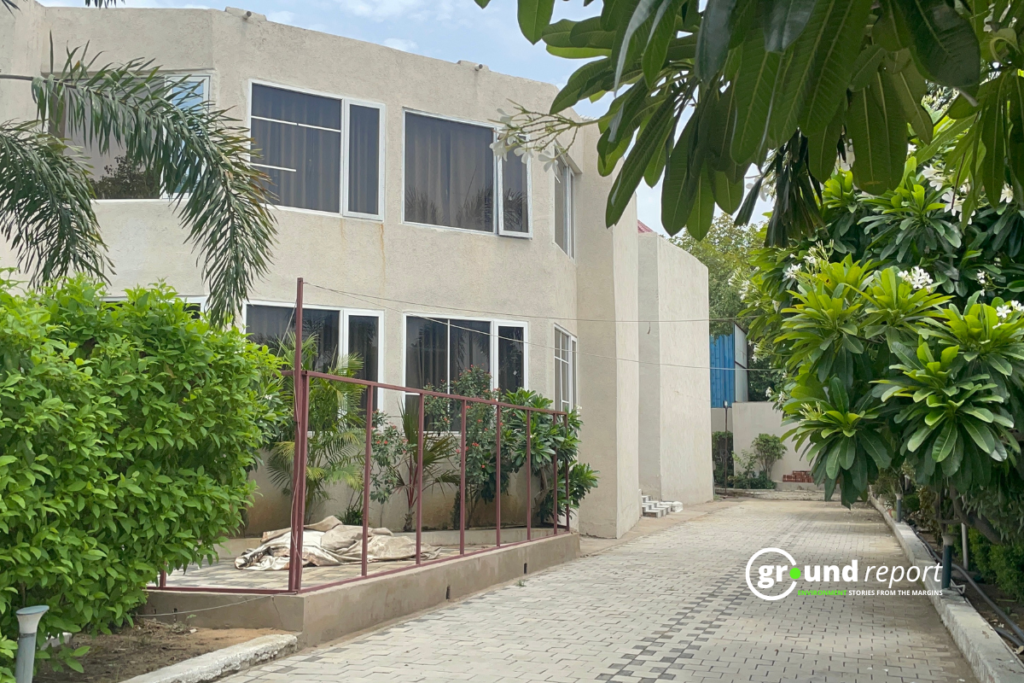
Several facilities listed as complete—including the butterfly park, cycling track, Burma bridge, library and meditation centre—could not be found on site.
Baghel also questioned the park’s sanitation infrastructure. He said pollution control board norms require a sewage treatment plant (STP) wherever toilets are built close to a water body. No such plant exists at the site, he alleged, and wastewater from the toilets flows directly into the river.
An “eco-park” that floods every monsoon
The documents also raise questions about whether the island was suitable for permanent development in the first place.
A photograph from September 2016 shows the project site completely submerged during flooding in the Beehar River, with part of the bridge structure underwater.
A news report published at the time said floodwaters had cut off Rewa, the army had to be deployed, and the eco-park’s suspension bridge was swept away by the current.
Baghel said the island is part of the river’s natural floodplain. Although it sits slightly higher than the surrounding riverbed, he said, it is inundated during nearly every major flood.
Responding to the allegations, Rewa’s municipal commissioner said the matter would be investigated. Officials will compare the original approval conditions with the park’s present condition before drawing any conclusions.
Baghel has already submitted complaints to state authorities. If no action follows, he said, he plans to approach the National Green Tribunal (NGT). He is also preparing to file a public interest litigation (PIL) after the Madhya Pradesh High Court’s vacation ends.
Support Us To Sustain Independent Environmental Journalism In India.
More Ground Reports
He Was Married as a Child, Now Manish Dangi Helps Stop It for Others
Despite The Ban, How Gutkha Became MP’s Most Common Household Habit