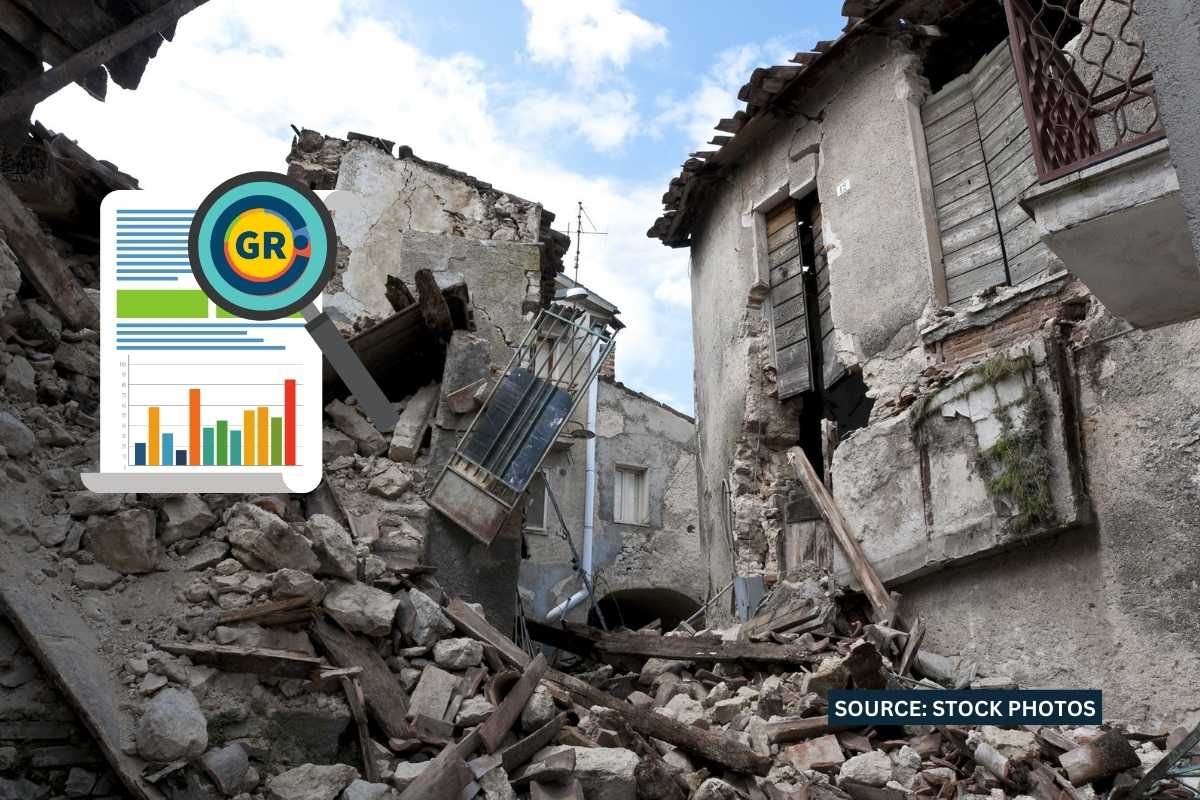
The frequency of earthquakes in India has increased significantly in recent years, particularly in the states of Jammu and Kashmir and Uttarakhand.
The India Meteorological Department has provided official data on the occurrence of earthquakes in Jammu and Kashmir (J&K) and Uttarakhand in recent years.
State faces most earthquakes in a year
Data shows that, on average, more than 30 earthquakes occur in Jammu and Kashmir each year. In the past five years, there have been about 150 earthquakes in J&K, with magnitudes mostly ranging from 3 to 5 on the Richter scale.
Similarly, Uttarakhand has experienced more than 700 earthquakes in the last ten years.
These data highlight the frequency and vulnerability of these regions to earthquakes. Earthquakes are natural phenomena caused by the displacement of tectonic plates below the earth’s surface.
Areas located close to these plates are more susceptible to earthquakes, and the Indian subcontinent sits on the boundary of two tectonic plates, making it a seismically active region.
The Himalayan region, including J&K and Uttarakhand, is particularly vulnerable to earthquakes due to its proximity to active tectonic plates.
The recent earthquake of magnitude 6.6 on the Richter scale, which was felt in several states in northern India, has once again highlighted the need for increased preparedness and response mechanisms to deal with this type of natural disaster shock.
Which parts of India come under these zones?
The Ministry of Earth Sciences has released a report revealing that 11% of India’s land area is in zone V, 18% in zone IV, 30% in zone III and the rest in zone II.
ZoneV states
Zone V includes parts of northeastern India, Jammu and Kashmir, Himachal Pradesh, Uttarakhand, the Rann of Kutch in Gujarat, a part of northern Bihar, and the Andaman and Nicobar Islands.
ZoneIV states
Zone IV includes Himachal Pradesh, the Union Territory of Delhi, Sikkim, the northern parts of Uttar Pradesh, Bihar and West Bengal, parts of Gujarat and small sections of Maharashtra near the west coast and Rajasthan.
ZoneIII states
Zone III includes Kerala, Goa, the Lakshadweep Islands, the remaining parts of Uttar Pradesh, Gujarat and West Bengal, parts of Punjab, Rajasthan, Madhya Pradesh, Bihar, Jharkhand, Chhattisgarh, Maharashtra, Orissa, Andhra Pradesh, Tamil Nadu and Karnataka.
The least seismic zone, Zone II, covers the rest of the country.
Harsh K. Gupta, the President of the Geological Society of India, emphasized that predicting when and where a destructive earthquake would occur in the Himalayan region, including J&K, Uttarakhand, and parts of northeast India, is a difficult task.
He emphasized the need for the implementation of earthquake safety measures in all constructions, as well as providing earthquake safety training to school students.
Gupta also recommended the deployment of earthquake early warning systems along the Himalayan belt and the observance of earthquake safety day in the vicinity of the Himalayan earthquake belt, similar to what Nepal does every year on January 16.
Keep Reading
Major Earthquake in Jammu & Kashmir
Which animals can predict earthquakes?
Top 10 most deadliest earthquake ever
SSGEOS predicts strong earthquake aftershock in Turkey
Support us to keep independent environmental journalism alive in India.
Follow Ground Report on X, Instagram and Facebook for environmental and underreported stories from the margins. Give us feedback on our email id greport2018@gmail.com.
Don’t forget to Subscribe to our weekly newsletter, Join our community on WhatsApp, and Follow our YouTube Channel for video stories.
Author
Support Ground Report to keep independent environmental journalism alive in India
We believe climate change should be the basis of current discourse, and our stories attempt to reflect the same.
Connect With Us
Send your feedback at greport2018@gmail.com
Newsletter
Subscribe our weekly free newsletter on Substack to get tailored content directly to your inbox.
When you pay, you ensure that we are able to produce on-ground underreported environmental stories and keep them free-to-read for those who can’t pay. In exchange, you get exclusive benefits.
Your support amplifies voices too often overlooked, thank you for being part of the movement.