Jammu and Kashmir’s annual power deficit has fallen sharply over the past decade, falling from 19.1% in 2014-15 to just 0.1% in 2025-26, according to Ministry of Power data. In absolute terms, the gap between electricity requirement and supply fell from 3,095 MU to just 19 MU over the same period.
The national average was 4.2%, which also dropped to 0.03% during April-December 2025, while J&K recorded 0.1 per cent.
These improvements map closely with other states which struggled in the same way in 2014-15. Take, for instance, Uttar Pradesh, which had a 15.6% shortage that year and has since brought its gap down to almost zero. Similarly, Uttarakhand cut its shortage from 3.0% to 0.4% in the same window.
The improvement in power supply across states was part of a nationwide expansion of India’s electricity infrastructure. A 2025 government-cited review noted that the country had added 238 GW of generation capacity and more than 2,01,088 circuit kilometres of transmission lines since April 2014.
The Union Territory’s power shortage was both complex and seasonal, driven in part by its heavy dependence on hydropower. Generation typically falls during winter, just as electricity demand rises, increasing the supply gap.
Reasons
The consumers are predominantly residential, accounting for 84% of the base, followed by commercial users at 13%. The remaining 3% comprises agricultural, industrial and government consumers, reflecting the UT’s largely household-driven electricity demand.
The reasons for the power shortage were mainly two: high AT&C (Aggregate Technical and Commercial) losses, like electricity lost through technical inefficiencies, power theft, faulty metering, billing gaps and unpaid bills, and the seasonal decline in hydropower generation.
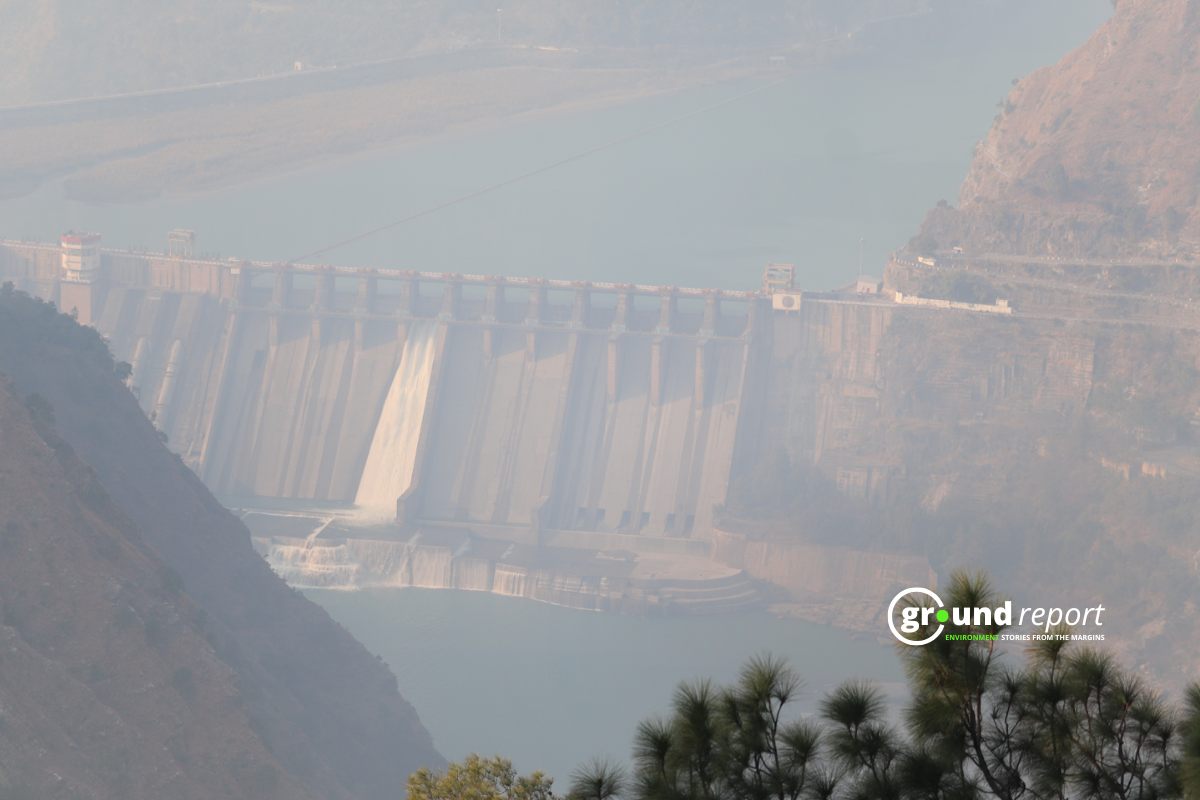
During winter, the water flow in the UT’s snow-fed rivers falls, reducing output from hydel power plants just as electricity demand remains high.
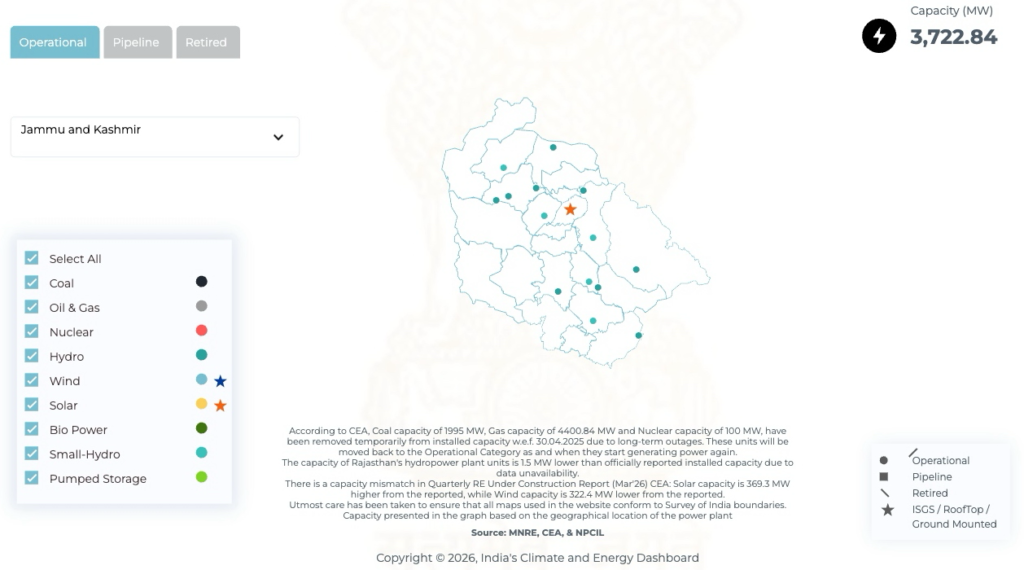
Around 98% of J&K’s electricity generation comes from large hydropower, with another 2–2.5% from small hydro. Solar’s contribution from 2019 to 2023, based on the available data through PIB.
What Has Changed In These Years?
The department worked to reduce AT&C losses, which fell from 55% in 2016-17 to 18.82% by November 2024, the J&K Economic Survey 2024-25 noted. Additionally, collection and billing efficiency increased to 81%.
And, for the winter shortfall, J&K entered into bilateral arrangements with states that have surplus power during winter, while also receiving unallocated power from the Ministry of Power from the quotas of the northeastern and western states.
In December 2023, the centre allocated 1,500 MW from the central pool to meet J&K’s winter power needs, along with another 472 MW under the SHAKTI (Scheme for Harnessing and Allocating Koyala Transparently in India) policy, taking the additional allocation to 1,972 MW.
And this extra electricity could be supplied because India expanded its power sector too. Between 2014 and 2025, the installed capacity more than doubled from 249 GW to 509.743 GW.
With these changes, the state caught up with the shortfall despite not producing its own electricity.
Increasing Demand and Hydropower Potential
Jammu and Kashmir’s electricity demand has risen with economic growth and increasing electrification. In December 2023, its winter demand reached around 2,800 MW, while the deficit stood at about 1,400 MW, according to the PIB release.
The Economic Survey 2024-25 said the UT has an estimated potential of 18,000 MW, of which 14,867 MW has been identified. Only 3,540.15 MW, or 23.81% of the identified potential, has been harnessed.
The Ministry of Power, in a PIB release, said generation capacity was expected to double in three to four years, with four major projects, Pakal Dul, Kiru, Kwar and Ratle, to add 3,014 MW.
Four more hydel projects with 3,284 MW are also planned.
Apart from hydro, there is a push towards rooftop solar. The Economic Survey said 76 MW had been installed by November 2024, with plans to scale capacity to 270 MW. By March 2026, 25,160 rooftop solar systems had been installed under PM Surya Ghar, from 97,260 applications received since February 2024.
Support Us To Sustain Independent Environmental Journalism In India.
More Ground Reports
He Was Married as a Child, Now Manish Dangi Helps Stop It for Others
Despite The Ban, How Gutkha Became MP’s Most Common Household Habit