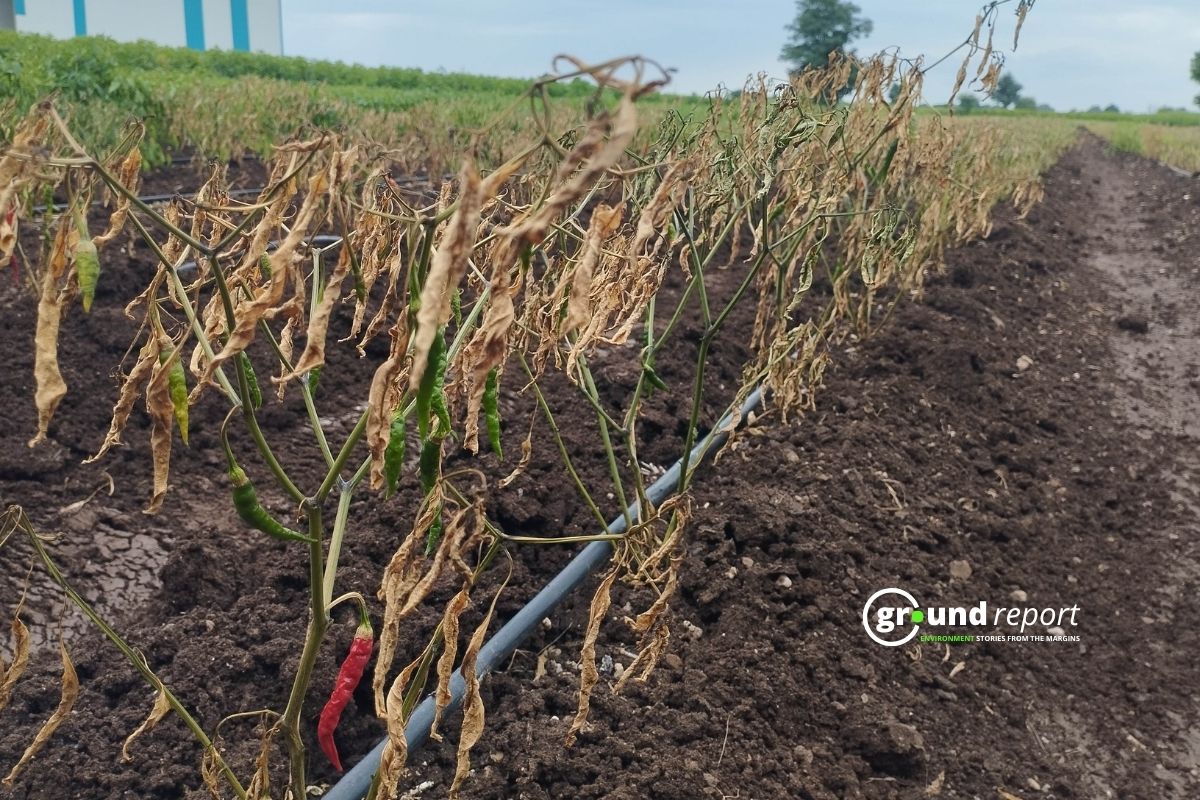
Khargone | Kamlesh Patidar, a farmer from Ubdi who earned good profits from chilli last year, appears disappointed this season. Patidar planted chilli on three acres on May 25. He harvested 15 quintals during the first picking about a fortnight ago and received ₹18 per kg. Soon after, however, pest attacks increased.
Chilli plants across two acres began to shrivel, bringing production to a halt. The plants on the remaining one acre are still healthy, raising hopes of a red chilli harvest. But Patidar remains worried about them too.
He said he spent ₹70,000 on the two acres. He complained that despite the pest attack and shrinking plants, horticulture department officials were yet to visit his field. He alleged that the horticulture department focuses only on subsidy-based schemes and pays little attention to damaged crops.
Alkesh Ramesh, a farmer from Likkhi, also saw the leaves of his chilli plants on two acres begin to shrivel, eventually destroying the entire crop. Before the crop was lost, he harvested eight quintals of green chilli in one picking.
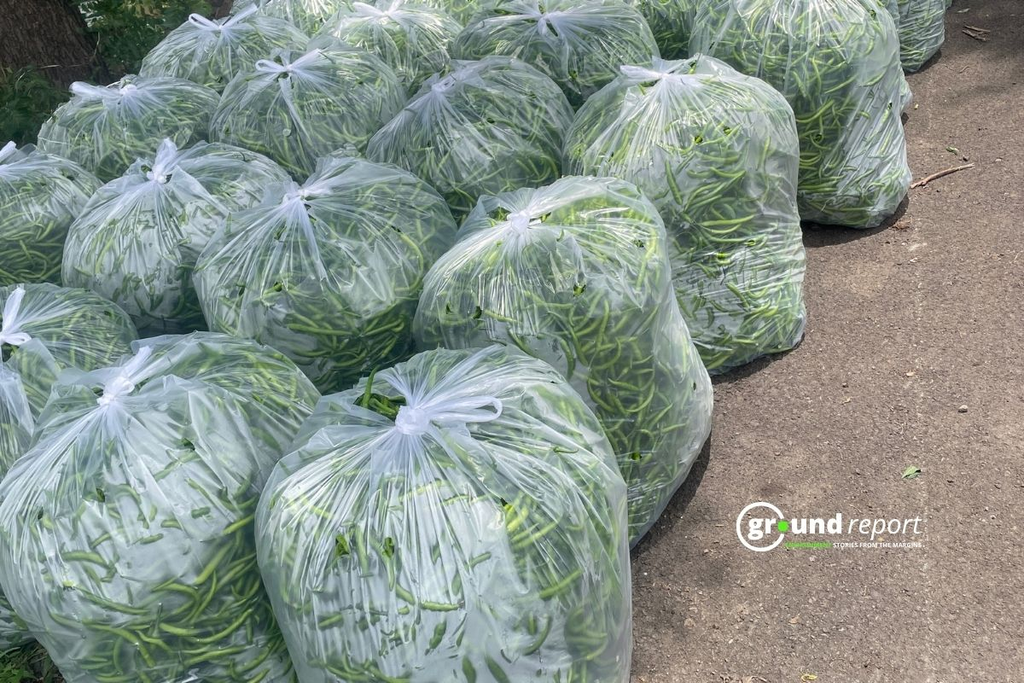
The chilli crop, part of the One District One Product (ODOP) initiative, has turned into a loss-making proposition for farmers this year. Although chilli has received a Geographical Indication (GI) tag, farmers were struggling because of low prices. Pest attacks have also caused plants to shrivel in several fields.
The situation has reached a point where a farmer in Tanda Barud uprooted his chilli plants because of low prices. In Devli village, a farmer ran a rotavator over his standing chilli crop. In Romchichli, another farmer mixed the harvested chilli into the soil as manure instead of selling it to a trader.
Bedia is home to what is considered Asia’s second-largest chilli market. Last year’s good prices for red chilli encouraged more farmers to grow the crop this season. As a result, chilli is being cultivated on around 42,000 hectares in the district, among nearly 50,000 farmers.
Farmers now hope that red chilli will fetch better prices after the poor returns from green chilli.
Farmer Runs Rotavator Over Chilli Crop
Mohan Kumarawat of Tanda Barud had planted chilli on one-and-a-half acres. His first picking yielded 17 quintals of chilli, for which he received ₹25 per kg. This raised his hopes. But during the next picking, even though he had 25 quintals of good-quality chilli, no trader wanted to buy it.
Mohan took the produce to the Indore market, where he received only ₹13 per kg. After adding transportation, loading and unloading, and other expenses, he barely recovered his costs.
Fearing further losses, he uprooted the chilli plants and planted tomatoes instead. He had invested ₹1.25 lakh in the crop and suffered a loss of ₹70,000.
His neighbour, Pradeep Kumarawat, also ran a rotavator over his chilli crop, which was laden with produce. He received only ₹10–15 per kg during the first two pickings. By the third picking, the price had fallen to ₹8–10 per kg, making it impossible to recover even the cost of harvesting. He therefore destroyed the entire crop.
Farmers Complain at Nursery After Plants Begin Drying
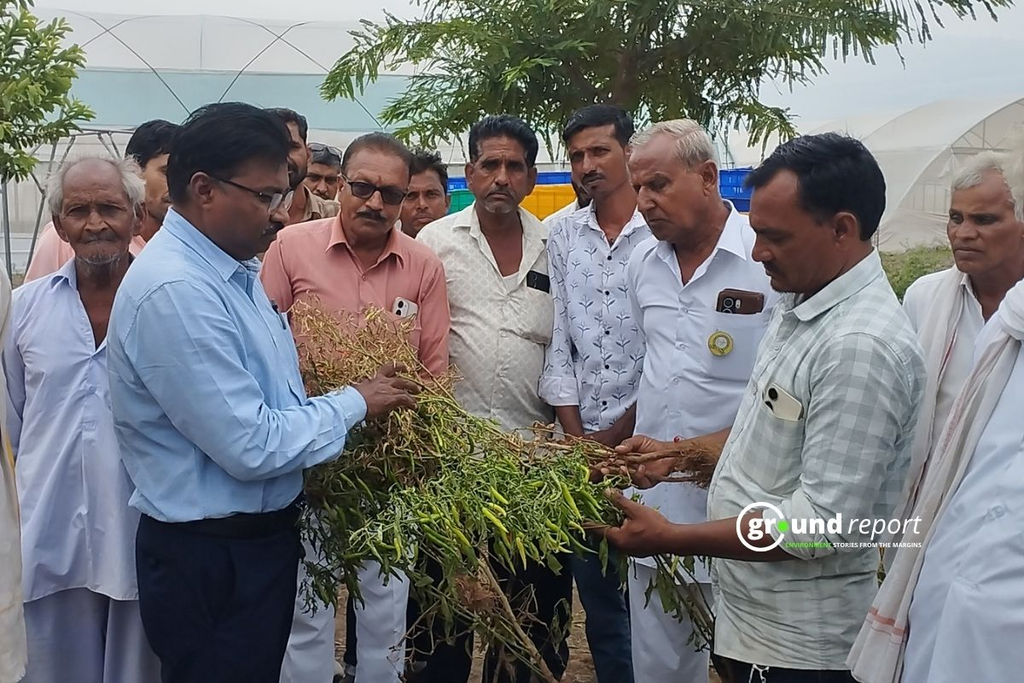
Farmers from Durgapur complained of disease and poor fruiting in their chilli plants and travelled to Advait Nursery in Mangrul to raise their concerns. The farmers alleged that they had purchased seedlings from the nursery and planted them across around 40 acres. The plants have not developed as expected in several fields, and many have started drying up. They said they are facing losses of thousands of rupees.
Ganpati Yadav had spent ₹55,000 on seedlings for three acres. He also showed the damaged plants to the nursery operator. The horticulture department was subsequently informed about the issue. Department officials also visited the nursery and noted the farmers’ complaints.
The farmers explained that the changes began around 50 days after transplantation. Initially, they assumed it was due to weather or a common disease and sprayed pesticides. But the problem continued to worsen. Many plants were now failing to produce fruit, leaving farmers worried that they may lose their entire investment.
The farmers demanded scientific testing of the affected fields. They sought compensation for their losses if an investigation finds any problem with the quality of the seedlings or the nursery.
Khargone horticulture department Deputy Director K.K. Girwal, who visited the site, said an investigation team would be formed based on the complaints and would inspect the fields. The team would assess the crop condition and examine the disease symptoms before preparing a report. Further action would be decided based on the findings.
Virus or Wilt? Cause Still Unknown
Farmers linked the symptoms on the chilli plants to a virus. However, the actual cause has not yet been officially established.
Nursery operator Prabhu Kushwah said the farmers from Durgapur had purchased seedlings from his nursery. He said complaints of viral disease were currently being reported in chilli crops. He added that wilt can cause symptoms such as yellowing and disease. Kushwah said the same seedlings had also been sold to other farmers, but so far complaints had come only from farmers in Durgapur.
He said the company concerned would be informed about the issue.
At the same time, he said some plants in his own field were also drying up sporadically. He said only an inspection by agricultural scientists would establish the cause.
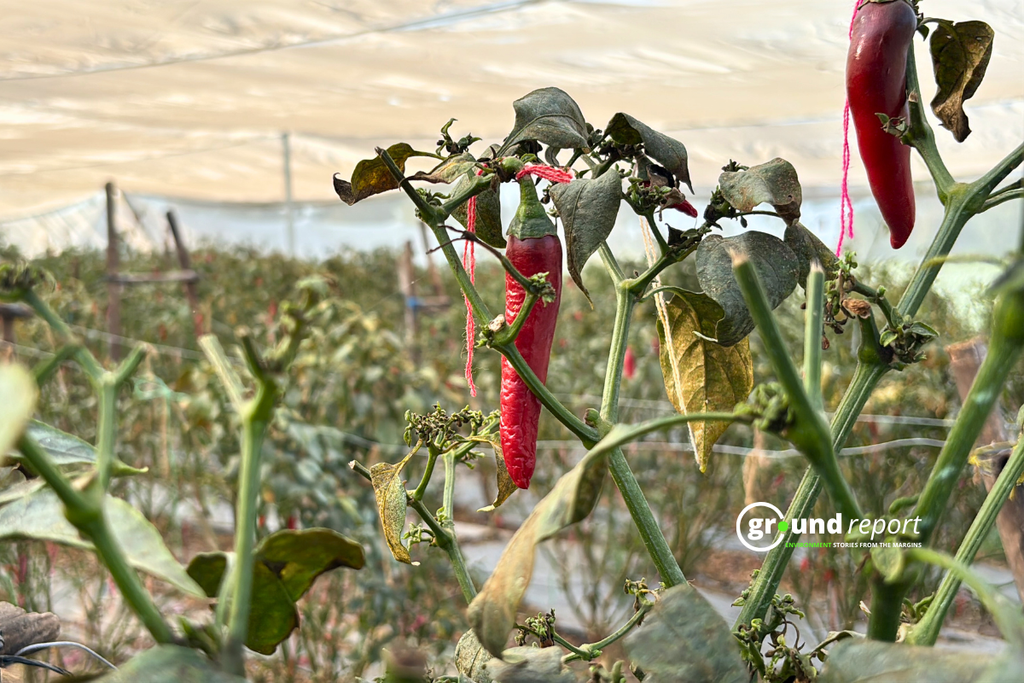
The reports of crop damage from different parts of Khargone are concerning. According to estimates, chilli is cultivated on around 45,000 hectares in the district, producing approximately 157,500 metric tonnes. This makes it a major crop for local farmers.
Black Thrips Suspected
Dr R.K. Singh, a scientist at the Krishi Vigyan Kendra, said the complaints from different parts of the district raised the possibility of a black thrips infestation (Thrips parvispinus) in chilli crops.
The pest hides inside flowers and beneath leaves, which can allow it to develop pesticide resistance relatively quickly.
Singh said black thrips can be controlled through chemical, biological and physical methods. To prevent the development of pesticide resistance, he recommended rotating pesticides rather than spraying the same chemical repeatedly.
Support Us To Sustain Independent Environmental Journalism In India.
More Ground Reports
He Was Married as a Child, Now Manish Dangi Helps Stop It for Others
Despite The Ban, How Gutkha Became MP’s Most Common Household Habit