
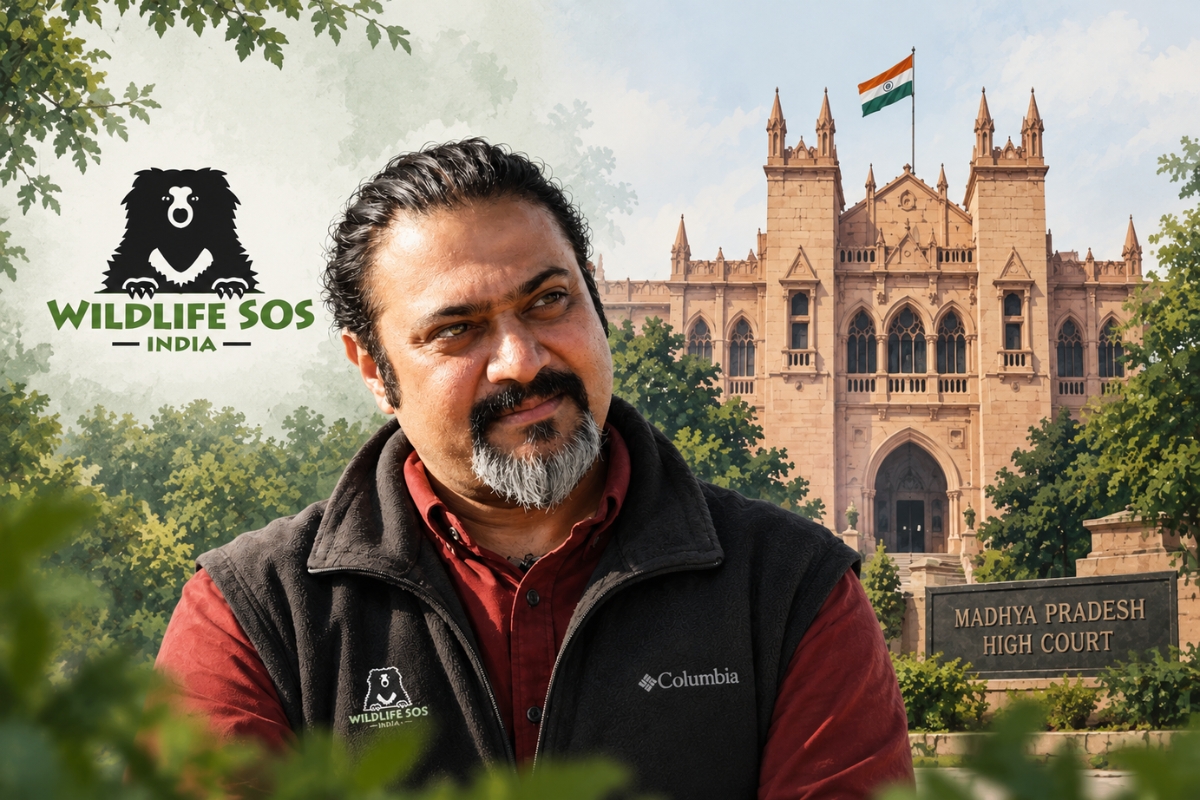
The Madhya Pradesh High Court has withdrawn legal protection for Kartick Satyanarayan, co-founder and CEO of the wildlife group Wildlife SOS, ruling that he failed to cooperate with an investigation into the alleged poaching of 10 leopard skins.
Justice Rajesh Kumar Gupta of the Gwalior Bench issued the order on September 7. The order was uploaded on September 10. The judge said Satyanarayan “has not approached this Court with clean hands” and had obtained his earlier protection “without full disclosure of vital records and circumstances.”
The court ordered Satyanarayan to appear before the Madhya Pradesh Forest Department’s State Tiger Strike Force and cooperate with investigators.
The case later reached the Supreme Court, which on September 21 directed that the interim protection earlier granted by the High Court on September 2 would continue until disposal of the pending writ petitions. The Supreme Court did not express any opinion on the merits of the case and directed Satyanarayan to appear before forest authorities on September 28 and fully cooperate with the investigation.
What The Investigation Alleges
The case began July 23, when police arrested four men on the Gwalior-Agra highway carrying 10 leopard skins. Wildlife SOS said at the time that the seizure followed months of surveillance by the group’s own anti-poaching unit.
Investigators traced the skins back to Madhya Pradesh and opened a separate inquiry into the alleged killings. Officials say the leopards were hunted in the Kuno, Sheopur and Morena forest divisions, an area that also hosts India’s reintroduced cheetah population.
The forest department says 15 people have been arrested across Haryana, Madhya Pradesh and Delhi.
Two of them, Bhagwan Singh, described by officials as a wildlife trader linked to Wildlife SOS, and Wasim Akram, a director at the group, allegedly named Satyanarayan during questioning.
Samita Rajora, the state’s principal chief conservator of forests for wildlife, said the department holds strong digital evidence tying the accused to the group.
She also questioned why Wildlife SOS did not alert authorities earlier if the group had no role in the killings.
“Why did they wait for a year for action against them?” Rajora said. “More revelations will be made on their involvement. But this was done to raise funds.”
Wildlife SOS has rejected the allegations. The organisation says its personnel were involved in anti-poaching intelligence work and helped authorities expose the alleged poaching operation.
Wildlife SOS Says Its Role Changed From Informant To Accused
A Wildlife SOS spokesperson, in an email response to Ground Report, said the events that began in July were initially part of the organisation’s longstanding cooperation with forest and wildlife departments.
The spokesperson said Wildlife SOS has worked with forest and wildlife departments across 19 states for more than three decades, sharing intelligence, expertise and on-ground assistance in support of wildlife protection.
According to the organisation, intelligence shared by Wildlife SOS led to the July 23 operation by the Uttar Pradesh Forest Department and police, resulting in the seizure of 10 leopard skins and the arrest of four people.
The organisation said the operation was authorised and guided by the Divisional Forest Officer, Agra, and that Wildlife SOS’s role was publicly acknowledged by the Uttar Pradesh Forest Department.
The investigation subsequently expanded into Madhya Pradesh, where allegations emerged involving Wildlife SOS personnel and its leadership.
Wildlife SOS said this represented a significant departure from its longstanding engagement with enforcement authorities. The organisation said it has worked with the Madhya Pradesh Forest Department since 2006 on wildlife rescues, treatment and conservation efforts.
The spokesperson said the inter-state nature of the case makes jurisdiction, coordination and the sequence of investigative actions important.
“What began as cooperation with authorities in one state has subsequently resulted in action against individuals associated with an organisation that has worked with government agencies across state jurisdictions for decades,” the spokesperson said.
Wildlife SOS said it believes the roles and responsibilities of all those involved should be established through due process.
A broader reading of the circumstances suggests that Wildlife SOS found itself caught between two state authorities and competing investigative processes, having worked with one state’s enforcement machinery before subsequently coming under scrutiny from another. This inter-state dynamic, and the differing approaches to the investigation, may be relevant in understanding how its position shifted from that of an informant and enforcement partner to an organisation facing investigation.
Wildlife SOS said it believes the roles and responsibilities of all those involved should be established through due process. Further describing its plight, Wildlife SOS added that its position in the matter as that of a whistleblower, having shared intelligence that it says contributed to efforts to uncover suspected wildlife crime, before subsequently facing allegations arising in connection with the same investigation.
Dispute Over Documents And Evidence
Wildlife SOS also raised concerns over its access to documents related to the investigation.
The spokesperson said the organisation had repeatedly requested the Forest Offence Report, FIR and other relevant material setting out the basis of the allegations but had not received them.
According to Wildlife SOS, this has made it difficult for the organisation to respond meaningfully to claims concerning statements, digital evidence, financial links and other material reportedly being examined by investigators.
The organisation also disputed reports about statements allegedly made by people in custody that implicated Satyanarayan.
Wildlife SOS said it had not been provided the underlying documents or official material concerning those claims and therefore could not independently assess them.
The organisation strongly disputed any interpretation of such material that seeks to establish wrongdoing by Wildlife SOS or its representatives and said it reserves the right to challenge such claims through legal channels.
The spokesperson said a distinction should be maintained between allegations appearing in the public domain and evidence formally placed before the concerned parties.
“Any allegations must ultimately be tested against evidence and through a fair, transparent and legally established process,” the spokesperson said.
Wildlife SOS also said that treating anti-poaching intelligence work as participation in wildlife crime could discourage informants, conservationists and others from assisting authorities.
The organisation said it remains willing to cooperate with any legitimate investigation.
Why The Court Withdrew Protection
Satyanarayan had gone to court seeking to quash two summonses, dated August 14 and August 19, along with the underlying offence report.
His lawyers argued that Wildlife SOS staff had helped Uttar Pradesh officials make the original seizure and that Madhya Pradesh could not run a second investigation into the same incident.
On September 2, the court barred the State Tiger Strike Force from taking coercive action against Satyanarayan and allowed him to attend questioning with a lawyer present. The order also required him to cooperate with the investigation.
The state then asked the court to reverse that order. It said Satyanarayan had not disclosed a third summons issued on August 24 and an arrest warrant issued on August 31 after he failed to appear.
The department’s September 10 statement called him an “absconding accused.”
Prosecutors also challenged his stated reason for not appearing: that he was caring for his ailing mother in Hyderabad. Investigators told the court a hospital confirmed she had been discharged on August 6 and that Satyanarayan had not visited her there.
The state also argued that the Uttar Pradesh and Madhya Pradesh cases are not duplicates. The Agra case deals with possession and transport of the skins, officials said, while the Madhya Pradesh probe covers the alleged original hunting and those who allegedly facilitated it.
The High Court accepted the distinction and recalled the earlier protection. Its September 7 order said the investigation concerned the alleged hunting of protected wildlife in Madhya Pradesh, procurement and movement of wildlife articles and the alleged participation or facilitation of those offences.
Supreme Court Restores Interim Protection
Satyanarayan challenged the High Court’s September 7 order before the Supreme Court.
On September 21, the Supreme Court directed that the High Court’s September 2 order would continue to operate in the pending writ petitions. The bench of Justices Ujjwal Bhuyan and Atul S. Chandurkar did not express any opinion on the merits of the case.
The court directed Satyanarayan to appear before the forest authorities on September 28 at 11 am and fully cooperate with the investigation. It also allowed the parties to place additional facts and documents before the High Court.
The order did not clear Satyanarayan of the allegations. It also did not rule that the Madhya Pradesh investigation was unlawful. Instead, it restored the interim protection while requiring him to join the investigation.
Wildlife SOS Welcomes Supreme Court Order
Following the Supreme Court order, Satyanarayan said he was ready to cooperate with the Madhya Pradesh State Tiger Strike Force.
“I am extremely grateful that the Hon’ble Supreme Court of India considered our prayers and passed a favorable order,” Satyanarayan said in a statement issued on September 22.
He said he would appear before the STSF in Shivpuri and use the opportunity to present facts and respond to what he described as unfounded allegations.
Wildlife SOS said the Supreme Court order provided an opportunity for the organisation to present its case through the legal process.
Co-founder Geeta Seshamani said Wildlife SOS, its employees and volunteers had worked with government departments across 19 states for more than three decades.
The organisation said it has assisted in rescuing more than 5.31 lakh animals and has provided intelligence, technical expertise and on-ground assistance in wildlife rescue, conflict mitigation, conservation and anti-poaching efforts.
Wildlife SOS also said it was concerned about the detention of Wasim Akram and the summons issued to Satyanarayan without, according to the organisation, sufficient details about the allegations being shared with them.
Satyanarayan Appears Before STSF
Satyanarayan appeared before the Madhya Pradesh State Tiger Strike Force in Shivpuri on September 28, following the Supreme Court’s direction.
The STSF questioned him for three consecutive days in connection with the recovery of the 10 leopard skins in Agra and the alleged poaching network linked to Kuno.
According to reports, the questioning continued for more than 27 hours between September 28 and September 30.
Satyanarayan denied the allegations against himself, Wildlife SOS and its staff. He maintained that the organisation has consistently worked with government agencies on wildlife protection and anti-poaching efforts.
Investigators also asked him to provide documents and other material in support of his claims, according to reports. The STSF may question him again as the investigation continues.
Speaking after his first appearance, Satyanarayan said Wildlife SOS was “absolutely innocent” and had spent decades supporting forest departments.
“We are animal lovers. Wildlife conservation has always been the purpose of our lives,” he said, adding that the organisation would assist the Forest Department in every possible way.
What The Two Investigations Cover
The dispute also centres on whether the Uttar Pradesh and Madhya Pradesh cases concern the same offence.
The Madhya Pradesh government has argued that the two investigations cover different stages of the alleged crime. The Uttar Pradesh case concerns the alleged possession, transportation and dealing of the leopard skins recovered in Agra.
The Madhya Pradesh investigation focuses on the alleged hunting of the protected animals in Madhya Pradesh, along with possible abetment, facilitation, procurement and movement of wildlife articles.
Wildlife SOS has challenged the interpretation of the events and says its personnel were assisting authorities in exposing the alleged wildlife crime.
The organisation has also maintained that it has records and evidence to establish the nature of its work and its cooperation with enforcement agencies.
Investigation Remains Pending
The Madhya Pradesh investigation remains ongoing. Wildlife SOS continues to deny involvement in the alleged poaching and says it will cooperate with investigators while seeking access to relevant documents and pursuing available legal remedies.
The organisation said its work spans more than 32 years, covers 19 states and has included assistance in the rescue and rehabilitation of more than 5.31 lakh animals.
The High Court proceedings also remain pending. The Supreme Court’s September 21 order restored interim protection for Satyanarayan while directing him to cooperate with the investigation.
The Supreme Court did not determine whether the allegations against Satyanarayan or Wildlife SOS are true or false. The investigation and pending court proceedings will determine the legal status of the allegations.
Support Us To Sustain Independent Environmental Journalism In India.
More Ground Reports
He Was Married as a Child, Now Manish Dangi Helps Stop It for Others
Despite The Ban, How Gutkha Became MP’s Most Common Household Habit