हिंदी में पढ़ें: Bhanu Kumar Rathore lives in Dalki village in Segaon tehsil of Khargone district. In mid-February, one part of his field shows onion flowers while another section has tomato crops growing between bamboo stakes. Hanging among these crops are some yellow board-like cards. The field also has a few corn plants.
He cultivates seasonal vegetables, including chilli, onion, tomato, and cucumber, across eight acres. He produces onion seeds and sells vegetables directly in the market. But six years ago, his farming looked nothing like this.
Until 2019, he did conventional farming of cotton, chilli, maize, and soybean. Bhanu Kumar suffered a loss in 2021 on his 2-acre chilli crop. He had invested Rs 40,000–45,000 per acre. And, even after spraying pesticides following a pest attack, he could not recover his costs.
In 2020, Vinod Patidar, 32, of Mengaon, planted chilli on his five acres of land. But the crop was destroyed by thrips (Scirtothrips dorsalis) and whitefly (Bemisia tabaci). He applied pesticides every two days, but nothing stopped the pest attack. Vinod had invested ₹2 lakh in the crop, yet the produce that could have earned him up to ₹8 lakh was sold for just ₹3 lakh.
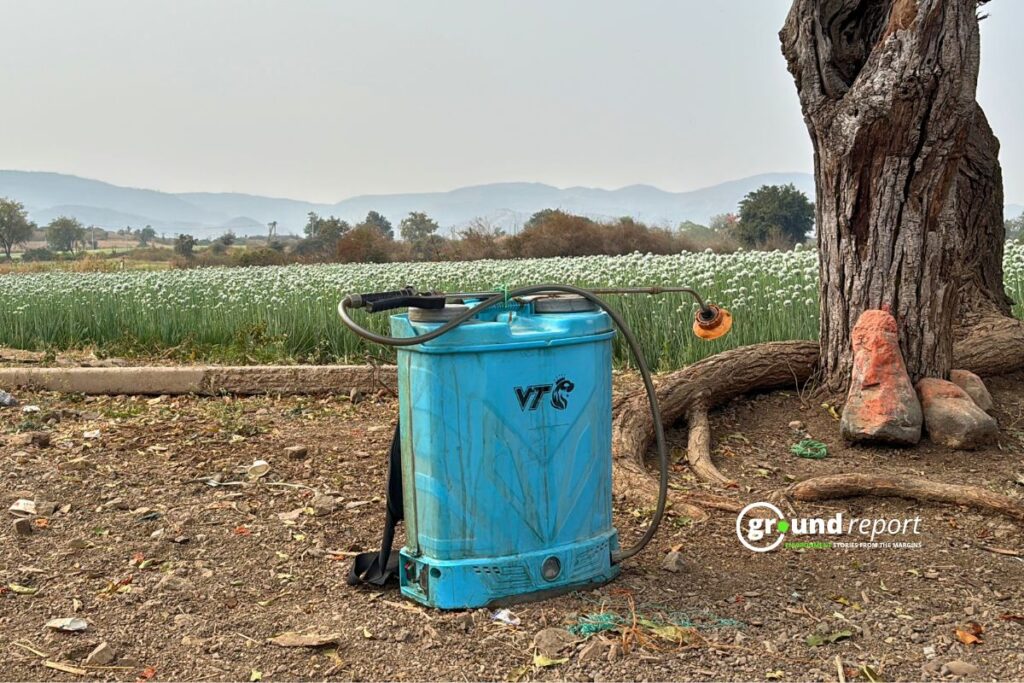
Four years ago, Praveen Rathore of Dalki stopped growing chillies. Persistent pest attacks had driven up labour and input costs, making the crop increasingly difficult to sustain. Across Khargone, numerous farmers have watched pests devastate their fields and erode their earnings.
Another villager, Balkrishna Patidar, asked Rathore to join Nimad Fresh Farmers Producer Organisation (FPO) and shift to seed and vegetable cultivation. He was also advised to use Integrated Pest Management (IPM) techniques instead of traditional pest control methods.
India is the world’s second-largest fertiliser consumer and one of the largest pesticide-consuming countries globally. Yet three decades of government-backed Integrated Pest Management programmes have brought only 3 to 5 percent of the country’s agricultural land under the technique. In the Khargone district of Madhya Pradesh, a cluster of vegetable farmers working through an NABARD-supported FPO has used IPM to cut pesticide costs by more than half and reduce spray rounds from 30 to 15.
But, inadequate field staff, a declining training outreach, and the absence of coordination between Krishi Vigyan Kendras and the national IPM research centre point to a policy apparatus that has struggled to move a proven method beyond isolated pockets.
What is IPM?
According to government information, IPM is an eco-friendly approach to pest management that combines cultural, mechanical, biological, and, when necessary, chemical control methods. Praveen Rathore of Dalki sees it as a pest-controlling method without increasing dependence on pesticides.
Dr. Donthi Narasimharao Reddy, Visiting Senior Fellow at the Impact and Policy Research Institute (IMPRI), explains it more precisely: “In IPM, the farmer develops an understanding of pests, learns their life cycle, and takes steps to eliminate them at the larval stage.”
According to Dr. Reddy, this technique relies more on pest control measures that do not harm the soil or human health, instead of chemicals. In ideal conditions, pest management under this technique is carried out through four approaches:
Cultural pest management: Traditional methods such as crop diversification, changing crop rotation, leaving fields fallow, and destroying residues of old crops.
Physical and mechanical management: Manually removing pests and destroying their larvae, understanding pest behaviour, and applying specific countermeasures for different pests. Separate traps are set for different pest types.
Biological management: Planting fruit-bearing trees and taking other measures to attract pest-eating birds to the field. Also includes management through parasites, bacteria, and fungi that prey on pests.
Chemical management: If the above measures still fail to control pests, pesticides are applied — but only those specific to the pest in question, so that other organisms are unaffected. Spraying is limited only to the areas most heavily infested.
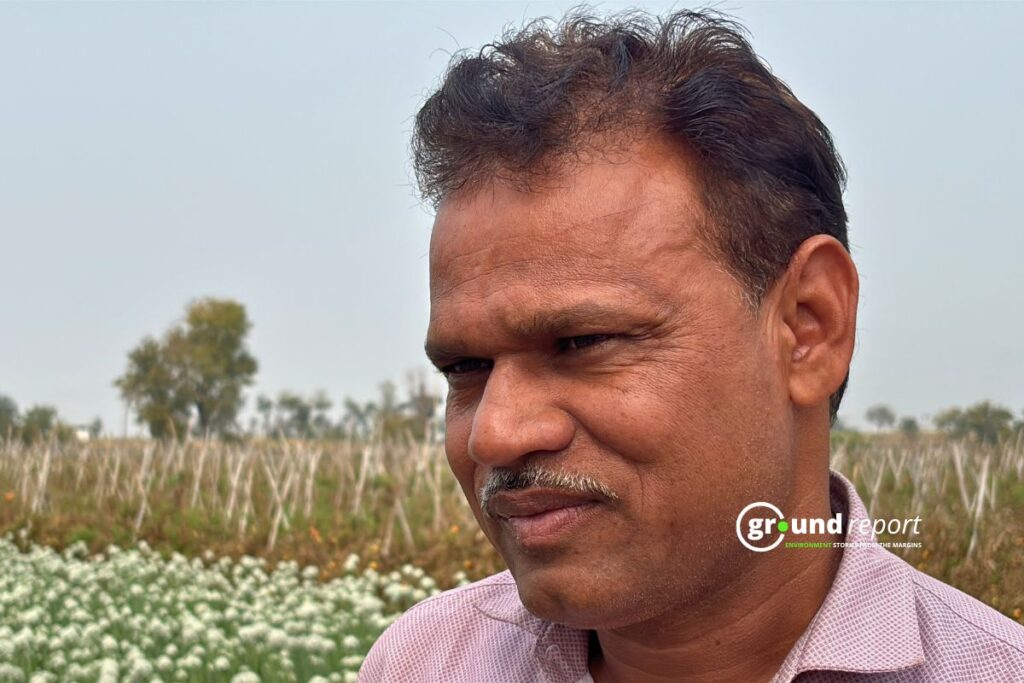
How Are They Managing Now?
Bhanu Kumar now plants some ‘host plants’ alongside his main crop. Pests are drawn to these host plants instead of the primary crop.
Pramel Kumar Gupta, who has over two decades of experience in agriculture, explains with an example: “BT cotton packets used to come with a small packet of desi cotton inside. Farmers had to plant this along the edges of the main field so that caterpillars would attack it and the main crop would be protected.”
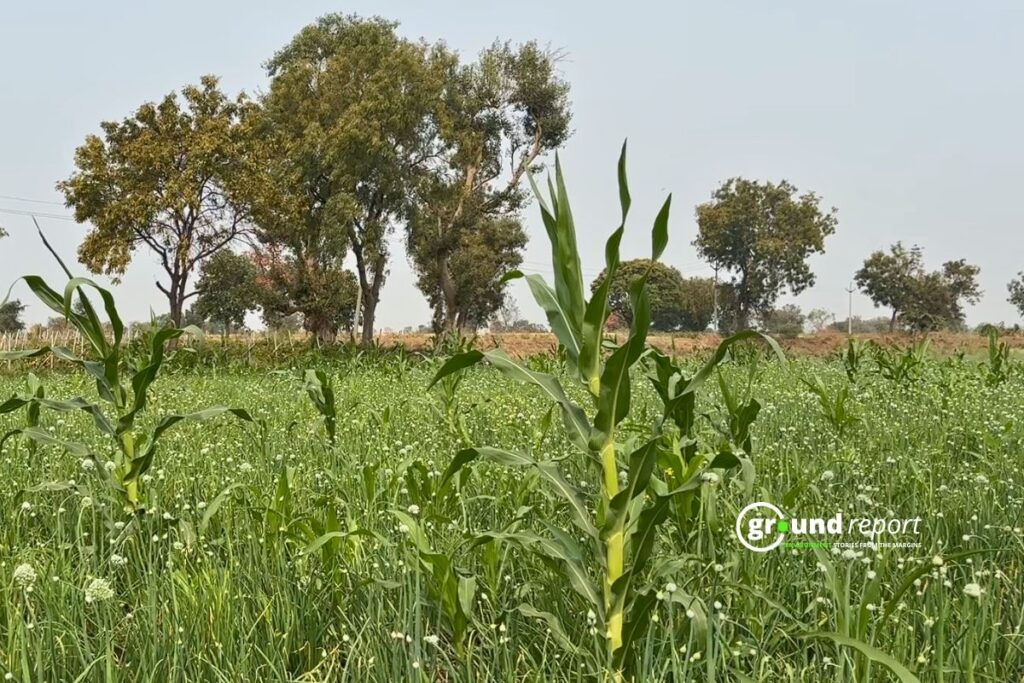
Bhanu plants corn plants along the edges of his onion crop and marigold plants among the chilli as host plants. This makes early identification of pests and dealing with them in the initial days much easier.
Dr. S.K. Singh, Senior Scientist (Extension) at Krishi Vigyan Kendra (KVK) Khargone, explains that whitefly is attracted to yellow colour, which is why marigold flowers are effective: “When marigold flowers are present, whitefly is attracted to the flowers rather than the chilli. When the farmer periodically removes these flowers from the field, the fly is managed.”
Besides marigolds, farmers also use yellow sticky traps, which attract and trap insects on contact.
Rather than sowing the same crop in the same field every year, these farmers rotate their crops every season.
Dr. Singh recommends deep ploughing before starting chilli cultivation in the summer. This would ensure that pest eggs in the soil are destroyed. These farmers also plant large trees in their fields, which push birds to eat pest larvae.
Sanjay Patidar, who cultivates chilli on 5 acres, uses silver-black mulch. The black side of the mulch film faces the ground while the silver side faces upward. Dr. Singh explains that the silver colour reflects sunlight, which disorients thrips, spider mites, and whitefly.
Sanjay previously used pesticides based on Profenofos, Acephate, and Triazophos. That caused him itching, headaches, and cold-like symptoms. Now he uses alternatives like neem oil and cow dung manure.
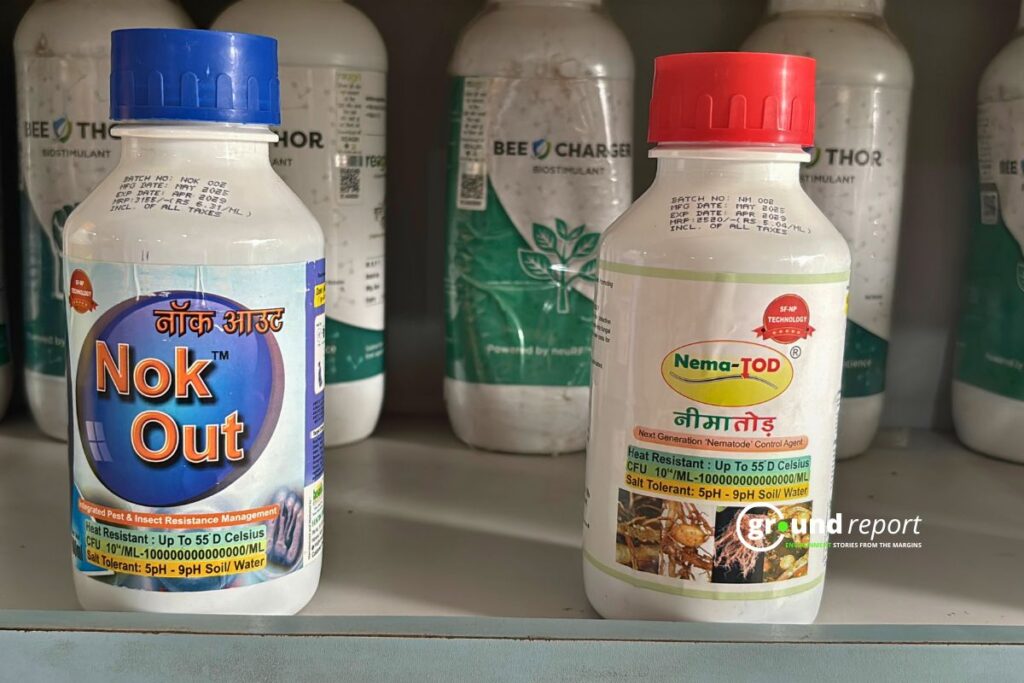
That said, farmers associated with this FPO don’t entirely stop using chemical pesticides. Instead, the FPO provides them with a list of pesticides that are less harmful to the body and soil. Praveen has sprayed his five-month tomato crop only 10–15 times, compared to the 25–30 rounds of spraying he used to do earlier.
Impact on Costs
Sanjay used to spend an average of Rs 18,000 per acre on pesticides, which has dropped to Rs 7,000. Similarly, Bhanu Kumar, with mulching and labour costs, invests Rs 35,000 per acre and produces an estimated 90 quintals of green chilli. Kumar says that even with chemicals, farmers achieve the same yield.
Prof. Rajinder Peshin of Sher-e-Kashmir University of Agricultural Sciences and Technology (SKUAST), Jammu, has authored four books on IPM. He notes in his analysis of multiple studies that implementing IPM programmes reduces pesticide use by 21 to 100 percent. His analysis covers research from different parts of the country on vegetables as well as cotton, paddy, and pulses.
A study conducted in Jammu & Kashmir between 2008 and 2016, however, also shows pesticide use increasing in some cases.
Dr. Reddy concedes that IPM can cut spending on pesticides and other inputs. The trade-off, he says, is labour. The approach requires more time and hands-on management, making it difficult for many farmers to adopt on their own.
How Many Farmers Has IPM Reached?
To limit pesticide dependence, India first began IPM-related research for cotton and paddy in 1974. The National Research Centre for Integrated Pest Management (ICAR-NRIIPM) was established in 1988. Today, 36 Central Integrated Pest Management Centres operate across the country, including two in Madhya Pradesh.
Despite this, IPM farming covers at most seven million hectares in India, i.e., only 3 to 5 percent of agricultural land. Between 2019 and 2023, farmer training programmes contracted, as both training targets and actual participation dropped.
Dr. Singh says the KVK conducts its own training programmes and field demonstrations to promote Integrated Pest Management (IPM). There is no support from the Central Integrated Pest Management Centre in Indore.
Pramel Kumar Gupta, who has worked on IPM since 2007, says a shortage of field staff at KVKs has limited the programme’s reach. He argues that scaling up IPM adoption was intended to be led by the National Research Centre for Integrated Pest Management ( NRIIPM). The expansion has not materialised at the required scale.
Dr. Reddy argues that Indian agriculture has changed significantly since IPM was first promoted in 1988. Like the introduction of Bt cotton, newer crop varieties, and the emergence of new pest challenges. He says the approach needs fresh research and adaptation to remain effective under current farming conditions.
One organisation that promotes IPM is the Nimad Fresh Farmer Producer Organisation (FPO), and receives support from the National Bank for Agriculture and Rural Development (NABARD). According to Vijendra Dinkar Patil, NABARD’s Assistant Manager and District Development Manager for Khargone, the FPO has been sanctioned ₹18 lakh over three years, in addition to support through matching equity grants and the NabSanrakshan programme.
Singh believes wider adoption of IPM will depend on farmers receiving better returns for their produce. This can happen through FPOs, contract farming arrangements, or other market linkages—Singh says IPM will become not only economically viable but increasingly necessary.
Support Us To Sustain Independent Environmental Journalism In India.
More Ground Reports
He Was Married as a Child, Now Manish Dangi Helps Stop It for Others
Despite The Ban, How Gutkha Became MP’s Most Common Household Habit