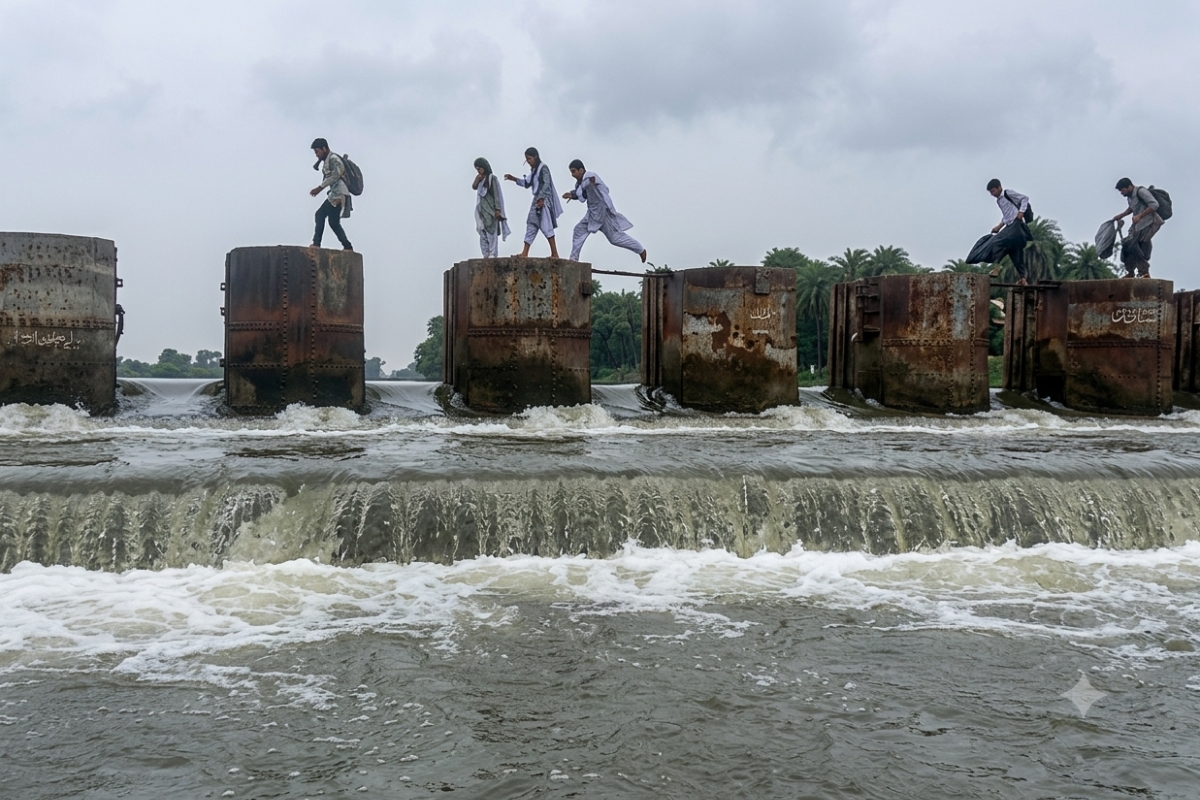
A video from Madhya Pradesh’s Vidisha district recently went viral. It showed around nine children risking their lives to reach school by climbing over the high walls of a stop-dam on the Betwa River.
After completing middle school, i.e., till Class 8, the nearest high school with Classes 9 and 10 was so far away that the children saw the shortcut across the dam as their only practical option.
The issue affected three gram panchayats in Vidisha district: Jiwajipur, Mundra Harisingh, and Kirmichi Bandhera.
The Long Way Round
Anmol Singh, secretary of the Kirmichi Bandhera panchayat, said children from his village had to travel to Paloh village in Jiwajipur to attend high school. The school by the main road was 18 kilometres one way, or 36 kilometres every day. To avoid the exhausting commute, the children used a shortcut across the stop-dam.
Durgaprasad Sharma, secretary of the Mundra Harisingh panchayat, said children from Imaliya and Kakraua also travelled about 14 kilometres by road. That route included a dangerous railway crossing.
Around ten years ago, a stop-dam was built on the Betwa River to meet the irrigation needs of local farmers. The river between the villages dries up in summer. After the monsoon, however, water remained knee-deep until Diwali, making the crossing difficult. To avoid the long journey and unsafe roads, the children climbed over the walls of the stop-dam.
The administration had provided bicycles, but cycling 30 to 36 kilometres every day was simply not practical for schoolchildren.
Five to Six Children Dropped Out Every Year
Bhagwan Singh Rawat, a teacher at Government Middle School, Kirmichi Bandhera, shared his experience.
“This year, 12 children from our school passed Class 8. Of them, five stayed home and did not continue their studies because they were afraid of the distance and the route. Class 8 began at this school in 2007, and I have been posted here since 2009. Looking at the records since then, an average of five to six children who pass Class 8 drop out of school for good every year. This is only an estimated figure. In reality, the number of children who drop out could be even higher.”
Vidisha’s problem reflected a structural gap that ran through India’s entire school system.
Nationally, only about 5.4% of schools offered continuous schooling from Grade 1 to Grade 12. Half of India’s schools offered only primary education. This meant most children had to change schools at least once, often to schools much further from home, as they moved from primary to middle to secondary levels.
In Vidisha, the district’s 2,543 schools in 2025–26, 2,153 stopped at Class 8 or below: 1,202 taught only the primary grades, 801 covered Classes 1 to 8, and another 150 covered just Classes 6 to 8. That left only 390 schools across the entire district, roughly 15% of the total, offering classes at the secondary level (9 and 10) at all, whether alone or bundled into a longer 1-to-10, 6-to-10, or higher-secondary structure.
While every child who finished the foundational stage moved on to the preparatory stage, the transition rate from middle to secondary school was just 72.5%. That meant roughly 27.5% of eligible Vidisha students did not move on to secondary education at all.
Within Vidisha alone, 33,392 students migrated between schools of different levels in the same district in 2025–26, mostly moving from primary or upper-primary schools toward secondary and higher secondary schools. A further 1,888 students migrated to schools in other districts of the state, and 127 crossed state lines altogether.
Administration’s Response
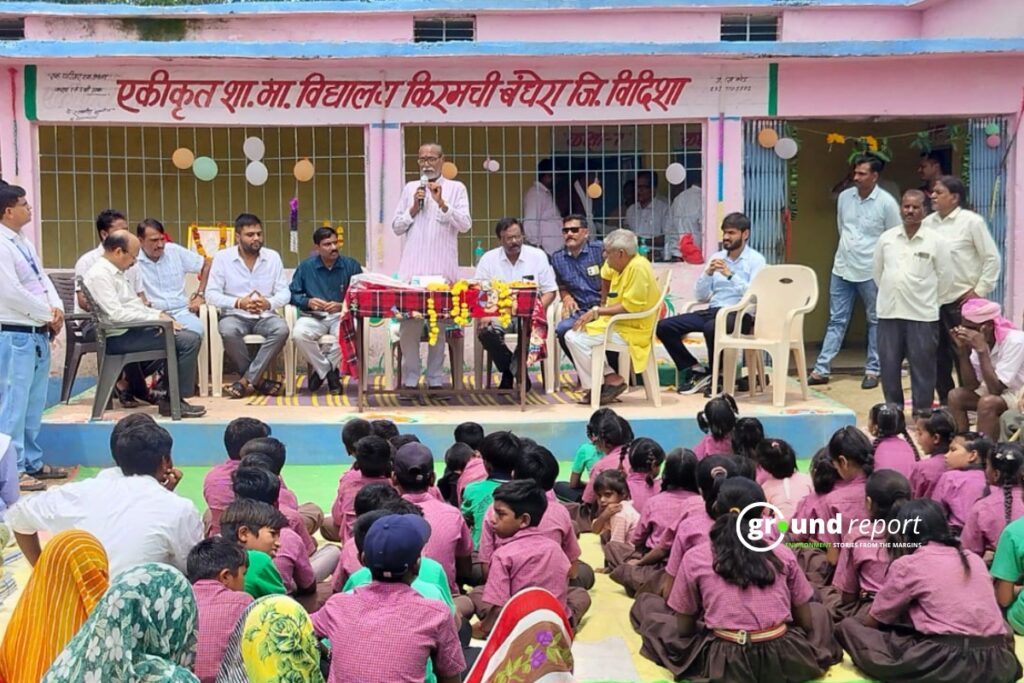
Ground Report spoke to Vidisha District Education Officer (DEO) Narendra Kumar Ahirwar. He pointed to both government norms and local circumstances.
“According to the rules, the distance to a high school from any village should be a maximum of seven kilometres,” Ahirwar said. “Earlier, kids crossed the Betwa River through a temporary stone pathway. This time, the stones washed away during the rains. That created problems for the children, and the matter came to our attention.”
After the video went viral and the issue received public attention, an alternative arrangement for the temporary upgrade of Government Middle School, Kirmichi Bandhera, into a high school was made with immediate effect.
Under a decision approved by the commissioner in August 2026, permission was granted to start Classes 9 and 10 at the school with immediate effect from the 2026–27 academic session.
“On the very first day, four children from the area took admission. Our teachers are now conducting door-to-door surveys to bring all such children back into mainstream education. After this, a proposal will also be sent to the government for a permanent school building.”
To ensure teaching could begin without delay, the DEO made a temporary arrangement by posting two teachers. Mukesh Sharma, a middle school teacher, was assigned to teach social science, while Vimal Rathore, also a middle school teacher, was assigned mathematics.
The High Court Steps In
The Madhya Pradesh High Court took cognisance of the matter as a Public Interest Litigation after the video went viral, with a division bench of Acting Chief Justice Vivek Rusia and Justice Pranay Verma hearing the case.
When the state government informed the court that the middle school at Kirmichi Bandhera had been proposed for an upgrade to a high school, the bench expressed displeasure, questioning how two teachers could teach every subject at the school and noting that this would adversely affect the students’ education.
The court appointed senior advocate Naman Nagrath and advocate Himanshu Mishra as amicus curiae to advise on building a bridge or a stop-dam to provide children with safe passage across the river.
It issued notices to the state’s chief secretary, the principal secretary of the Public Works Department, and the Vidisha Collector, directing them to file a status report. The matter was listed for its next hearing in September.
The National Human Rights Commission also took suo motu notice of the case, stating that if the reports were true, they raised serious human rights concerns.
Reasons Weigh Against Girls
According to the NFHS-6 (2023–24) fact sheet, school education continued to face major challenges in rural India. Only 69.2 per cent of children aged six years and above in rural areas had ever attended school.
As per NFHS-5, among rural girls who dropped out, 7.0 per cent cited “school being too far” as the primary reason, while another 1.7 per cent cited a lack of transport. In comparison, only 1.9 per cent of rural boys cited distance as the main reason for dropping out.
Nationally, the single biggest reason cited was disinterest in studies, reported for 35.7 per cent of boys and 21.4 per cent of girls, followed by cost, at 16 per cent for boys and 20 per cent for girls.
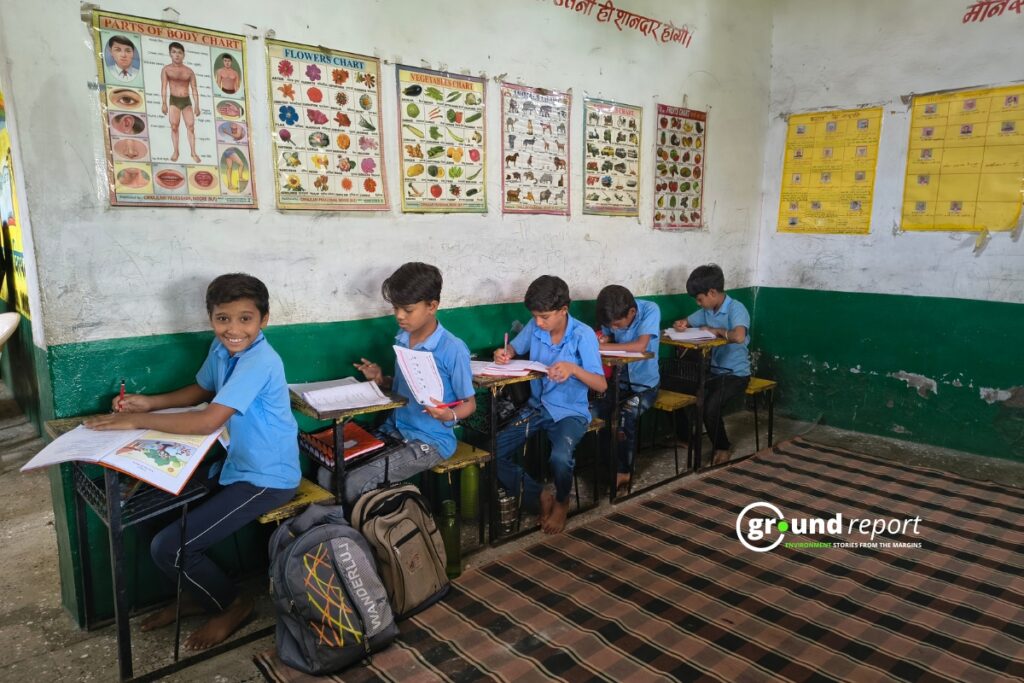
Distance was not the leading national driver of dropout, but where it applied, it applied almost entirely to girls. Marriage, by contrast, accounted for roughly 7 per cent of girls’ dropouts and just 0.3 per cent of boys’, while household work claimed 13 per cent of girls against 10 per cent of boys.
Trends
The latest UDISE+ (Unified District Information System for Education Plus) report released by the Ministry of Education presented both encouraging and concerning trends in school education across India.
At the national level, the secondary school dropout rate declined from 8.2% in 2024–25 to 7.0% in 2025–26, while the transition rate from Class 8 to secondary education improved from 86.6% to 88.3%. During the same period, the number of schools declined by 4,791.
However, Madhya Pradesh continues to lag behind the national average; its secondary dropout rate stood at 11.0% in 2025–26. The rate is higher among boys (12.6%) than girls (9.3%), and the number of schools declined by 2,426.
At the district level, in Vidisha, the number of schools declined from 2,594 to 2,543, a reduction of 51 schools. Infrastructure coverage improved: electricity coverage rose from 86.89% to 92.8%, while 100% of schools reported access to drinking water.
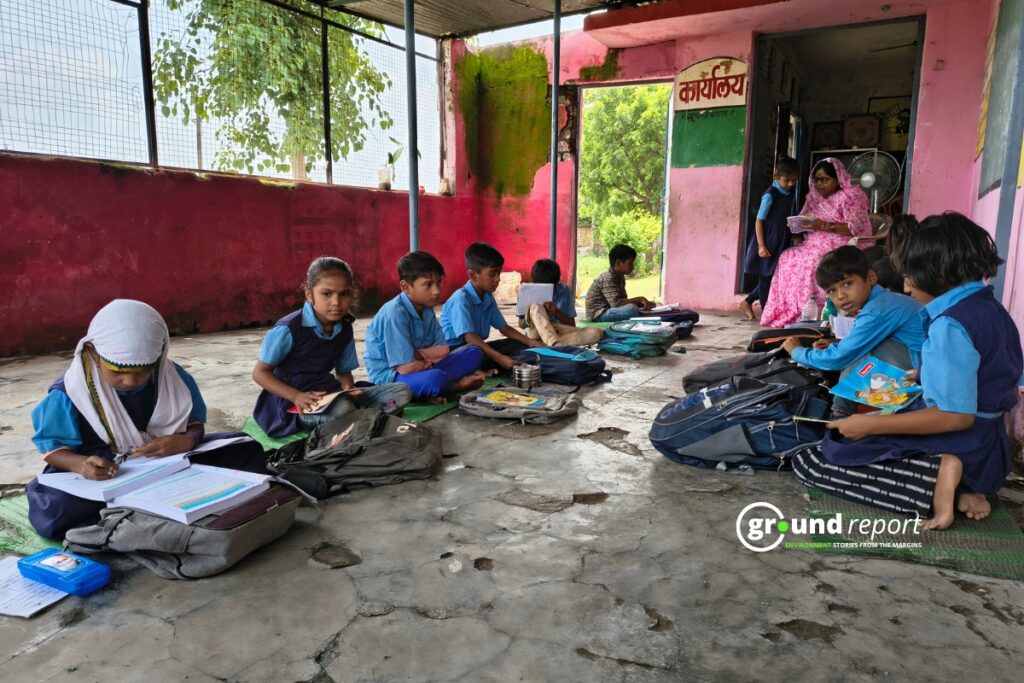
A NITI Aayog analysis found that Madhya Pradesh’s Gross Enrolment Ratio, at the secondary level, stood at just 68.2% in 2024–25, placing the state among the five weakest performers in the country, behind only Bihar, Nagaland, Uttar Pradesh, and Jammu & Kashmir.
GER measures the ratio of children enrolled at a given school stage against the total number of children who are officially the right age for that stage.
At the higher secondary level, the picture was worse still. Madhya Pradesh’s GER of 45.0% put it among the bottom seven states nationally, well short of the national average of 58.4%. In other words, fewer than half of Madhya Pradesh’s eligible teenagers were enrolled in Classes 11 and 12 at all.
What Comes Next
For now, the stop-dam remains closed to foot traffic, and watchmen have been posted to keep children off it. Four students have enrolled at the newly upgraded high school, and teachers are going door to door to find the others, the ones who stopped counting themselves as students after Class 8. Whether they come back will depend on what the High Court’s amicus curiae recommends, and on whether Bhopal follows through with a bridge, a proper stop-dam crossing, or the permanent school building the DEO has promised to propose.
Until then, the two teachers posted to Kirmichi Bandhera will still be trying to teach every subject to two full grades. The next hearing is in September.
Support Us To Sustain Independent Environmental Journalism In India.
More Ground Reports
How much did the country’s first ‘Samriddhi Kendra’ live up to its promises?
How the Country’s First ‘Green PM Awas’ Was Built, and Will Others Follow?
Stay Connected With Ground Report For Underreported
Author
Support Ground Report to keep independent environmental journalism alive in India
We believe climate change should be the basis of current discourse, and our stories attempt to reflect the same.
Connect With Us
Send your feedback at greport2018@gmail.com
Newsletter
Subscribe our weekly free newsletter on Substack to get tailored content directly to your inbox.
When you pay, you ensure that we are able to produce on-ground underreported environmental stories and keep them free-to-read for those who can’t pay. In exchange, you get exclusive benefits.
Your support amplifies voices too often overlooked, thank you for being part of the movement.