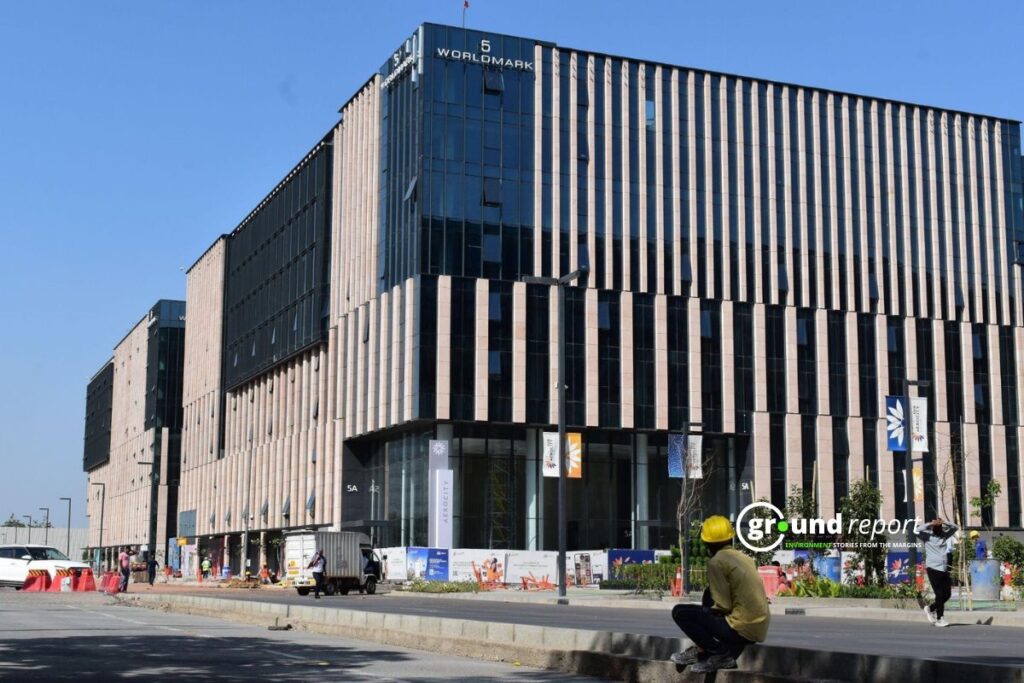
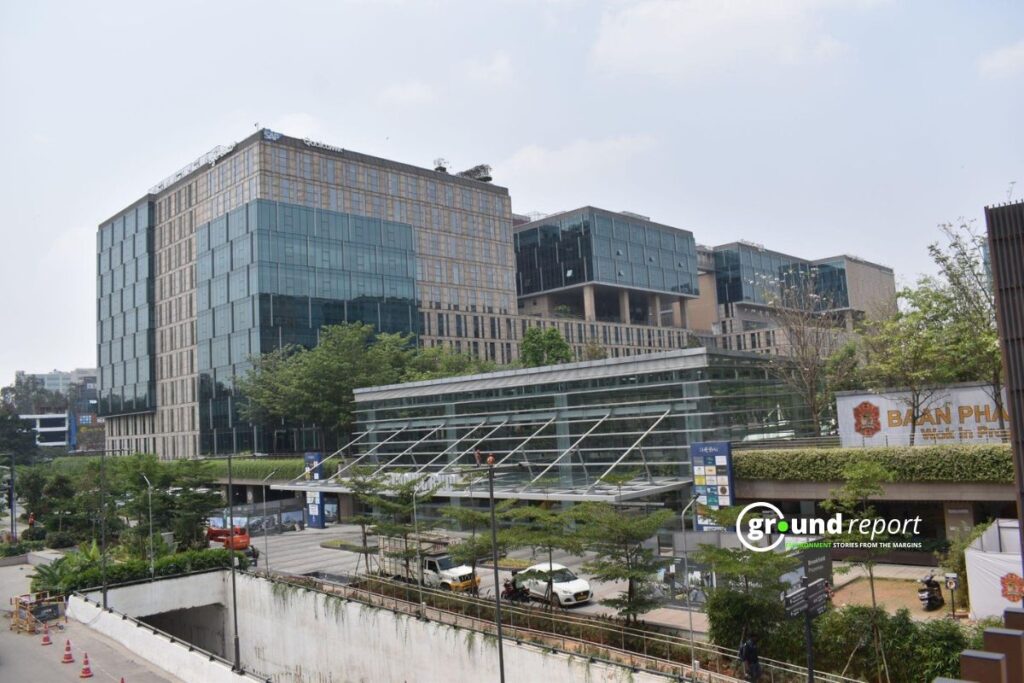
In Delhi’s Aerocity, close to the Indira Gandhi International Airport, Nand Kishore, a 50-year-old construction worker from Munger, Bihar, squats on a concrete divider to rest for a few minutes. Behind him are glass-and-steel towers housing corporate offices, restaurants, retail stores, and showrooms.
“It’s only the beginning of summer, but it already feels too hot,” Kishore says. By afternoon, “the glass buildings around the site throw heat back onto the roads, and the concrete roads and floors also become very hot.”
After a short rest, he will return to work at Aerocity’s Worldmark complex, a glass-and-steel district near Delhi airport. Soon, these under-construction buildings will have centralized air conditioning to beat the city’s rising temperature. Though the irony is palpable. For people who build these spaces, there is no refuge from heat.
Delhi’s urban heat crisis has grown alongside the city’s long-term physical expansion. A 2024 study published in Heliyon found that Delhi’s built-up area increased from 7.67% of the city’s area in 1977 to 38.28% in 2014 and is projected to reach 53.83% by 2030. The study says this expansion is happening largely at the cost of cultivable land, forests, and wasteland.
A 2025 study, Mapping Heat Inequality Across Neighborhoods in Delhi, says that when built-up surface area increases from roughly 25% to 55%, experienced temperatures rise by about 0.6°C. In contrast, increasing tree cover from just 3% to 11% lowers experienced heat by approximately 1°C.
Noida and Gurugram are among the NCR’s major corporate corridors. Real estate consultancy Jones Lang LaSalle (JLL) notes that DLF Cyber City’s office developments helped turn Gurugram into a magnet for MNCs between 2000 and 2010, while Uttar Pradesh is now developing data centre parks in Noida, Greater Noida, and the Yamuna Expressway region.
Nearly 2,000 km south, Bangalore, touted as India’s Silicon Valley, was once famous for its pleasant climate, but it is now prioritizing its urban infrastructure, which has intensified heat stress across parts of the city.
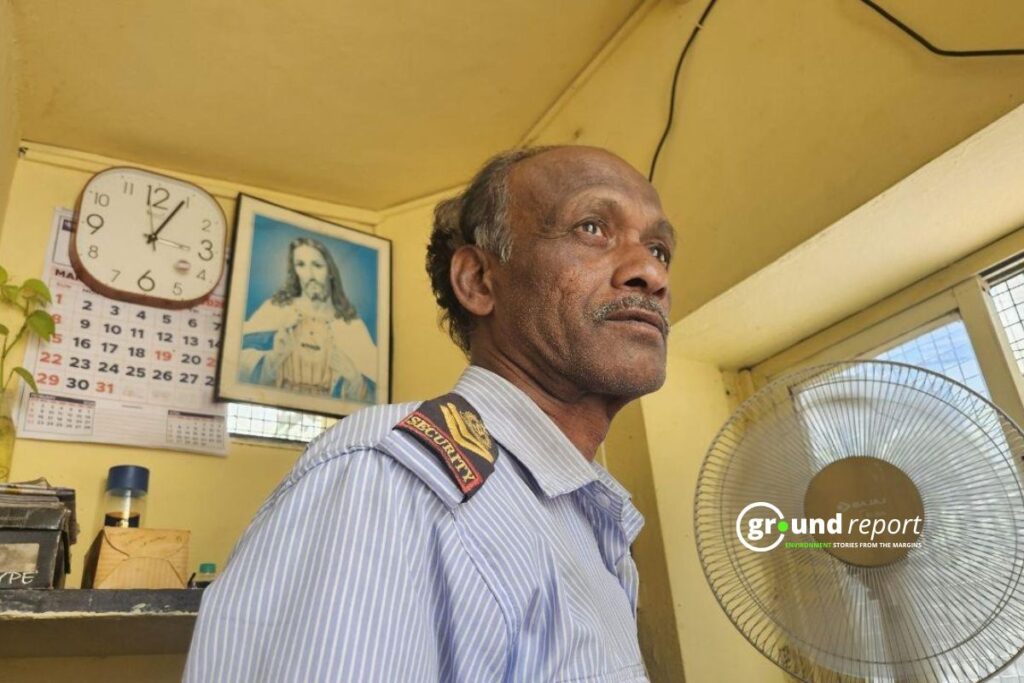
K. Prakash works as a security guard at the Indian Social Institute in Bengaluru. “I don’t remember using a fan in March or April in this city. Earlier, Bengaluru was called an ‘air-conditioned city’,” the 55-year-old says. Prakash works in a part of the city where trees still offer some shade. But when he visits areas such as Whitefield, Bellandur, or Marathahalli, he says the landscape feels different. “There are many IT parks and tech villages. I see a big change there,” he says.
Bengaluru’s expansion is visible in long-term land-use data.
A Times of India report citing IISc researchers says the city’s built-up area rose from around 8% in 1973 to 87.6% in 2025, while green cover, open spaces, and water bodies declined sharply.
From Delhi’s glass-and-steel commercial hubs to Bengaluru’s expanding tech corridors, India’s urban growth is reshaping how heat is experienced in cities. Through reporting from Delhi and Bengaluru, this story sees how concrete-heavy infrastructure, shrinking green cover, and climate-insensitive urban development are intensifying heat exposure for workers and residents.
Urban Heat Island
What Kishore, Kashyap, and Prakash describe is linked to the urban heat island effect. The dense urban areas become hotter than the surrounding regions because concrete, asphalt, glass, and metal absorb heat during the day and release it slowly later. Trees and water bodies, which otherwise cool the air through shade and moisture, are increasingly replaced by buildings, roads, parking lots, and paved surfaces.
Dr. Vijayalaxmi Kasinath, a professor at the School of Planning and Architecture, says modern construction materials such as concrete, steel, and glass have a quality called “thermal lag”: they absorb heat during the day and release it slowly after sunset. This is one reason cities remain hot even at night.
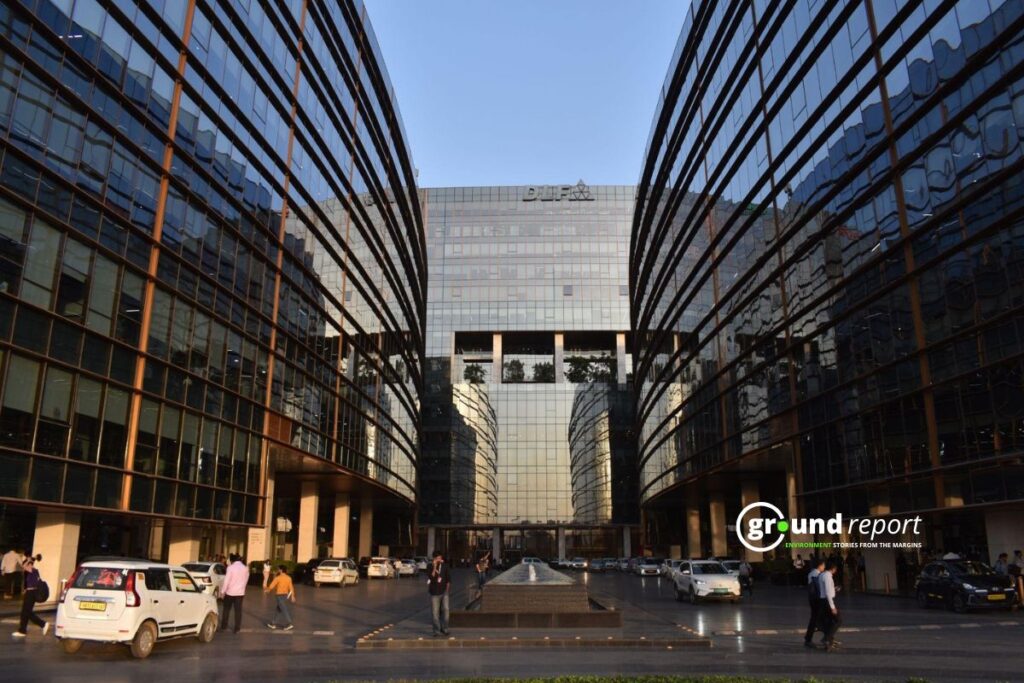
Glass-heavy buildings add another layer. Reflective glass may reduce heat entering the building and cut electricity bills inside, she says, but it pushes heat outward, making streets and open spaces around it hotter.
A 2025 report by the Council on Energy, Environment, and Water says nights are heating up faster than days across India; nearly 70% of districts recorded at least five additional very warm nights every summer between 2012 and 2022. In contrast, only around 28% of districts saw a similar rise in extremely hot days.
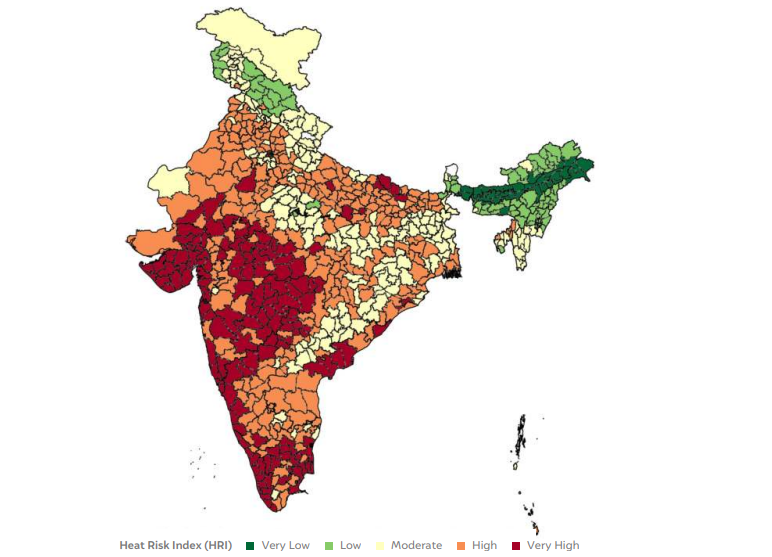
In the last decade alone, Bengaluru recorded around 11 additional very warm nights per summer, while Delhi saw six. Researchers warn that warmer nights are particularly dangerous because the human body does not get enough time to recover from daytime heat exposure.
Zohra Mutabanna, a specialist in sustainable urban growth and mobility, says much of the urban heat island effect seen in Indian cities today is a consequence of planning and design decisions. According to her, the problem lies in how cities themselves are expanding.
Mutabanna says private developers must be held accountable for the materials they use, the construction methods they follow, and the way they design landscapes around large projects. Mutabanna also says many large private developments are designed to maintain indoor comfort through advanced cooling systems, while overlooking their impact on outdoor heat exposure.
But she adds that heat resilience also depends heavily on government planning decisions, including how much green cover is protected in public spaces, whether trees are cut for infrastructure, and whether construction is allowed over water channels or forested areas. Large concrete roads and asphalt surfaces, she says, hold more heat and intensify the urban heat island effect.
Health Implications
Heat exposure increases the risk of heat stress, heatstroke, and complications linked to hypertension and diabetes, especially among elderly people, outdoor workers, children, and low-income communities.
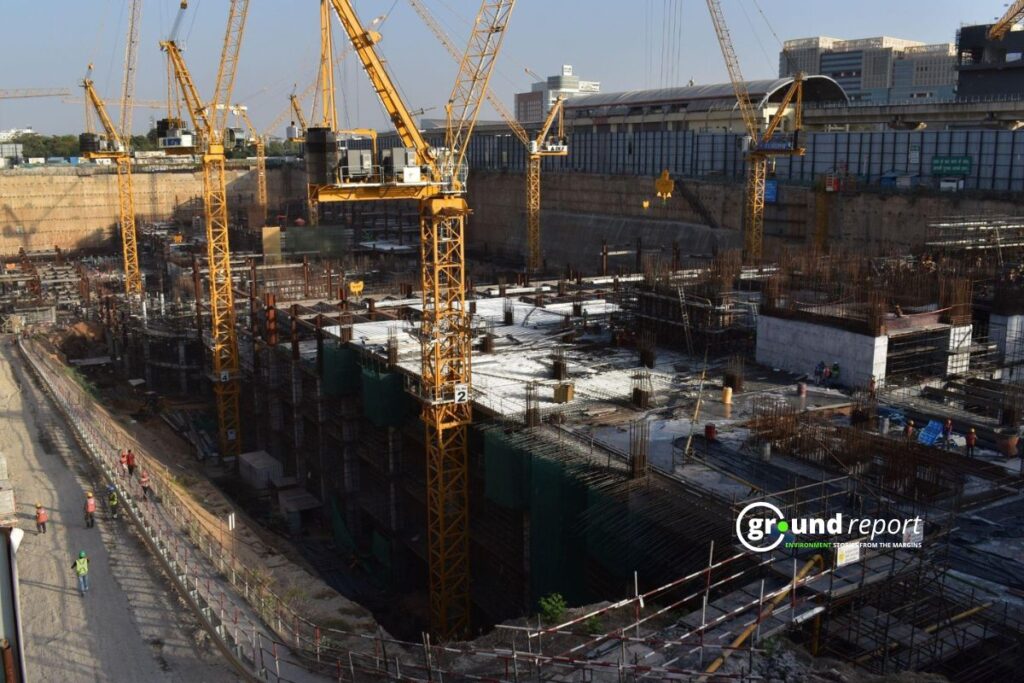
A 2025 report by the Lancet Countdown, focused on India, warns that rising heat is becoming a major public health and labour crisis. In 2024 alone, extreme heat led to the loss of an estimated 247 billion labour hours across India. The construction sector accounted for nearly one-fifth of these losses. Researchers estimate that the economic impact linked to reduced work capacity due to heat reached nearly USD 194 billion last year.
Delhi’s “Master Plan”
Delhi’s draft Master Plan 2041 mentions combating urban heat islands through mass tree planting, expanding green-blue infrastructure, energy-efficient buildings, and climate-resilient development. But Dr. Syamal Kumar Sarkar, senior adviser at TERI and former secretary of the Ministry of Water Resources, Government of India, says the gap lies in implementation.
“In theory, it is being talked about. But in reality, there are a lot of things to be done,” Sarkar says. According to him, Indian cities need more urban forests, water bodies, green roofs, and cool roof materials. He adds that water bodies remain one of the most neglected parts of urban climate planning despite their cooling effect.
Sarkar says private developers can move from “reactive cooling” to preventive measures such as green real estate development, but argues that monitoring and implementation remain weak. “Who is monitoring their performance?” he asks.
Some green-building examples show that it is possible to design large public buildings in ways that respond to heat. Delhi’s Indira Paryavaran Bhawan, described by The Energy and Resources Institute (TERI) and the Association for Development and Research of Sustainable Habitats (ADaRSH) as India’s first net-zero energy building, was designed to reduce both energy use and heat stress.
Instead of depending only on artificial cooling, the building uses natural daylight, rooftop solar power, reflective roof tiles, recycled and locally available materials, and windows that reduce heat entering from outside.
It also saves water by recycling wastewater, collecting rainwater, and using plants that need less water. According to TERI, only 30% of the total site is covered by the building, while more than half of the outdoor area has been kept open with plantation and grass cover. The project achieved around 40% energy savings and complies with India’s Energy Conservation Building Code.
Singapore offers one example of how a dense, highly urbanised city is trying to respond to rising heat through planning and technology. A World Bank note says the city has three broad approaches: creating more shade and wind corridors, reducing heat absorbed by buildings and roads, and cutting heat released from vehicles and air-conditioning systems.
On the ground, these measures can mean more shaded walkways, trees along streets, lighter-coloured roofs and pavements that absorb less heat, buildings designed to allow wind movement, and cooling systems that serve several buildings together instead of every building depending only on individual air-conditioners. Singapore has also used heat maps to identify where the city is getting hotter so planners can decide where more shade, greenery, or cooling measures are needed.
Kasinath says India already has examples of climate-sensitive buildings. But they remain exceptions because most commercial developments are driven by cost, speed of construction, and corporate image. Glass façades and sealed air-conditioned interiors are often preferred. “In many fast-growing commercial areas, the dominant model still relies on glass façades, large paved surfaces, air-conditioned interiors, and limited shade outside,” she says.
After all, they project a modern look and make indoor cooling easier to control, but they do little for people outside the building.
Ground Report also reached out to major developers and infrastructure firms, including Tata Projects and DLF, with questions related to heat-risk planning, worker protections, and climate-sensitive design. No responses were received at the time of publication. The story will be updated if the companies respond later.
This story was produced with support from Internews’ Earth Journalism Network.
Edited by Rajeev Tyagi
Support Us To Sustain Independent Environmental Journalism In India.
More Ground Reports
He Was Married as a Child, Now Manish Dangi Helps Stop It for Others
Despite The Ban, How Gutkha Became MP’s Most Common Household Habit
Stay Connected With Ground Report For Underreported Environmental Stories.
Support Ground Report to keep independent environmental journalism alive in India
We believe climate change should be the basis of current discourse, and our stories attempt to reflect the same.
Connect With Us
Send your feedback at greport2018@gmail.com
Newsletter
Subscribe our weekly free newsletter on Substack to get tailored content directly to your inbox.
When you pay, you ensure that we are able to produce on-ground underreported environmental stories and keep them free-to-read for those who can’t pay. In exchange, you get exclusive benefits.
Your support amplifies voices too often overlooked, thank you for being part of the movement.