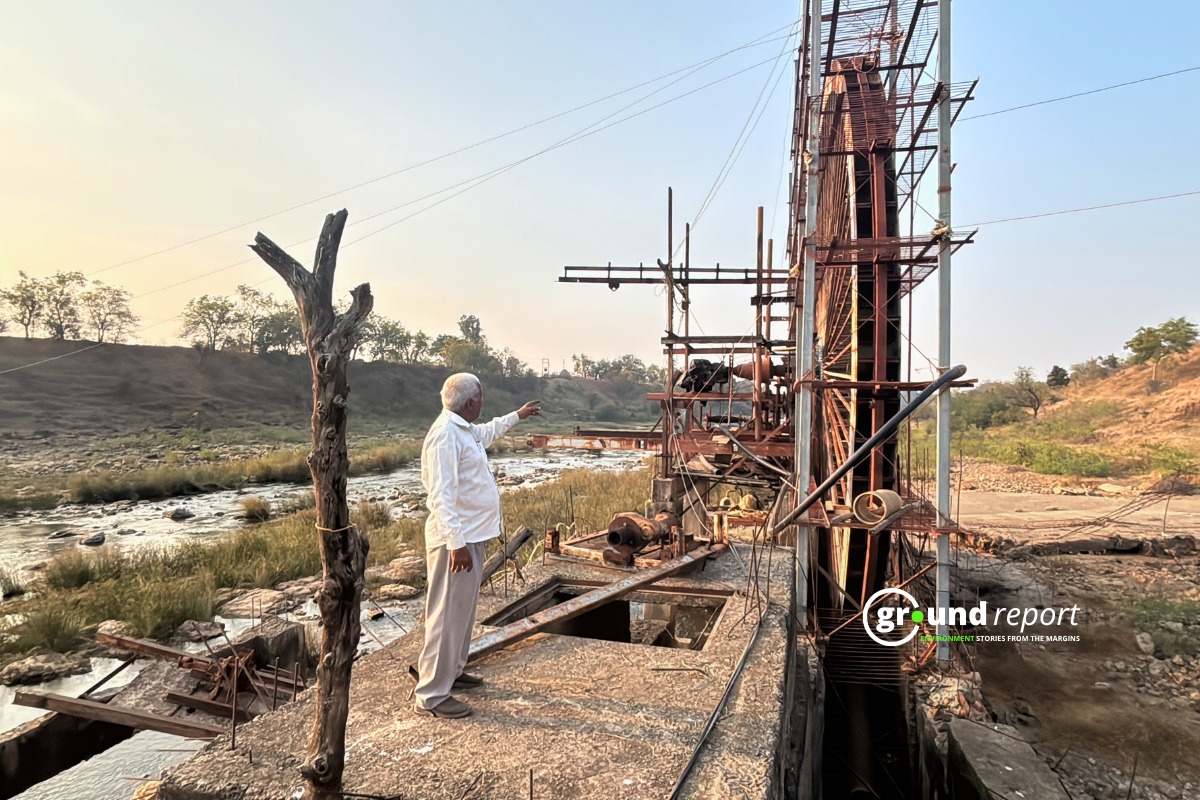
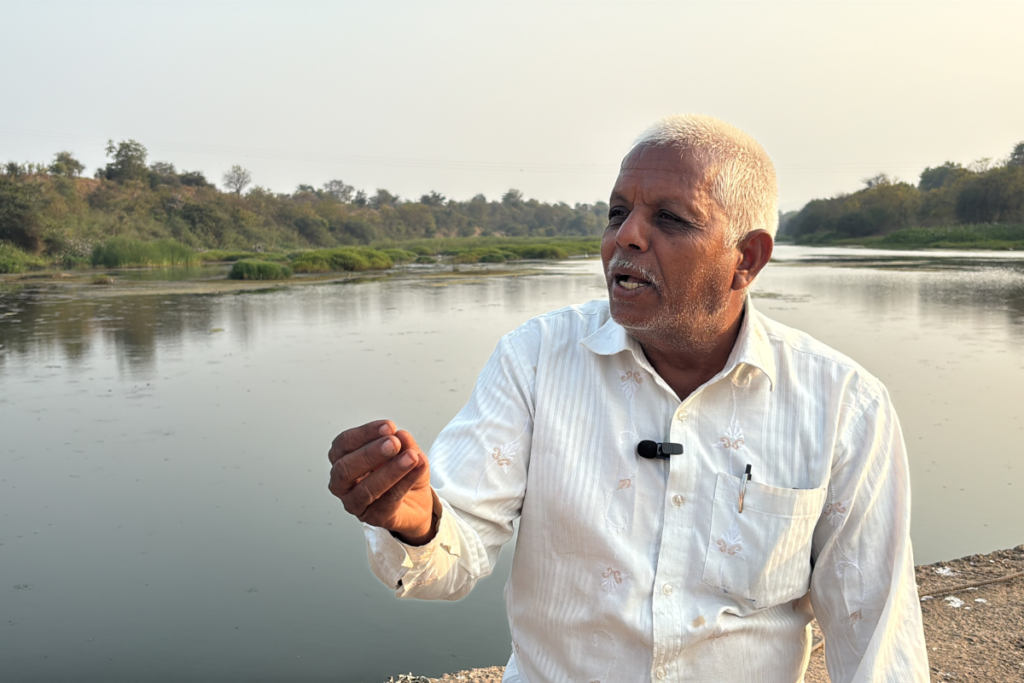
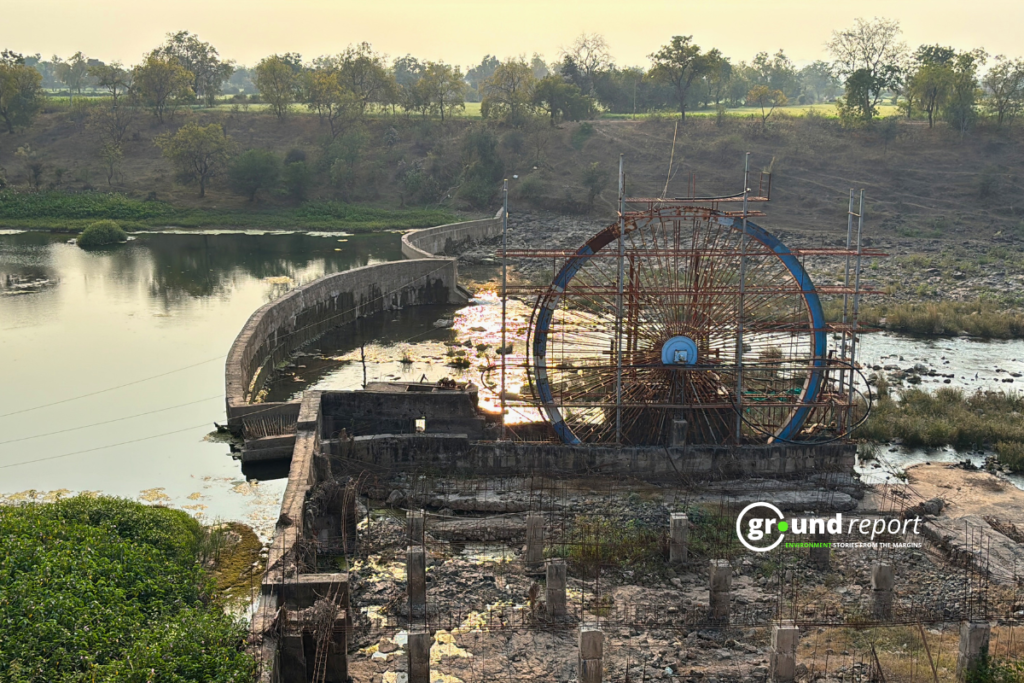
Mohanlal Jangde, 60, stands on a hillside overlooking the Kunda River near Badi Khurd village, about 21 kilometres from Khargone. Below him, 3 meters high, 500 meters long dam cuts across the narrow valley. In front of it sits a massive turbine, untouched by time, even as parts of the surrounding infrastructure have crumbled. The hydropower project was never completed.
Jangde built the 100-kilowatt (1×0.10 MW) hydropower project himself. His goal was to generate electricity for nearby villages while ensuring that the water remained available through the summer. Today, farmers regularly draw water from the dam whenever they need it. But the turbines have never produced a single unit of electricity.
In 2009, Jangde, a civil contractor, decided to build the dam on his own initiative and later applied for support under a central government scheme for small hydropower projects. Under the program, he had to contribute at least 20% of the project cost, with the central government covering the remainder.
But approvals were delayed, the scheme lapsed, and the promised grant never arrived. More than a decade later, Jangde is still asking the government to release the funds so he can complete the project.
A funeral that sparked an idea
Jangde says that in 2009, after his father’s death, he came to the banks of the Kunda River for the head-shaving ritual performed as part of the funeral rites. At the time, most of the river was dry.
At the time, the village received electricity for only four to five hours a day. With the river dry, residents had no choice but to climb the valley to fetch water.
As a civil contractor, Jangde believed a small dam could solve both problems at once; store water through the dry months and generate electricity for surrounding villages.
Months later, in December 2009, the Ministry of New and Renewable Energy launched its Small Hydro Power (SHP) Programme to promote hydropower projects of up to 25 MW.
The scheme encouraged state agencies and independent private producers to develop small hydro projects and tap India’s estimated 21,000 MW of small hydropower potential.
Micro-hydel projects of up to 100 kW were eligible for central financial assistance of ₹40,000 per kilowatt, provided developers contributed at least 20% of the project cost.
Jangde said he was unaware of the scheme when he first conceived the idea. It was only after approaching local officials to prepare a Detailed Project Report (DPR) that he learned his project could receive nearly ₹40 lakh in central assistance.
Approvals came, but too late
In 2011, Jangde submitted a proposal to the central government. The project was estimated to cost ₹60.87 lakh, of which he expected ₹40 lakh in central support. The then-local MLA, Jamuna Singh Solanki, also recommended the proposal.
However, the original SHP programme ended on March 31, 2012. According to documents obtained by Ground Report, Jangde’s project was approved only in February 2013 under Madhya Pradesh’s 2011 policy for implementing small hydel projects.
A year later, in July 2014, the Centre revived the SHP programme. Under the revised guidelines, projects whose construction had begun on or before March 31, 2013, remained eligible for financial assistance under the earlier scheme.
On paper, Jangde still qualified for nearly ₹40 lakh in central support.
The missing Power Purchase Agreement
Yet another hurdle emerged. Although the project had been approved, Jangde had no Power Purchase Agreement (PPA), a prerequisite for selling electricity.
In a letter dated June 27, 2016, Mridul Khare, Deputy Secretary in Madhya Pradesh’s New and Renewable Energy Department, informed him that he first needed a PPA with the Madhya Pradesh Poorv Kshetra Vidyut Vitaran Company Limited (MPPKVVCL).
Jangde responded that electricity generated from the project would first supply nearby villages and flour mills, with surplus power fed into the Bhagwanpura grid through MPPKVVCL. He later informed the state government that MPPKVVCL Indore was preparing to sign the agreement.
The process took four years.
Finally, on March 21, 2017, Jangde signed a PPA with the MP Power Management Company and mailed it to the relevant central government office the following day.
Nine days later, on March 31, the SHP programme ended again.
When Jangde approached officials, he said they told him there was no active policy under which financial assistance could be released.
“The central government told us that when they make a new policy, they will include us. That new policy still hasn’t been made. Eight or nine years have passed. We kept waiting for a new policy, and because it still hasn’t come, the work remains stuck exactly where it was.”
Since 2017, he has written repeatedly to district, state, and central government authorities seeking the grant.
Water, but no electricity
Despite the funding deadlock, Jangde continued construction.
By 2023, he had built a dam about four metres high and nearly 650 feet wide, spending roughly ₹5 crore of his own money.
Jangde said the Kunda River no longer runs dry in April.
On April 4, 2023, during a public hearing before the Khargone Collector, Jangde requested that the Water Resources Department reimburse the cost of constructing the dam. He argued that the structure serves a public purpose and has community backing, including a Gram Sabha resolution and recommendations from three panchayats.
He later renewed the request in another letter to the collector.
Neelam Meda, executive engineer with the Water Resources Department in Khargone, rejected the demand.
“Our department only issued the No Objection Certificate (NOC) for this project. The project does not belong to our department, so the question of providing funds does not arise.”
She said the department constructs dams under its own schemes and also has programmes for check dams at the panchayat level. But there is no provision to fund a privately built dam intended for power generation.
Meanwhile, Rekha Rathore, who recently became the acting collector of Khargone, told us, “Please send me the information about this matter and I will look into it.” We sent her the details of the project and the person involved via text.
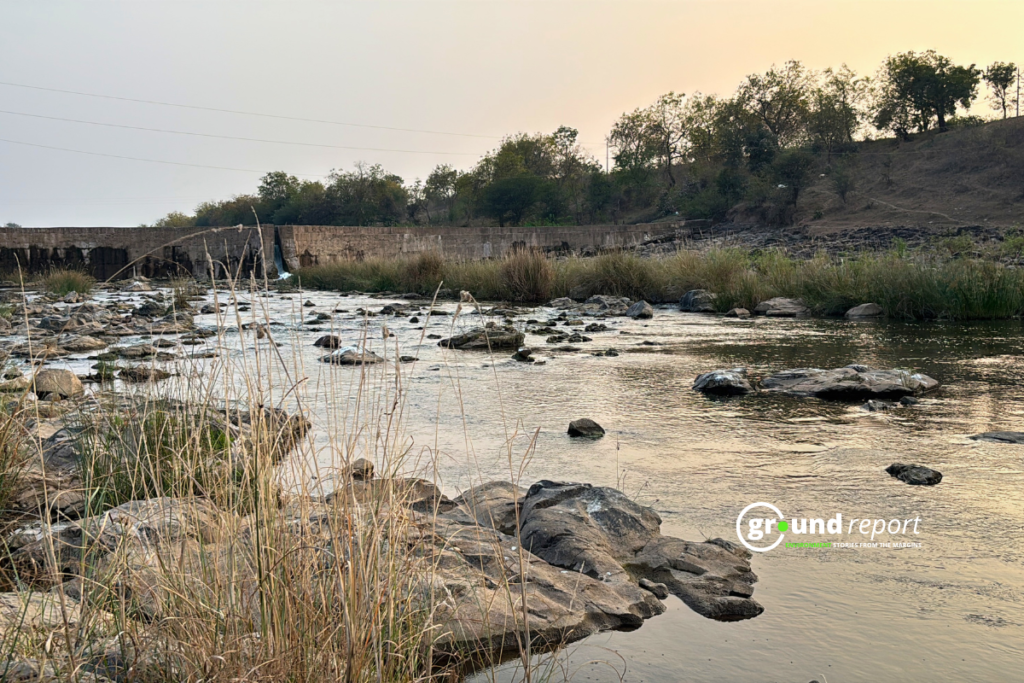
When Ground Report visited the site in February, farmers were drawing water from the reservoir, and others were fishing. One villager said water now lasts until mid-April, though shortages still begin in May.
In that sense, Jangde said, the project has achieved half its purpose, as it stores water. But without the remaining funds, it cannot generate electricity.
As of February 2026, the total installed capacity of small hydropower in India is 5,171.36 MW, while the installed capacity of large hydropower is 51,164.67 MW. Therefore, electricity production can be increased by focusing more on this sector.
The government launched the Small Hydropower Development Scheme in May. The government is planning to spend ₹2,584.60 crore on this scheme between 2026 and 2030. Therefore, it remains to be seen whether Mohanlal Jangde will be able to secure the funds to generate electricity.
Support Us To Sustain Independent Environmental Journalism In India.
More Ground Reports
He Was Married as a Child, Now Manish Dangi Helps Stop It for Others
Despite The Ban, How Gutkha Became MP’s Most Common Household Habit