
Rising temperatures are setting new records every year, and months are not far behind in increasing the heat compared to previous years. According to scientists at NASA’s Goddard Institute for Space Studies (GISS), keeping up with this trend of rising temperatures, September 2023 was the hottest September on record. This month also set a record for the highest temperature anomaly, where the greatest deviation from the long-term average was observed.
This shows global temperature anomalies along with the seasonal cycle. From January to December, the temperature increases from left to right, it increases during the warm months and shows a decrease in temperature during the cold months.
Each line’s color represents different years, with cool purple for the 1960s and warm orange and yellow for recent years. As each month’s height increases over time, we can see a trend of increase in long-term temperature. This trend results from human activities, which release greenhouse gases like carbon dioxide into the atmosphere.
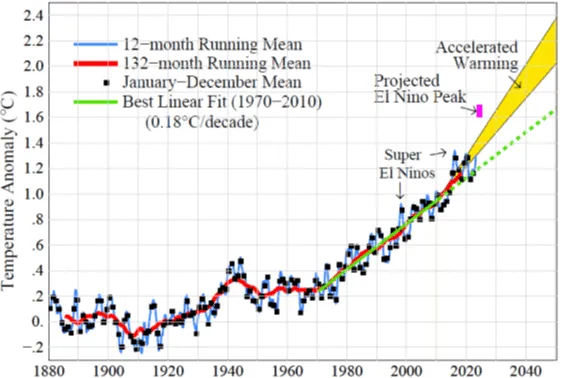
Referring to a press release, Gavin Schmidt, director of NASA’s Goddard Institute for Space Studies (GISS), said the biggest thing is that these records are happening before the current El Nino peak event. Whereas in 2016, the previous records were in spring after the peak.
/ground-report/media/post_attachments/wp-content/uploads/2023/10/septann2023.gif)
El Nino is the warm phase of a natural cycle of trade winds and sea temperature in the eastern tropical Pacific region that affects temperature and rainfall patterns worldwide.
What is Goddard?
The nation’s largest organization of scientists, engineers, and technologists uses Goddard, NASA’s premier space flight facility, for continuous study of Earth, Sun, our solar system, and universe by building spacecraft, instruments, and new technology.
It manages communication between mission control and astronauts orbiting on the International Space Station. Goddard scientists monitor the sun, provide information on meteorites for signs of life-building blocks. It helps to see far into space and unravel the mysteries of our own changing world.
Goddard engineers build sensitive instruments; they build telescopes that are crucial for peeking into the universe. They operate test chambers that ensure the existence of those satellites.
Notable global heat and cold marks for September 2023
| Northern | Hottest | 50.1°C (122.8°F) | Omidieh, Iraq | September 11 |
| Northern | Coldest | -40°C (-40°F) | Summit, Greenland | September 21 |
| Southern | Hottest | 44.5°C (112.1°F) | Villamontes, Bolivia | September 17 |
| Southern | Coldest | -80.6°C (-113.1°F) | Vostok, Antarctica | September 8 |
Major weather stations in September: 20 all-time heat records
| St. Croix (U.S. Virgin Islands) | 36.1 | September 9 | Territorial |
| Ducos (Martinique) | 36.6 | September 15 | Territorial |
| Nagahama (Japan) | 36.0 | September 27 | – |
| Parnaiba (Brazil) | 39.4 | September 20 | – |
| Za Doca (Brazil) | 38.4 | September 20 | – |
| Cobija (Bolivia) | 39.8 | September 24 | – |
| Magdalena (Bolivia) | 40.3 | September 25 | – |
| Belo Horizonte Airport (Brazil) | 38.6 | September 25 | – |
| Sete Lagoas (Brazil) | 38.8 | September 25 | – |
| Balsas (Brazil) | 41.9 | September 25 | – |
| St. Laurent do Moroni (French Guiana) | 38.8 | September 25 | Territorial |
| Januaria (Brazil) | 41.8 | September 26 | – |
| Manaus (Brazil) | 39.3 | September 26 | – |
| Grantley Adams Airport (Barbados) | 34.0 | September 26 | – |
| Ebini (Guyana) | 40.1 | September 26 | National |
| Tingo de Ponaza (Peru) | 41.4 | September 27 | National |
| New Amsterdam (Guyana) | 37.0 | September 29 | – |
| Mabaruma (Guyana) | 36.0 | September 30 | – |
| Timehri Airport (Guyana) | 38.0 | September 30 | – |
| Kourou (French Guiana) | 35.3 | September 30 | – |
2023: Twenty-six heat records set
By the end of September 2023, 20 nations or territories had either set or equaled their all-time national heat record. Six of these records were established in September. Remarkably, five nations or territories — Laos, the U.S. Virgin Islands, Chad, Saba, and French Guiana — matched or surpassed their previous all-time heat record twice in 2023. Laos, in particular, exceeded their previous all-time heat record an impressive four times in 2023.
The current record for the most national/territorial all-time heat records is 24, which was set in 2019. The ones set so far in 2023 are as follows:
| Thailand | 45.4 | 113.7 | April 15 |
| Laos | 42.7 | 108.9 | April 18 |
| Laos | 42.9 | 109.2 | April 19 |
| Laos | 43.5 | 110.3 | May 6 |
| Laos | 43.5 | 110.3 | May 7 |
| Vietnam | 44.1 | 111.4 | May 6 |
| Vietnam | 44.1 | 111.4 | May 7 |
| Singapore | 37.0 | 98.6 | May 13 |
| Chad | 48.0 | 118.4 | May 25 |
| Chad | 48.0 | 118.4 | June 16 |
| China | 52.2 | 126.0 | July 16 |
| Vatican City | 42.9 | 109.2 | July 18 |
| Cayman Islands | 35.3 | 95.5 | July 22 |
| Albania | 44.0 | 111.2 | July 25 |
| Morocco | 50.4 | 122.7 | August 11 |
| U.S. Virgin Islands (USA) | 35.6 | 96.1 | August 14 |
| U.S. Virgin Islands (USA) | 36.1 | 97.0 | September 9 |
| Dominica | 36.6 | 97.9 | August 27 |
| Aruba | 36.5 | 97.7 | August 28 |
| Saba | 34.4 | 93.9 | August 29 |
| Saba | 34.4 | 93.9 | September 8 |
| Martinique (France) | 36.6 | 97.9 | September 15 |
| St. Barthelemy (France) | 35.5 | 95.9 | September 15 |
| French Guiana (France) | 38.1 | 100.6 | September 15 |
| French Guiana (France) | 38.8 | 101.8 | September 25 |
| Guyana | 40.1 | 104.2 | September 26 |
| Peru | 41.4 | 106.5 | September 27 |
| Suriname | 38.0 | 100.4 | September 30 |
| Myanmar | -6.0 | 21.2 | January 17 |
| China | -53.0 | -63.4 | January 22 |
| Cyprus | -12.8 | 8.0 | February 8 |
First year to surpass 1.5°C threshold?
By analyzing this year’s temperature trends and comparing them to previous years, both NOAA and Berkeley Earth state that 2023 has an over 99 per cent chance to be the next hottest year on record.
According to both NOAA and Berkeley Earth, after analyzing this year’s temperature trends and comparing them with previous years, there is over a 99% chance that 2023 will be the hottest year on record.
Berkeley Earth’s latest assessment also strongly suggests that 2023 is likely to be the first year on record where the annual global temperature will exceed a significant climate milestone. As per Berkeley Earth scientist Robert Rohde’s September update, “There is now a 90% chance that 2023 will have an annual-average temperature anomaly more than 1.5°C/2.7°F above the 1850-1900 average.” This is a significant increase from last month’s report, which forecasted only a 55% chance of a 1.5°C anomaly.
Rohde added that “Prior to the start of 2023, the likelihood of a 1.5°C annual average this year was estimated at ~1%.” The drastic shift in this forecast highlights the extraordinary progression of the last few months, which have been warmer than expected.
Before 2023, many people widely believed that global average temperatures would not permanently exceed 1.5°C — the optimistic climate limit established by the 2015 Paris Agreement — for years or even decades. A May 2022 report from the WMO and the UK Met Office even stated that there was only a 50-50 chance that just one year between 2022 and 2026 would exceed that milestone.
Keep Reading
Part 1: Cloudburst in Ganderbal’s Padabal village & unfulfilled promises
India braces for intense 2024 monsoon amid recent deadly weather trends
Support us to keep independent environmental journalism alive in India.
Follow Ground Report on X, Instagram and Facebook for environmental and underreported stories from the margins. Give us feedback on our email id greport2018@gmail.com.
Don’t forget to Subscribe to our weekly newsletter, Join our community on WhatsApp, and Follow our YouTube Channel for video stories.