

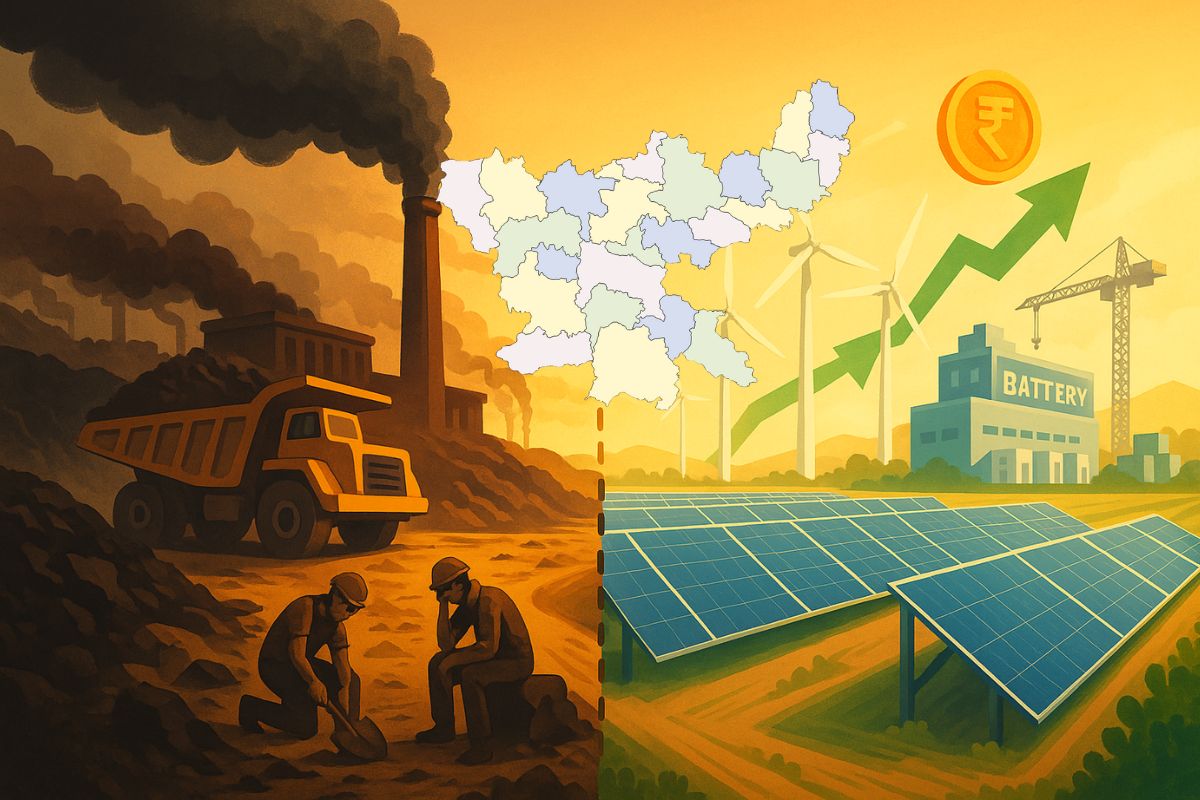
Jharkhand needs $256 billion over the next 45 years to move away from coal dependency, according to a new report by the Institute for Energy Economics and Financial Analysis (IEEFA). The massive sum will pay for closing mines, building clean energy infrastructure and supporting affected communities. State government funds alone cannot cover these costs.
The report, developed as part of the Jharkhand government’s Task Force on Sustainable Just Transition, proposes a sustainable finance framework that combines public money, private investment, concessional loans and international climate funding. Each sector of the transition requires different financing approaches based on risk and return profiles.
Financing Jharkhand’s Energy Transition
“Public funds alone are not sufficient to finance the transition,” the report states. “A sustainable finance framework involving public finance, private investment, concessional debt and international climate funds is essential.”
Coal mine closures will cost $18.1 billion after deducting existing escrow funds. Current regulatory deposits are insufficient. Actual technical closure costs are projected to be nearly three times higher than legacy norms due to elongated mine lifespans and steep overburden dumps.
Closing thermal power plants requires another $5.7 billion. Unlike coal mines, power plants have no escrow requirements or regulatory guidelines for decommissioning. This gap raises the risk of inadequate closures that could harm surrounding communities and the environment.
The report proposes creating a coal asset retirement financing facility. This facility would be jointly established by international development agencies and the Jharkhand government. It would pool concessional debt and grant funding from multiple sources.
Funding sources include budgetary support from central government, concessional loans from multilateral development banks, bilateral institutions, international climate finance mechanisms and philanthropic foundations. The facility would finance decommissioning costs, provide early closure compensation and ensure proper site remediation.
“By consolidating resources into a single financing facility, the process would benefit from improved coordination among all agencies involved in coal asset closures, while reducing transaction costs,” the report explains.
Learning from Other States’ Models
Other Indian states provide models Jharkhand can follow. Tamil Nadu created the Green Climate Fund, India’s first state-backed investment fund focused on green projects. Kerala established a bond-financed infrastructure vehicle channeling long-term debt into state projects.
Maharashtra created the Innovation and Technological Development Fund, a registered alternative investment fund that invests directly in innovation and sustainability enterprises. Odisha operates a startup growth fund that aggregates state and central resources for local businesses.
Renewable energy projects need different financing structures. Solar and wind power are capital-intensive but generate predictable cash flows with low operating costs. This makes them attractive to institutional investors like pension funds and insurance companies.
Corporations like renewable energy developers or battery manufacturers are the most suitable equity investors for BESS projects. Private equity funds investing through startups provide additional capital. However, heavy reliance on private equity raises project costs and slows large-scale adoption.
The report recommends Jharkhand tap central government support and international climate finance for concessional loans. These funds could be deployed through blended finance structures to enhance project creditworthiness and attract private capital.
“Green hydrogen production is still not profitable, and costs more than grey or blue hydrogen,” the report notes. “Corporations and PE funds are investing in the technology, but green hydrogen projects need concessional capital through grants, subsidies and concessional debt to accelerate their adoption.”
The report recommends multilateral development banks act as credit guarantors to attract commercial lenders. Governments must invest in shared infrastructure like roads and power generation. International climate finance mechanisms can support mining critical minerals for clean energy applications.
Support us to keep independent environmental journalism alive in India.
Keep Reading
Elephants Are Back in MP After a Century, But Can They Stay?
Solar Energy – A Paradigm Shift in Wildlife Conservation
Stay connected with Ground Report for underreported environmental stories.