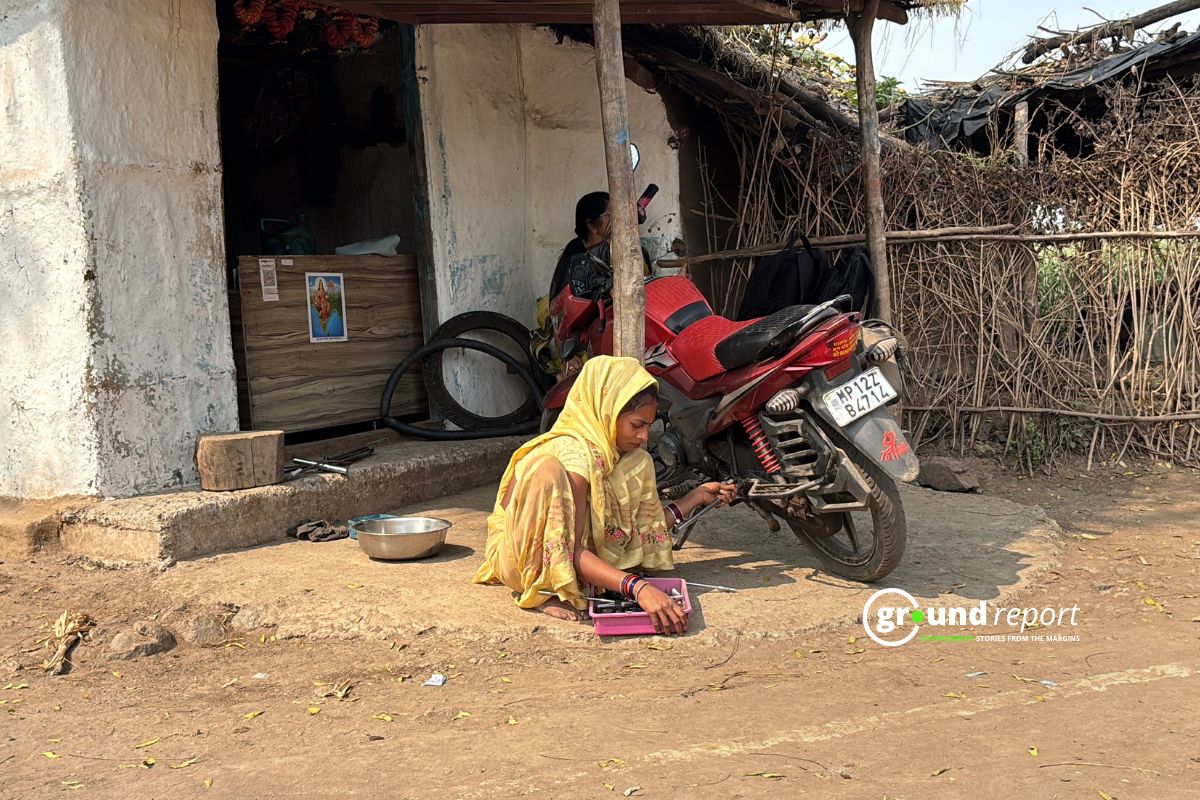
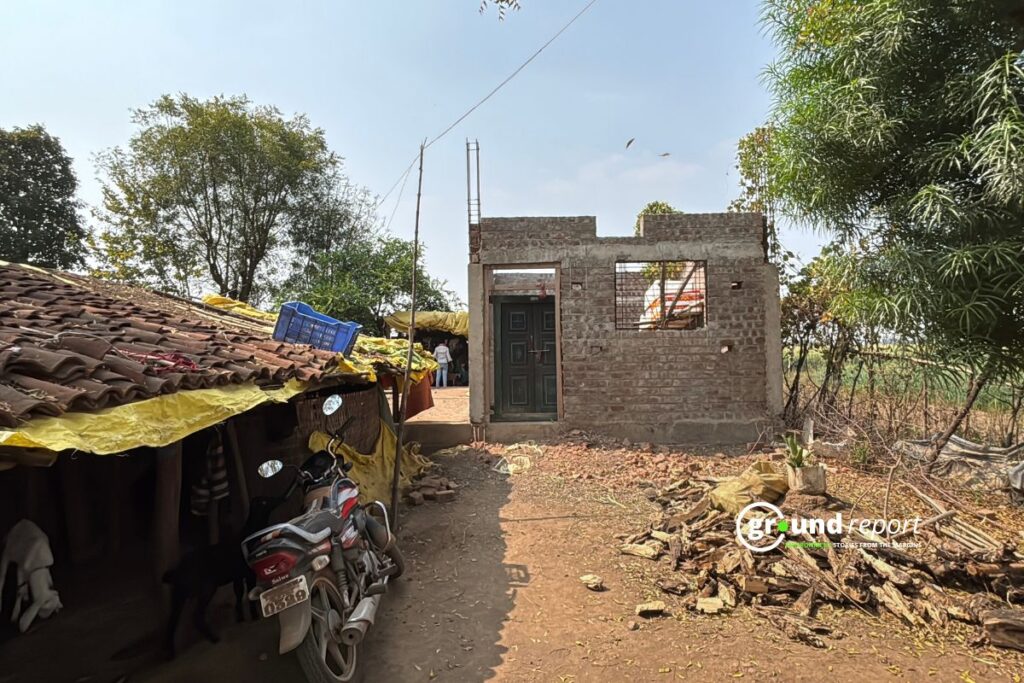
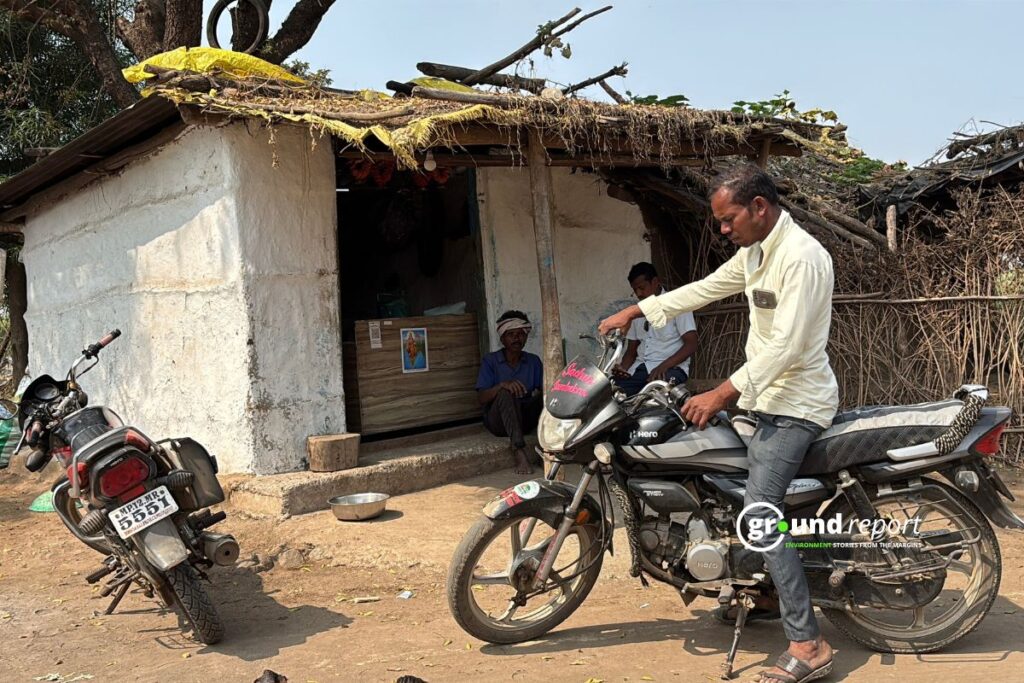
हिंदी में पढ़ें: In Rahatiya village in Madhya Pradesh’s Khandwa district, a house is under construction. Across from it stands a small motor mechanic’s workshop, its walls made of mud and grass and its roof patched together with tin sheets. Inside, someone is fixing punctures, replacing disc wires, and repairing broken motorcycles.
This is Sundar Jambhekar’s shop. She runs the workshop as her primary source of income. And, from this income, she is constructing the house.
Until about five years ago, she used to migrate to Maharashtra’s cotton and sugarcane belt to make a living. She recalls, “We used to go to Maharashtra to pick cotton. We’d come back home for a few months and then leave again for some other labour work.” When the nationwide lockdown was imposed in 2020, she had to struggle hard just to get back home. She later came into contact with Spandan Samaj Seva Samiti, an NGO.
And it was here that she received training as a motor mechanic under an initiative called “Karmayogini,” along with the tools she needed to start work. She put a tin roof over mud walls and started working. Now she wants to expand, make it bigger, better, and permanent.
Manisha Chauhan, who trained alongside her, also has similar ambitions.
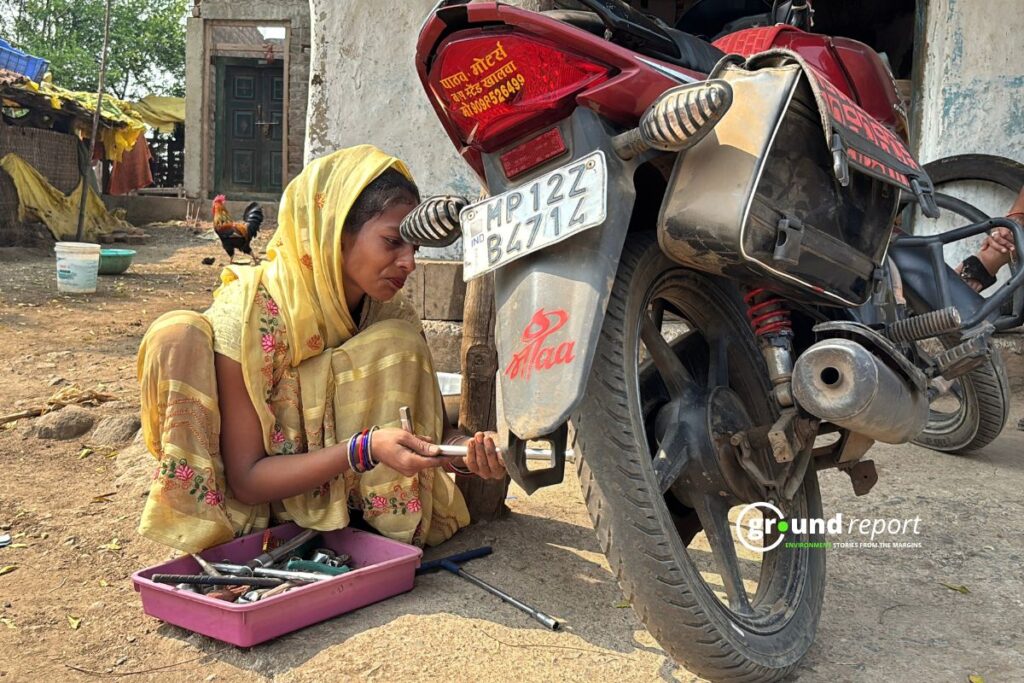
Both women have gone from earning 200 rupees a day picking cotton in Maharashtra to 1,500 rupees a day fixing vehicles in their home villages. The state has schemes that could help them scale up. Though neither woman has ever heard of them.
From Labourer to Owner
Sundar worked in the fields in Akola, Maharashtra; the conditions for shelter, food, and drinking water were terrible. “We had to live in tents, and there was no drinking water either.” Collecting firewood before heading out for labour was part of her daily routine. She also had to relieve herself and bathe in the open.
Sundar grows quiet as she recounts all this. She says, “If we had stayed home, we wouldn’t have had to go out in the open like that. We wouldn’t have had to live like that.”
Similarly, 24-year-old Manisha Chauhan from Saikhedakurd in the Burhanpur district used to go out for labour with other women from her village. She, too, was deeply troubled by such harsh conditions.
Sundar’s day began at four in the morning. After cooking on a brick stove, she would reach the fields by 8. She would work there until dusk, then come home, cook again, fill water, and sleep before the next day began. For a full day’s work, she earned 200 rupees. Manisha’s daily earnings were the same.
But during the lockdown, she also got the opportunity to receive motor mechanic training. While Sundar’s family was supportive, Manisha’s family was uncomfortable with the idea. She says, “My family said, ‘If you do mechanic work, what will the villagers say? ‘I told them—when we go out to migrate, nobody says anything. Why should I be ashamed of doing my own work?”
The same people who once tried to stop Manisha from doing this work now bring their vehicles to her for repairs. “People say they never thought I’d be able to do this kind of work.”
Now both of them earn up to 1,500 rupees a day. Sundar’s shop sits on the main village road, which brings her a steady flow of customers. Manisha, too, has built her workshop under a tin shed. The tools came from Spandan. She arranged the space and construction herself. Manisha estimates it costs around 50,000 rupees.
Migration, Effort, and the Capital Crunch
According to the 2011 census, 456 million people in India — 38 percent of the total population — migrate. Between 2001 and 2011, while the population grew by 18 percent, migration grew by 45 percent. From Madhya Pradesh, 29,79,492 people migrate to other states. And almost 2,18,94,713 people migrate within the state.
On 20 June 2020, the central government launched the Garib Kalyan Rozgar Abhiyan, aimed at providing employment and livelihood opportunities to migrants who had returned during the pandemic and to similarly affected rural residents. Under the scheme, 25 types of work were to be offered across 116 districts in six states, including Madhya Pradesh. In the state, 15,664 people were trained under the scheme, but only half, 6,589, found work after training. Neither Sundar nor Manisha is among them.
Seema Prakash of Spandan Samaj Seva Samiti says the organisation trained a total of 50 women and young women under its initiative.
After her training, Manisha started her business. But she now feels the need for more resources. She says, “I have to fill air with a hand pump all day long. Work is increasing. After doing this all day, my hands and back start aching.” She wants a motor-powered pump. Working inside a tin structure also becomes difficult in summer. She wants to upgrade to a permanent structure. She also wants to buy more tools and hire a few people. That, she thinks, would increase her earnings.
But all of this requires money she does not have. She saves whatever she can and is slowly improving the workshop, but her modest savings are nowhere near enough to cover the cost of expanding it.
Where Is the Government?
The Mukhyamantri Udyam Kranti Yojana was launched in April 2022 to provide financial assistance to young people like Sundar and Manisha who want to start their own businesses.
The scheme is open to Madhya Pradesh residents aged 18 to 45 who have passed Class 8. It offers loans ranging from ₹10 lakh to ₹25 lakh for service-sector enterprises, with the state government providing a 3 percent interest subsidy for seven years.
But neither woman knows the scheme exists. Manisha says people suggested she take a bank loan, but she assumed it would carry high interest. Sundar, too, knows little about bank loans or the government schemes linked to them.
When asked about the low awareness of the scheme, the general manager of the District Industries Centre, Manoj Rawat, says that anyone can contact Manager Sapna Vijaykare and the assistant manager at the District Trade and Industries Centre.
A search of the district website does turn up several articles on the scheme, including a success story of one Pawan Gaur, who received a loan of 2,35,000 rupees to open an auto garage under the scheme.
However, according to the Economic Survey 2025–26, only 7,250 applications were approved across the state in the relevant financial year, while nearly half as many — 4,239 — were still pending.
These women, who have broken social norms to move toward economic independence, remain untouched by these schemes. The schemes exist in the state, but awareness of them has yet to reach people living in interior areas. Sundar will eventually complete the construction of her house with her savings and support from the Pradhan Mantri Gramin Awas Yojana. But her workshop will have to keep waiting.
Support Us To Sustain Independent Environmental Journalism In India.
More Ground Reports
He Was Married as a Child, Now Manish Dangi Helps Stop It for Others
Despite The Ban, How Gutkha Became MP’s Most Common Household Habit