Across India’s cities, the sun sets. The heat does not. A seven-month study tracking temperatures inside 50 low-income homes in Chennai found that indoor temperatures never fell below 31 degrees Celsius, not in winter, not at 3 AM, not once. The concrete walls stored the day’s heat and spent the night releasing it. For the people sleeping inside, there was no relief.
Chennai is one city. But its housing is India’s housing. The same reinforced cement concrete construction, the same dense urban blocks, the same missing ventilation define low- and middle-income neighbourhoods from Ahmedabad to Hyderabad to Lucknow. What researchers measured in Tamil Nadu is happening, almost entirely unmonitored, across the country.
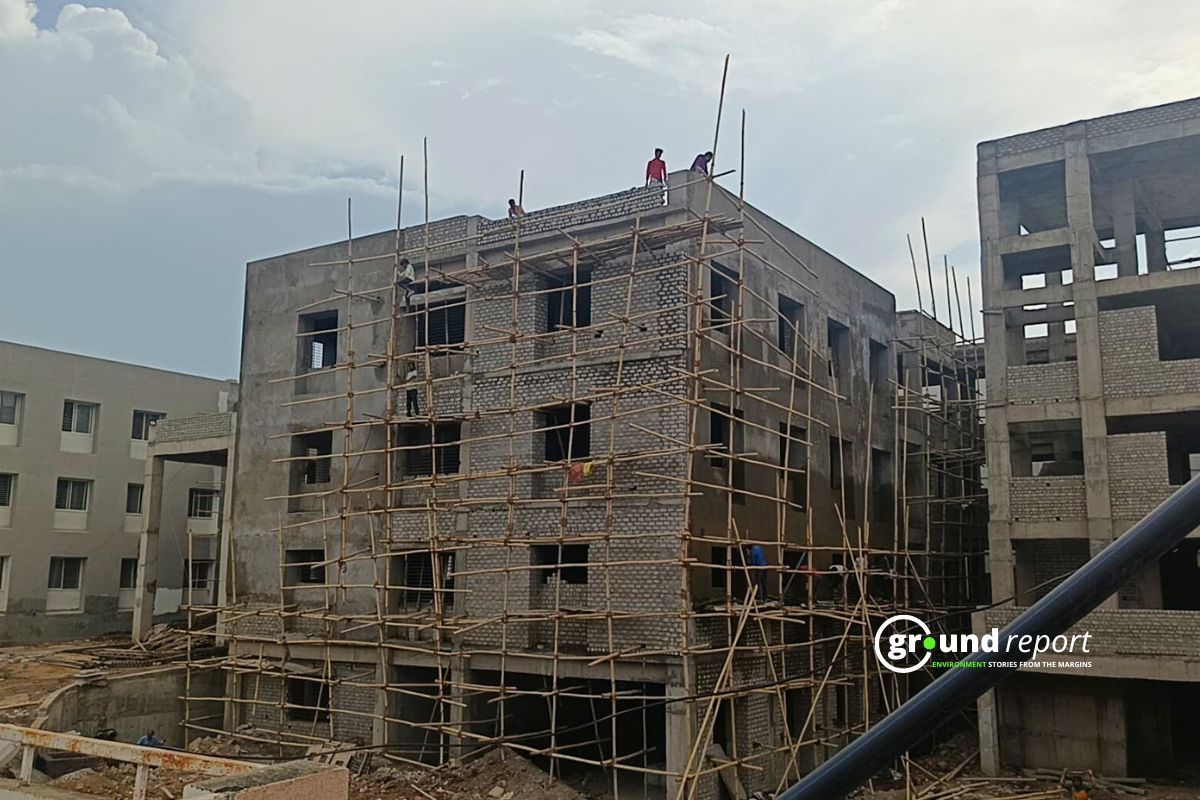
India’s construction boom delivered millions of homes built from reinforced cement concrete, durable, affordable, and thermally disastrous. Concrete absorbs solar radiation all day and releases it slowly through the night, turning buildings into slow-burning radiators. Studies in Ahmedabad and Hyderabad had already recorded nighttime indoor temperatures running two to five degrees Celsius hotter than outdoors. The Chennai study, sensors recording temperature and humidity every minute across seven months, is the most detailed confirmation yet.
India Meteorological Department data shows peak summer temperatures exceeding 45 degrees Celsius across multiple states. The national conversation tracks those outdoor numbers. What happens inside the homes where people retreat from that heat is largely unmeasured and almost entirely ignored.
Eight Months Above Discomfort Threshold
The Climate Trends study, conducted between October 2025 and April 2026, found indoor temperatures across 50 households regularly exceeding 32 degrees Celsius and climbing above 35 during the warmer months.
The worst-affected homes logged 5,700 to 5,800 hours above 32 degrees Celsius, eight continuous months at or above the moderate thermal discomfort threshold. Most households recorded between 3,000 and 5,000 such hours. The study period excluded peak summer. The researchers note their findings are conservative.
Relative humidity held above 75 percent throughout. High humidity disables sweating the body’s primary defence against heat making every degree more damaging than it measures.
Heat Peaks After Sunset
The most significant finding is not the afternoon temperature. It is the evening surge.
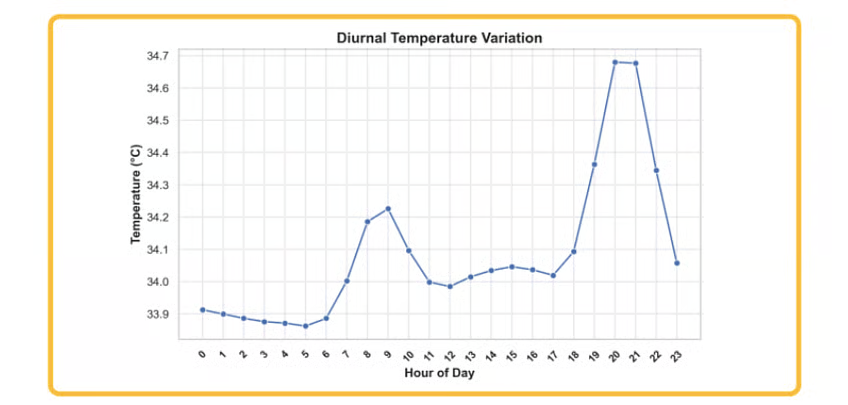
Indoor temperatures peaked between 8 and 9 PM, reaching nearly 34.7 degrees Celsius after dark. Concrete walls saturated with solar energy radiate it back through the night. By the time residents try to sleep, the walls are the heat source.
Between midnight and 6 AM, temperatures held between 33.8 and 34 degrees Celsius. Research published in The Lancet Planetary Health links elevated nighttime temperatures to increased mortality during heat waves. Sleep studies find that temperatures above 26 to 28 degrees Celsius significantly impair sleep. Above 30 degrees Celsius, the harm becomes cumulative. Every household in this study spent the night above 33 degrees in the cooler months.
“Most people spend the majority of their time indoors, where they face the dual threats of heat stress and poor air quality,” said Naveen Puttaswamy, Associate Professor at the Faculty of Public Health, Sri Ramachandra Institute of Higher Education and Research, and a co-author of the study. “These exposures carry uncertain physiological trade-offs and add psychological as well as economic strain.”
An Air Conditioner Cannot Fix a Wall
Cooling access split along income lines: every high-income household in the study had an air conditioner; every low-income household had only a ceiling fan.
But the study’s harder conclusion cuts across that divide. Even air conditioning cannot eliminate the underlying problem. Concrete retains heat through the full 24-hour cycle. When the AC turns off, at night, during a power cut, when the bill runs too high, the wall’s stored heat returns immediately. The structure is the threat. For the hundreds of millions of Indians in concrete homes without air conditioning, nothing masks it at all.
“The study brings into focus how night-time heat retention must also receive attention,” said Aarti Khosla, Founder and Director of Climate Trends. “It is concerning to note the level of baseline heat exposure and heat stress for the residents.”
India Monitors Outdoor Heat, It Ignores Indoor Heat
India has heat action plans. Most track outdoor temperature. Indoor nighttime heat is not systematically monitored in any major city, does not appear as a measurable target in most urban heat action plans, and carries no national residential standard. The problem is not only unaddressed — it is unmeasured.
The study calls for mandatory indoor heat monitoring as a baseline requirement of urban heat action plans. It recommends cool roof coatings — which can cut indoor temperatures by two to four degrees Celsius as an immediate, affordable intervention for existing homes. Improved cross-ventilation, roof vents, and insulation compound the gains. For new construction, it recommends compressed stabilised earth blocks and autoclaved aerated concrete over standard concrete, along with building codes that mandate thermal performance and ventilation.
“Heat stress has emerged as one of the defining challenges of our times,” said Pralhad Joshi, Union Minister for New and Renewable Energy, addressing the India Heat Summit 2026, where the study was released.
India issues colour-coded alerts when outdoor temperatures cross dangerous thresholds. No alert sounds for 34.7 degrees Celsius at 9 PM inside a concrete flat where a family is trying to sleep. That heat has no forecast, no name, and no end date. It is not a heatwave. It is the building. And for millions of Indians, it is every night.
Support Us To Sustain Independent Environmental Journalism In India.
Keep Reading
How Solar Solutions Are Helping Protect Crops from Wild Animals
Pench Tiger Reserve: How a Man Survived a Tiger Attack
Stay Connected With Ground Report For Underreported Environmental Stories.
Author
Support Ground Report to keep independent environmental journalism alive in India
We believe climate change should be the basis of current discourse, and our stories attempt to reflect the same.
Connect With Us
Send your feedback at greport2018@gmail.com
Newsletter
Subscribe our weekly free newsletter on Substack to get tailored content directly to your inbox.
When you pay, you ensure that we are able to produce on-ground underreported environmental stories and keep them free-to-read for those who can’t pay. In exchange, you get exclusive benefits.
Your support amplifies voices too often overlooked, thank you for being part of the movement.