Myaan… Deda dagin thadwa, gonez dongra di di di… Doge raja… uhun uhun, doge rani… uhun uhun. This is a children’s song in the Korku language, about a frog that lives in the forest. Both Sugandhi and Seema Prakash sing this with children at the anganwadi centre in Dabhiya, about 60 kilometres from Khandwa.
Before lunch, a sing-along activity is done to encourage language learning and entertainment. But many children neither understand the song nor repeat it. As the anganwadi worker later explained, these children do not understand Korku.
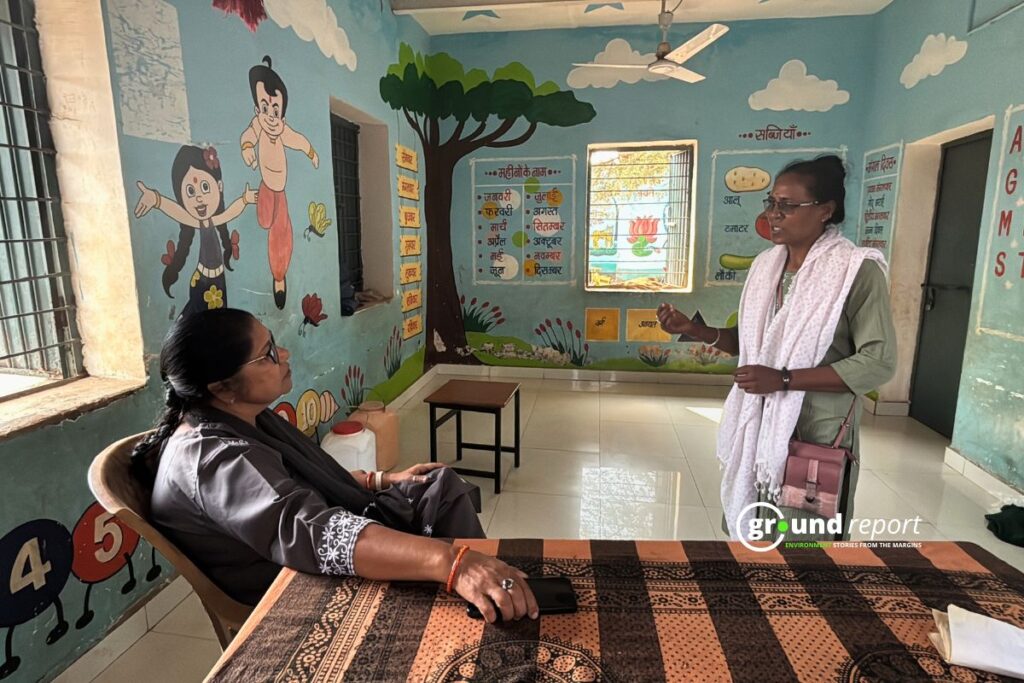
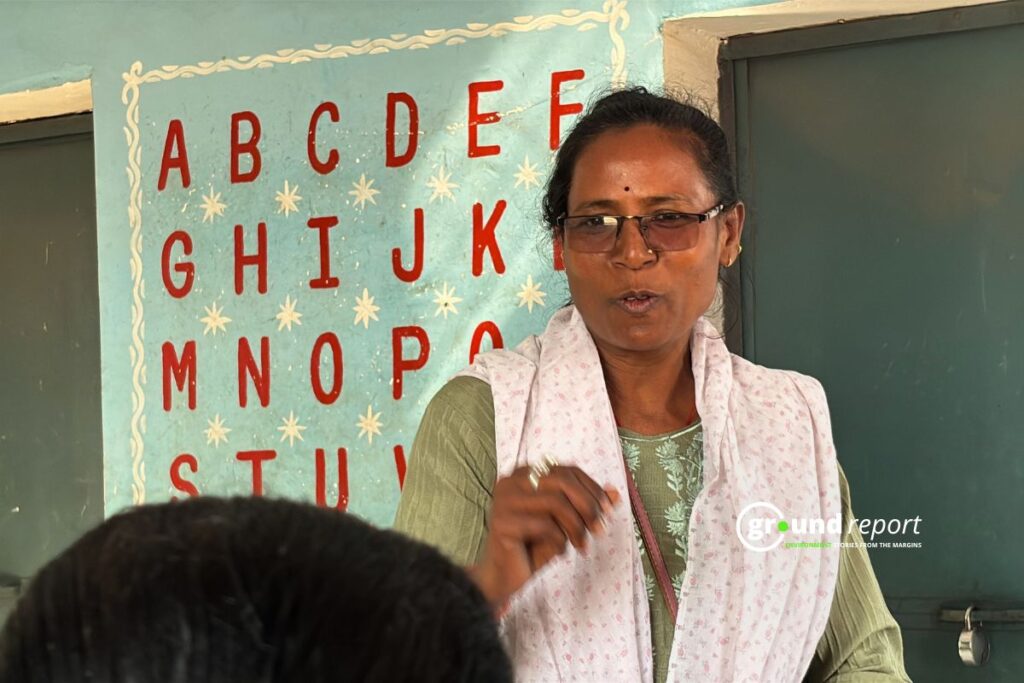
Most children at the anganwadi belong to the Korku tribal community. Yet the names of vegetables, fruits, and animals on the walls are only in Hindi. The English alphabet is also displayed, but not a single word in Korku. The anganwadi worker says she teaches and speaks only in Hindi and English to help children develop their language skills.
When Seema Prakash founded Spandan Samaj Seva Samiti in Khandwa to fight malnutrition among Korku children, she quickly ran into a wall. The communities she needed to reach spoke no Hindi, and her workers spoke no Korku. Without that bridge, mothers fled at the sight of health workers, children sat silent and uncomfortable at anganwadis, and no amount of awareness messaging landed. The answer, it turned out, was to save the language first.
Early Communication Difficulties
Seema Prakash began her work on nutrition in the Nimar region, which includes the present-day districts of Khandwa, Khargone, and Barwani, in 2003. Her work was to find innovative ways to raise public awareness to address malnutrition.
Prakash says, “Our biggest problem was that the villagers did not know Hindi, and we did not know Korku.” She explains that overcoming malnutrition required mothers and children to visit rehabilitation centres, maintain nutritious diets at home, and attend regular check-ups with local ASHA workers and at primary health centres. All of this needed sustained communication.
“Identifying malnourished children and pulling them out of that condition required knowing their weight and what they were being fed.” But the villagers refused to even speak to them, let alone allow their children to be weighed.
Sugandhi, who joined Spandan Samaj Seva Samiti as a grassroots worker from its early days, recalls, “In the beginning, when I would go to people’s homes, the baiyan — the mothers — would run away the moment they saw me.” Soon, Sugandhi and the organisation understood that the only way forward was to speak with the Korku people in their own language.
An Endangered Language and Nutrition
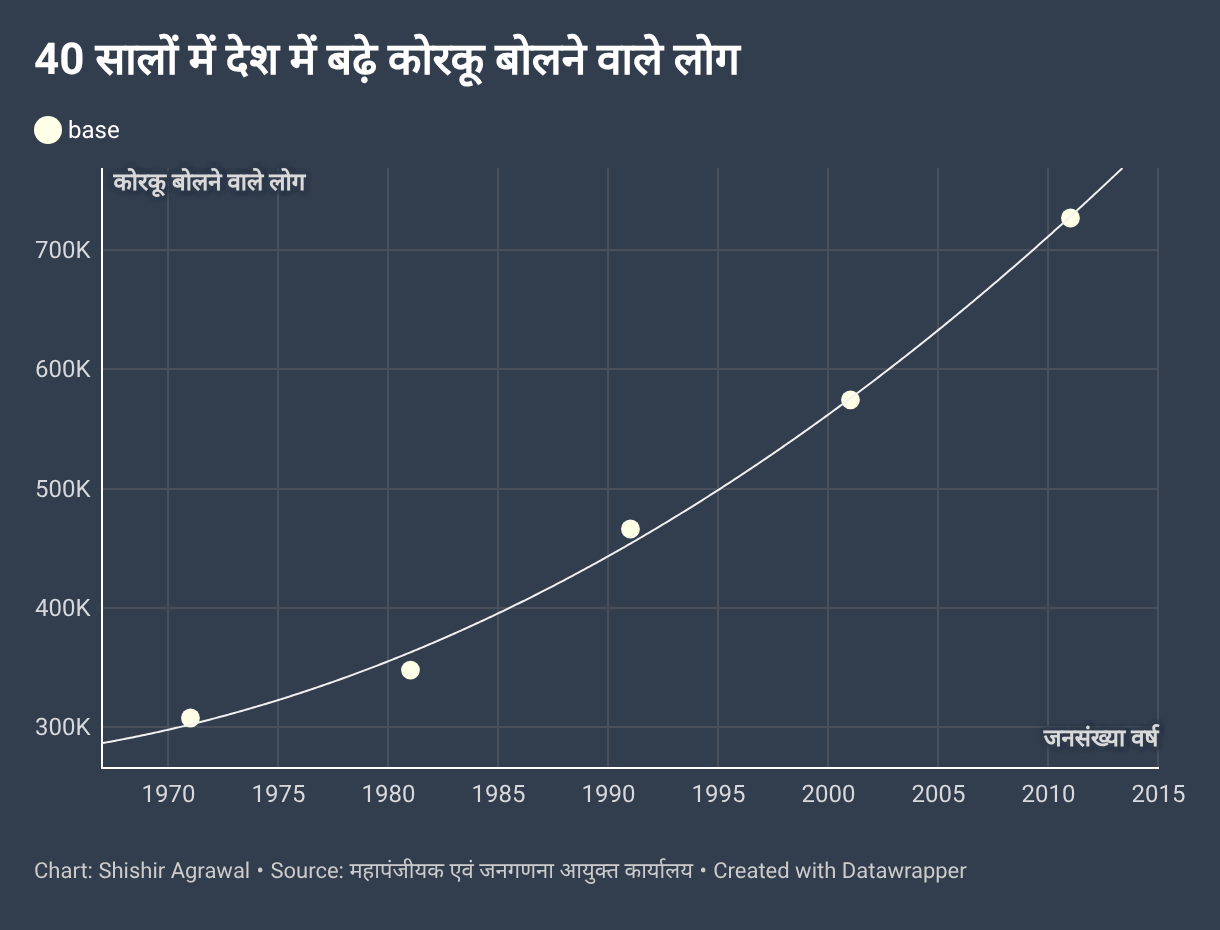
Korku is a Munda language spoken mainly in Madhya Pradesh and Maharashtra. UNESCO listed it in the Vulnerable category in its Atlas of the World’s Languages in Danger (2010). However, census data from 1971 to 2011 shows that the total number of speakers in the country has grown. According to the 2011 census, there were 7,27,133 Korku speakers across India, of whom 4,70,386 were in Madhya Pradesh.
Dr. R. Karthik Narayanan, who studies India’s linguistic diversity through tribal languages, says census figures do not capture the true state of a language. The Census records a person’s mother tongue based on the language they learned in childhood. But it does not measure how fluently they still speak it or whether the language is being passed on to the next generation. As a result, he says, census data alone cannot accurately measure a language’s vitality.
Sugandhi does not belong to the Korku community. But over the years, she learned the language from the villagers so she could speak with them. She says that when she spoke in Hindi, local people felt no connection with her. But once she switched to Korku, she could express herself effectively and explain government services more clearly.
Prakash explains, “We had to tell families how serious their child’s condition was and what they needed to do. If the language barrier had remained, that would have been very difficult.”
Initially, Prakash used the Korku language only for her own convenience, to make her work easier. But later she noticed that children from this community would come to the anganwadi and sit quietly, looking uncomfortable.
She believes, “A child will only enjoy being at the anganwadi if there is something there that they like.” So she began organising songs and activities in Korku. In time, her nutrition work grew into an effort to document the Korku language itself.
Administrative and Organisational Initiatives
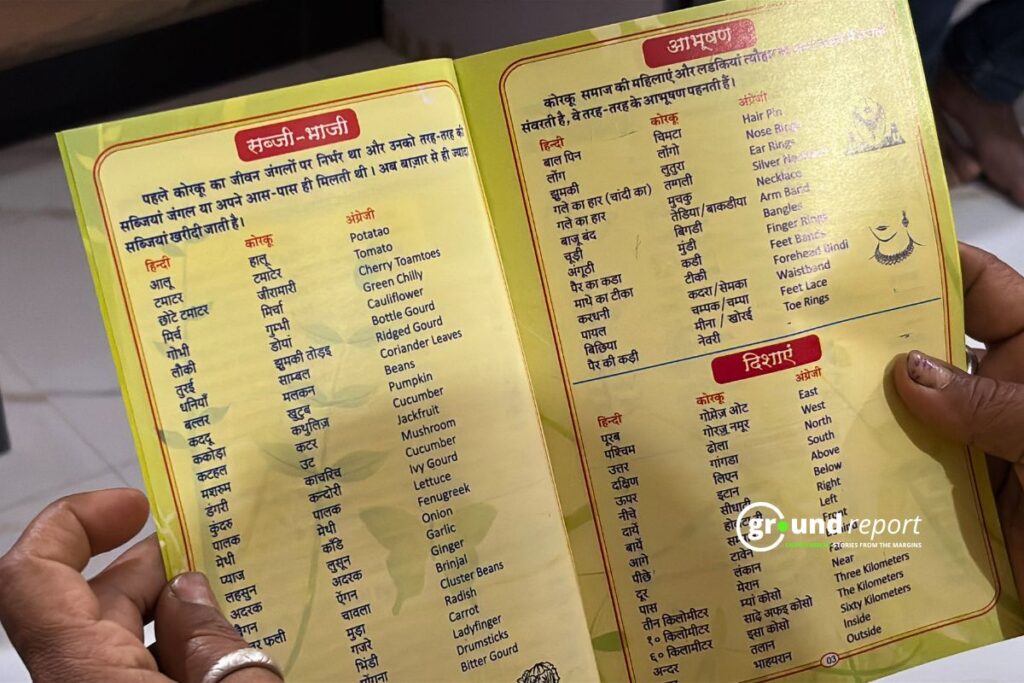
Seema Prakash and her organisation developed modules and a dictionary in the Korku language. She explained, “We collected Korku and Hindi vocabulary from elders, names of trees, animals, and everyday words, and then organised it into a document.” Spandan also developed a dictionary called Korku Shabd Gyan (Korku Word Knowledge). Prakash also authored a book on the Korku community, Lest We Forget Them.
Seema says, “Every child has the right to receive early education in their mother tongue.” With this in mind, her organization repainted anganwadi walls and also distributed posters in the Korku language.
She highlighted a gap between administrative processes and people on the ground: “Even the local government staff here doesn’t know Korku.”
However, Ratna Sharma, District Project Officer at the Women and Child Development Department in Khandwa, says, “In Roshni and Khalwa, women who speak Korku have been appointed as anganwadi workers and ASHA workers.” Sharma says these appointments aim to bridge the language barrier.
Yet Karishma Kanonje, posted in Langoti under Khalwa block, does not know Korku. And while the anganwadi worker and her assistant in Dabhiya do know the language, they too speak with children only in Hindi.
Speaking to Ground Report, Sharma said the district administration is producing short films and songs in Korku under the Saksham Anganwadi and Poshan 2.0 scheme, which will be shown at model anganwadis to raise awareness among families.
But when we visited several anganwadis in Khalwa in February 2026, all of them displayed only Hindi and English alphabets and posters, most of them in a dilapidated state. In most anganwadis, even the lines quoted at the opening of this article are ones children hesitate to repeat.
What has changed, however, is that people now trust Sugandhi. They no longer shy away when she visits. Instead, they talk to her and follow her advice to take their children to nutrition centres and hospitals.
Support Us To Sustain Independent Environmental Journalism In India.
More Ground Reports
He Was Married as a Child, Now Manish Dangi Helps Stop It for Others
Despite The Ban, How Gutkha Became MP’s Most Common Household Habit
Stay Connected With Ground Report For Underreported Environmental Stories.
Author
Support Ground Report to keep independent environmental journalism alive in India
We believe climate change should be the basis of current discourse, and our stories attempt to reflect the same.
Connect With Us
Send your feedback at greport2018@gmail.com
Newsletter
Subscribe our weekly free newsletter on Substack to get tailored content directly to your inbox.
When you pay, you ensure that we are able to produce on-ground underreported environmental stories and keep them free-to-read for those who can’t pay. In exchange, you get exclusive benefits.
Your support amplifies voices too often overlooked, thank you for being part of the movement.