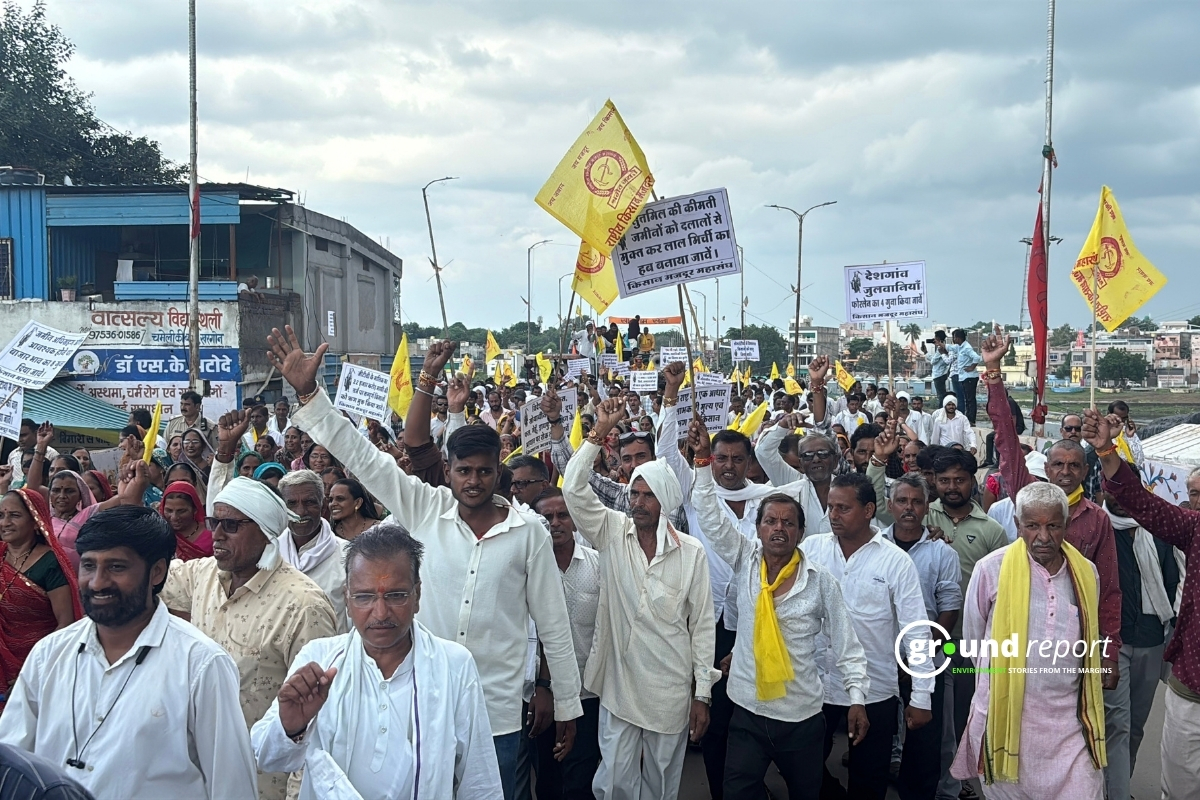

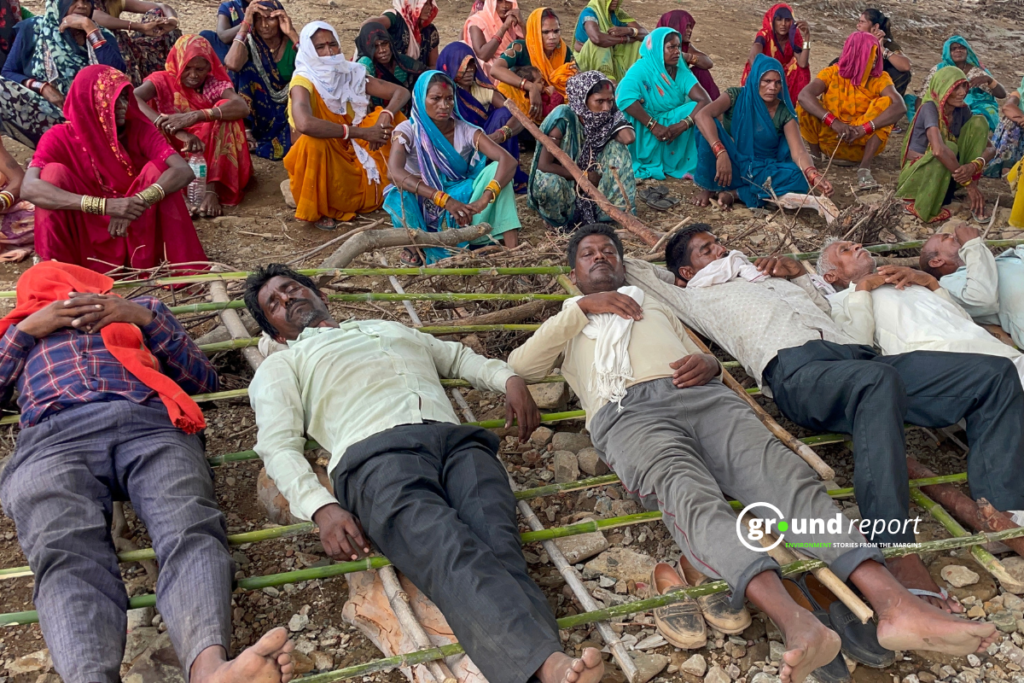
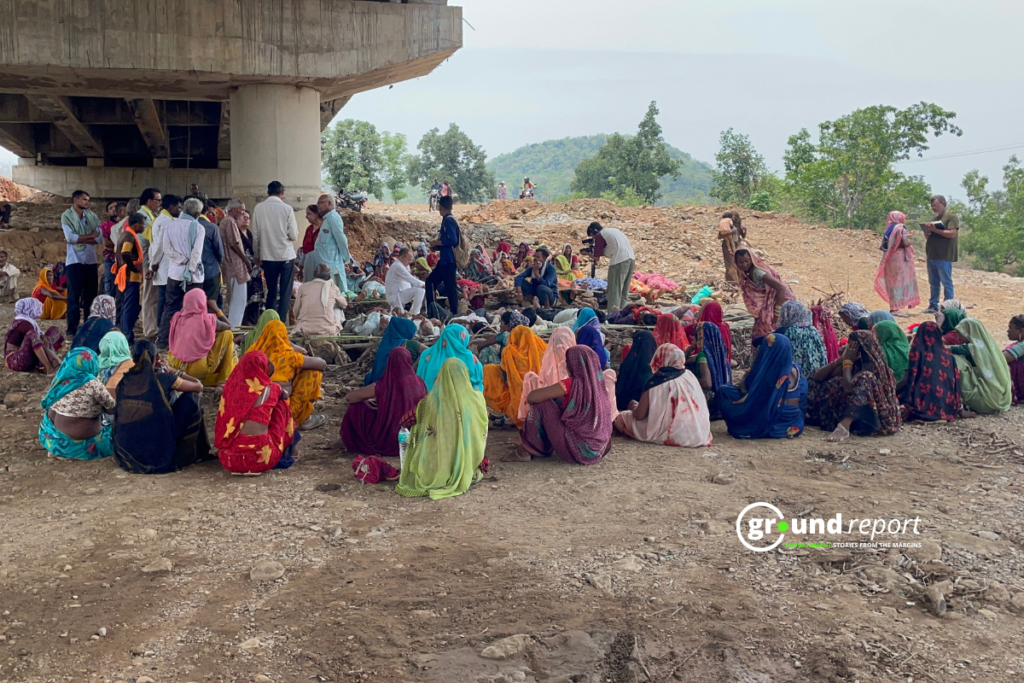
हिंदी में पढ़ें: The country’s first river-linking project faced renewed protest through the “pyre movement.” Affected tribal villagers gathered near the Barana River, a tributary of the Ken River, close to the project-affected village of Koopi, starting July 3.
Amit Bhatnagar sat on a hunger strike against irregularities in compensation and the demolition of affected people’s homes under the Ken-Betwa river linking project.
By July 6, social activists from Jhansi and other places had joined villagers in the protest.
Protesters alleged that their demands for compensation remained unmet, despite multiple rounds of talks between the movement and the administration. Activists from Jai Kisan Sangathan, the organizers of the protest, said more than 300 houses had been demolished so far.
The protesters alleged that the administration gave no proper notice before displacement and failed to provide compensation to all affected families. Villagers said officials fixed compensation arbitrarily, ignoring the Gram Sabha and general assembly, leaving families deprived.
Speaking to Ground Report, Amit Bhatnagar said he had been on a hunger strike since Monday, July 6, over his demands. He said the administration kept giving assurances, but nothing changed on the ground.
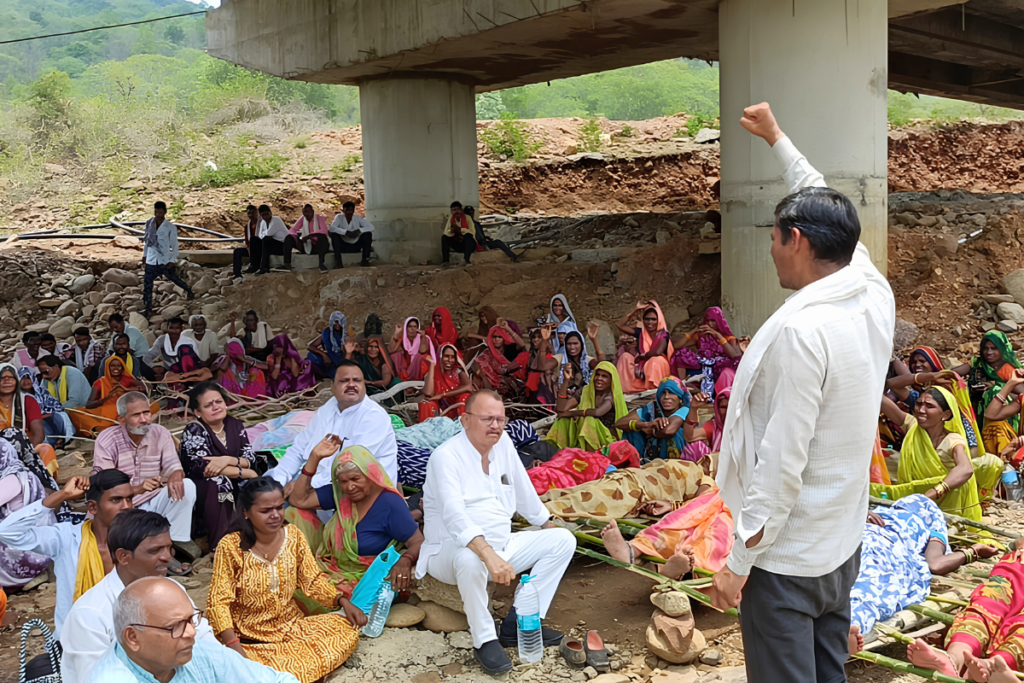
The protesters had staged a similar 10-day agitation before. In April, social activist Amit Bhatnagar led a protest at the Dhaudhan dam construction site.
Following this, the Chhatarpur collector formed an investigation team on April 15 to look into villagers’ objections. Protesters said these administrative actions produced no results, and the situation remained the same as it was three months ago.
This time, people displaced by the Majhgaon and Runj irrigation projects, as well as the Neguwa irrigation project and the Barethi solar power project, joined the protest alongside those from the river link project.
Which projects are at the center of the protest?
Five projects stood at the center of the protest.
The first was the Dhaudhan dam, being built in the first phase of the Ken-Betwa link project, with a planned full reservoir level (FRL) of 288 metres.
The second was the Majhgaon medium irrigation project, meant to develop 9,900 hectares of irrigated area. It required a dam 7,567 metres long and 33 metres high on the Bada Nala, a tributary of the Ken River.
Under the Runj irrigation project, a 1,182-metre composite dam was to be built on the Runj River in Panna’s Ajaygarh tehsil. It claimed to provide irrigation to a total of 12,550 hectares.
There was also the Neguwan minor irrigation project, costing around 32 crore rupees, meant to irrigate about 1,000 hectares of farmland for farmers in Neguwan and Dalaun villages.
The Barethi solar power project, of 630 megawatts, claimed to supply electricity to 300,000 people.
Homes demolished amid unresolved compensation questions
Sumatirani, 62, moved to Sukwaha village after her marriage at the age of 11. About two months ago, her house was demolished. She received compensation of 5 lakh rupees per acre for her land, but her demand for a house in exchange for a house and land in exchange for land, remained unmet.
In Dongaria, 100 houses were demolished. In the district’s Palkoha, Khariyani, and Pathapur villages, between 10 and 40 houses were demolished in each village.
Similarly, demolitions took place in eight villages of Panna district.
A notice published by the district administration on June 1 stated that 14 displaced families from Kakra village had received their compensation packages and been resettled. According to the notice, the empty houses of families who had received compensation and resettled were being demolished.
Protesters said families whose houses were demolished used their compensation money to buy land and build new houses. Some people had to live in makeshift huts during this time. Some affected people in Panna district were settled in Kondi village, where they received plots of 50×30 square feet.
Allegations of corruption and inadequate compensation
Bhatnagar alleged that around 4,500 people were affected by the Neguwa irrigation project. He said most of them had not yet received adequate compensation. He said even those who received compensation fell victim to administrative financial irregularities.
He said the same was true for the Barethi solar power project, where compensation was calculated based on 2012 rates. He said 116 people affected by the project had not received compensation so far.
He said he would soon make public the “dark truth” of each project, backed by solid evidence.
Protesters alleged that the administration had cut off supplies of rations, water, electricity, and medicines to people present at the protest site.
For an official response on the matter, Ground Report tried to reach Chhatarpur collector Parth Jaiswal by phone but could not get through. Akhil Rathore, assistant director in the district’s public relations department, asked us to contact the ADM office and the SDM of Bijawar.
However, according to information on the district public relations department’s website, the collector and the SP visited Karaundiya, the new settlement of the displaced, on June 20, and ordered that all facilities be ensured there. They directed officials to organize special camps to resolve the problems of displaced families, so that housing construction, documentation, and other necessary work could be completed quickly.
Support Us To Sustain Independent Environmental Journalism In India.
More Ground Reports
He Was Married as a Child, Now Manish Dangi Helps Stop It for Others
Despite The Ban, How Gutkha Became MP’s Most Common Household Habit