हिंदी में पढ़ें: Rambha Bai of Gopalpura village has been connected to the silk centre in Sarangpur, Rajgarh district, for the past seven to eight years. She and her husband used to work there as daily wage labourers. But in 2021, they were enrolled as beneficiaries under the Silk Samagra scheme for silk production. The couple began working on a one-hectare sericulture farm.
Three months ago, her husband passed away, and now she manages everything alone.
Rambha Bai says the work keeps her busy from morning to evening. “One person alone cannot cut enough leaves for the worms hatched from a hundred eggs,” she says. “The heat kills more worms, which creates serious problems.”
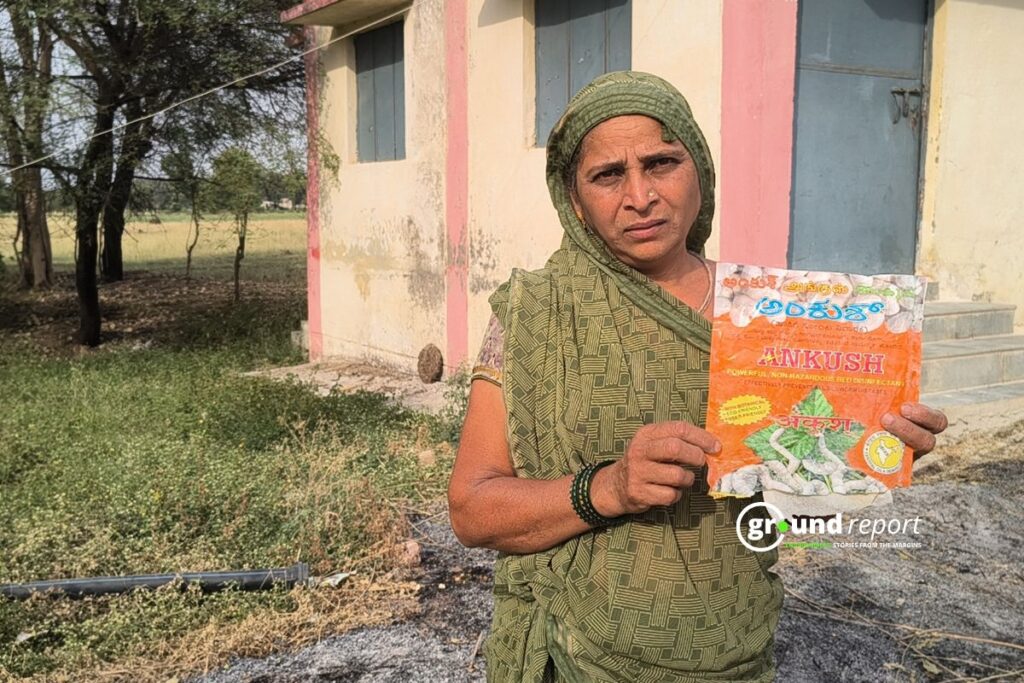
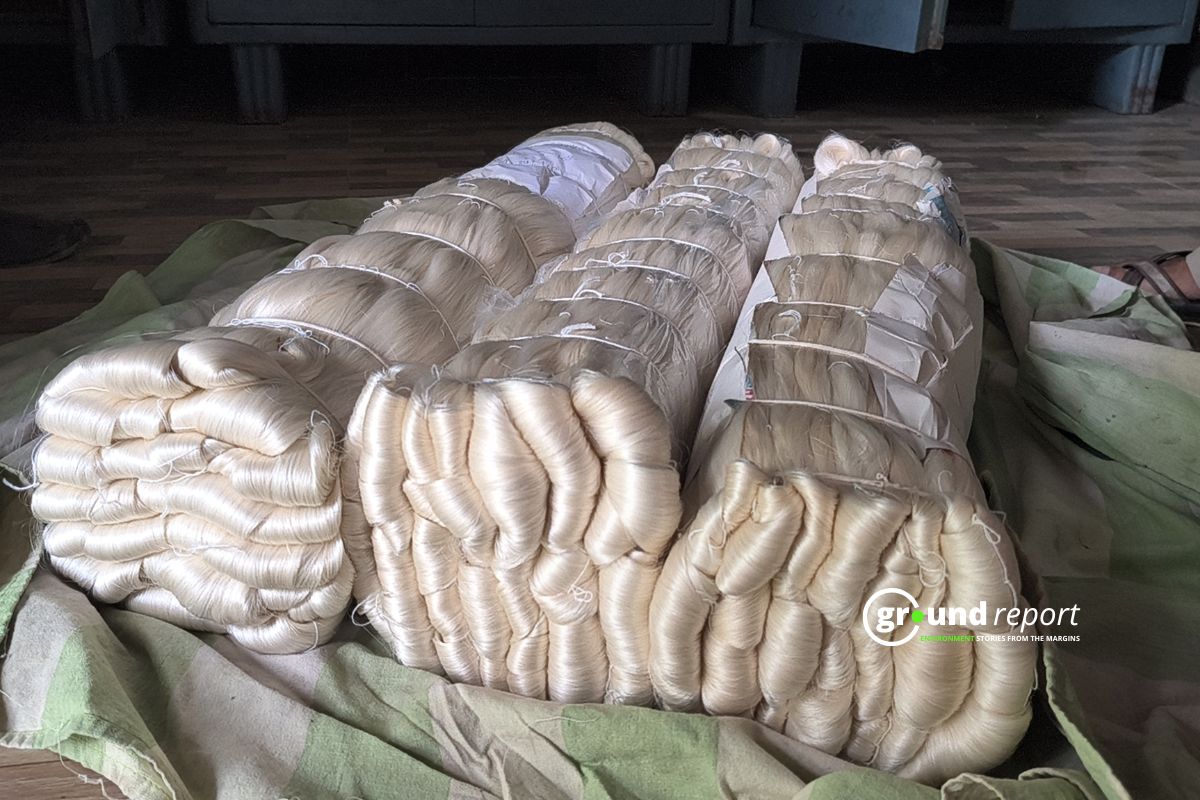
Rambha Bai is one of thirty beneficiaries in the Rajgarh district engaged in silk production. She produces around 200 kilograms of silk per year, which she sells to the Madhya Pradesh Silk Federation at ₹200 to ₹250 per kilogram. Recovering costs at this price is difficult, she says, and she considers working as a daily wage labourer a better option.
Silk production in Rajgarh and other districts is in poor shape, even as the government claims to paint a different picture. Output is declining across the state. The central government allocates far less budget to Madhya Pradesh compared to other states, and the silk centres and the department itself are struggling with acute staff shortages.
First, How Is Silk Made?
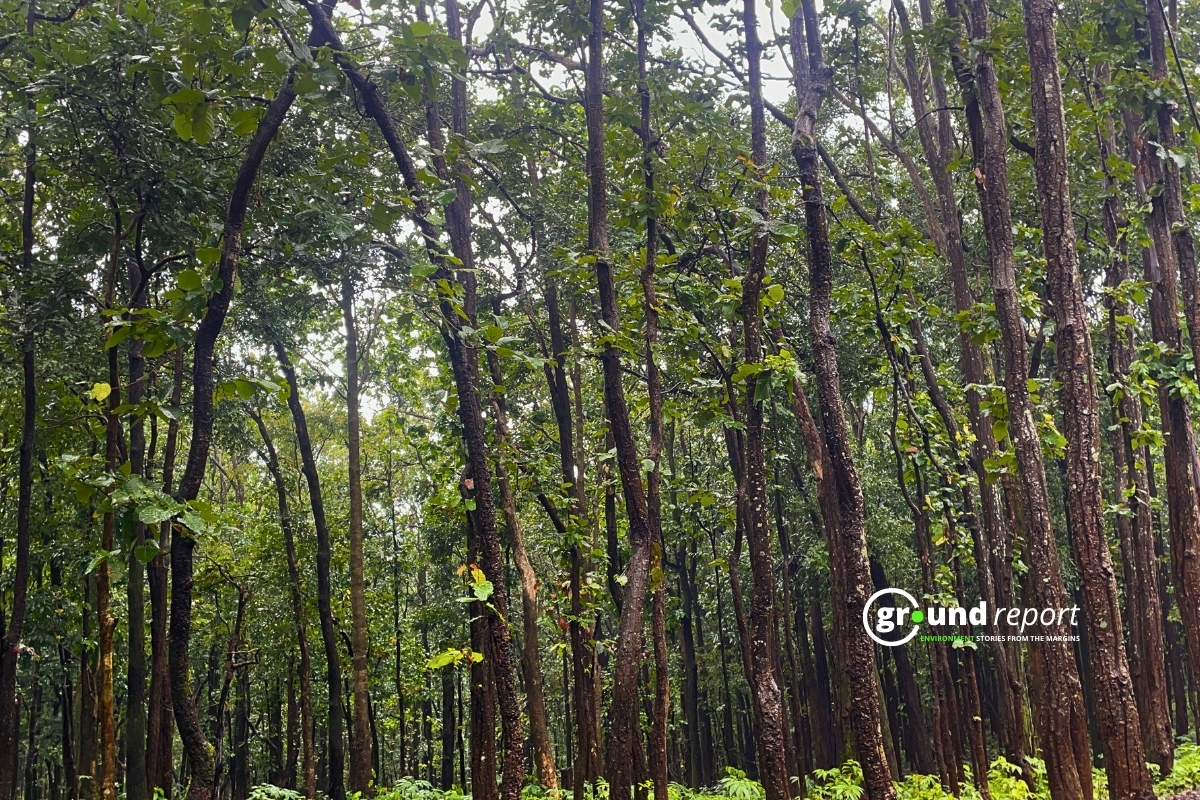
The process of making silk is known as sericulture, completed in four main stages. It begins with the cultivation of specific plants — primarily mulberry (shahtoot) or arjun — whose fresh leaves serve as food for silkworms.
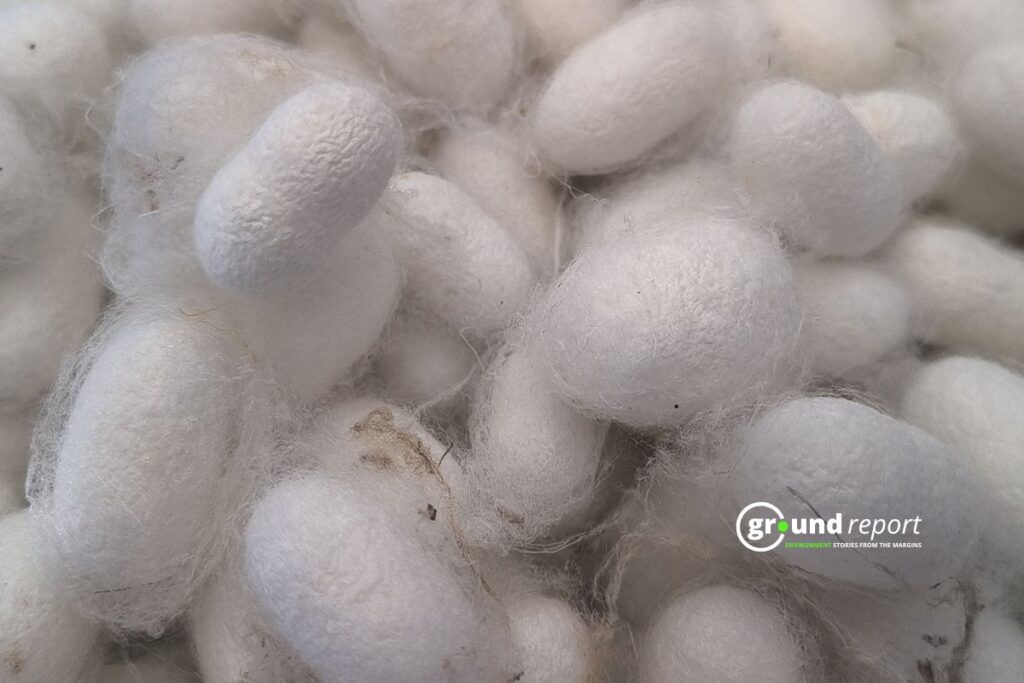
After continuously feeding on leaves for about a month, the worms secrete a special protein liquid from their mouths that hardens into a fine thread upon contact with air. The worm wraps this thread around itself to form a protective casing called a cocoon (koya).
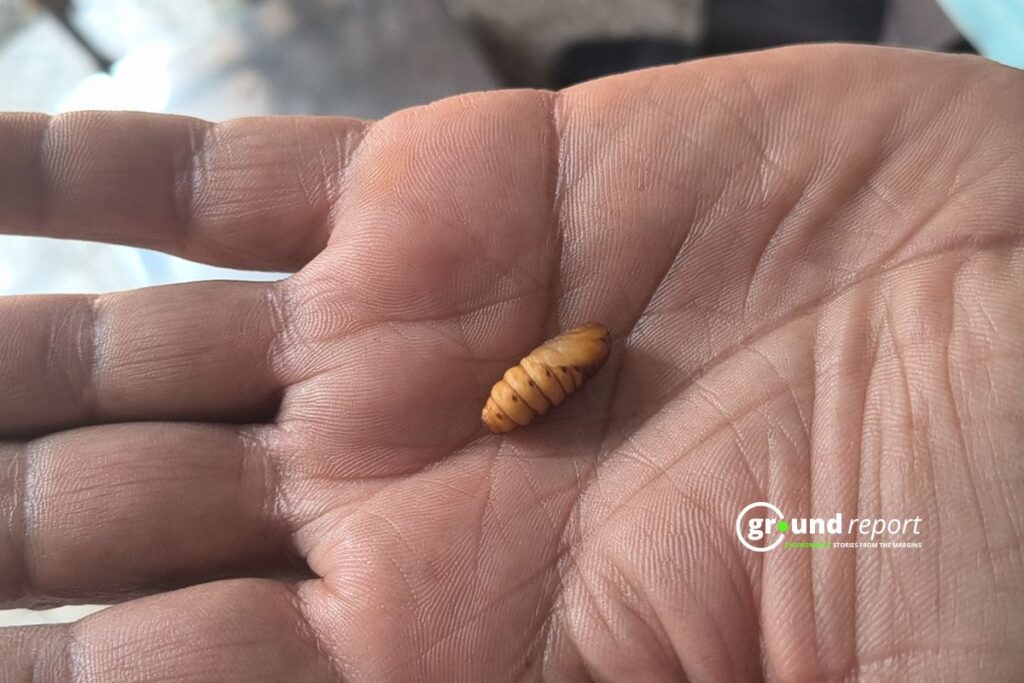
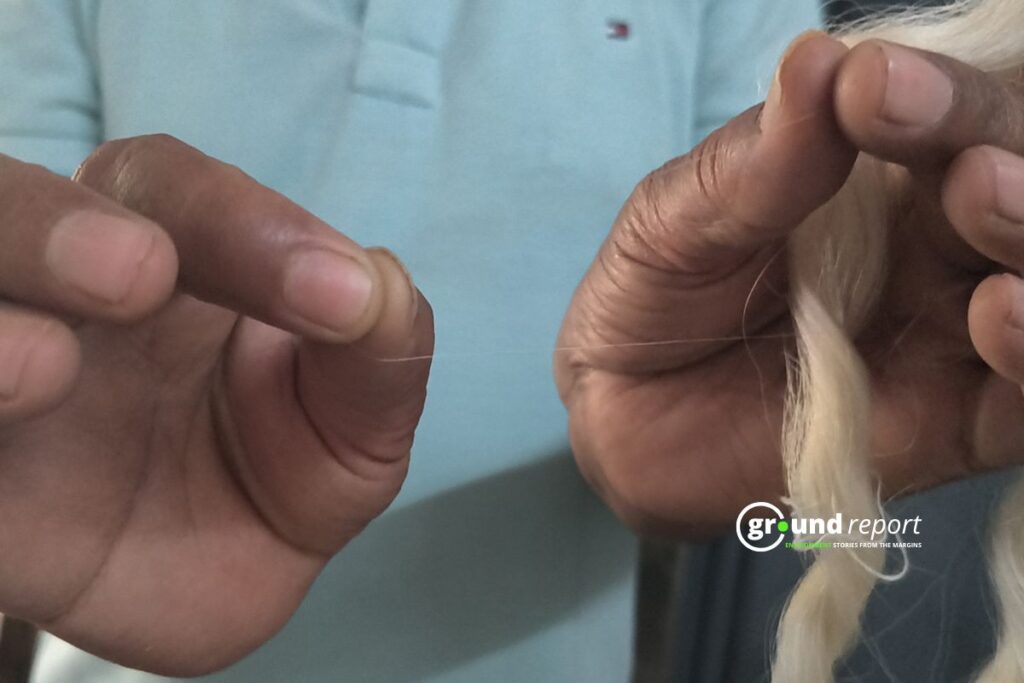
These cocoons are then collected and boiled in water to soften the silk fibres. This allows them to be separated easily. The fine threads are then reeled out using machines or spinning wheels — a process called reeling. After spinning and dyeing, the threads are woven on looms into fine silk fabric.
Climate Change and Silk
State minister for cottage and village industries Dilip Jaiswal says, 2.64 lakh kilograms of mulberry cocoons were produced over the past two years. Yet the state’s total silk output has fallen from 100 metric tonnes in 2018–19 to just 15 metric tonnes by December 2022.
Junior Inspector Dilip Jain, posted in Rajgarh, attributes farmer disengagement and low output to the local environment. “Rising temperatures and inadequate water supply are killing the worms or leaving them vulnerable to diseases for which there is no cure.”
He notes that the department used to manage everything, from weeding to daily labour. But now all responsibility rests with the farmer. The department now supports production only through the “chawki stage,” the initial, delicate phase of larval rearing.
In practice, the department raises the worms for only the first eight to ten days before handing them over to the farmer. After that, the farmer alone is responsible for feeding leaves to the worms while maintaining precise temperature and humidity levels throughout their development.
The ideal temperature for rearing mulberry silkworms is between 24°C and 26°C, with humidity requirements of 70 to 85 percent. Silkworms are ectothermic, making them highly sensitive to environmental fluctuations and adverse conditions such as excessive heat.
Severe heat stress can impair larval strength and feeding capacity. A moderate rise in temperature may initially improve metabolic activity and survival rates, but prolonged exposure to high temperatures leads to physiological stress, weakened immunity, and increased susceptibility to disease.
Mulberry silkworms are vulnerable to four main diseases — grasserie, flacherie, muscardine, and pébrine. All primarily triggered by temperature and humidity fluctuations.
Deputy Director Yogesh Parmar offers his own explanation for falling output: “This work is entirely water-dependent. Rajgarh and Guna face water scarcity, which is why interest is low. In the Chambal region, there’s no sericulture at all because of the same reason.”
An Entire District on One Employee’s Shoulders
The silk centre at Sarangpur in Rajgarh district spans roughly 50 acres. A single Grade-III employee manages the entire district. The officer currently posted here also holds charge of three additional districts.
Jain confirms this: “Earlier, there was a staff of ten to twelve people here. Today I am alone for the entire district. If production doesn’t happen, it reflects badly on our performance reports.” He adds that over the past few years, the cost of silk production has risen sharply while cocoon prices have remained stagnant.
A retired department official, speaking on condition of anonymity, says: “In districts like Rajgarh, Ujjain, Dhar, and Guna, production is negligible… Senior officials wanted to shut these centres down, but they’re limping along after some adjustments. There isn’t a single officer who doesn’t hold charge of three or four districts.”
Other districts aren’t better, either. According to a report by Dainik Bhaskar, two of Indore’s four silk centres have been padlocked shut. The remaining two, it reported, are together producing less than ₹60,000 worth of output in an entire year.
A Budget of ₹4,000 Crore, and Less Than ₹4 Crore for MP
Minister Jaiswal states that 3,600 mulberry and 850 tasar (kosa) cocoon-producing farmers in the state have been brought under self-employment schemes. He says that over two years, the directorate has facilitated new mulberry plantations across 231 acres in the private sector and 200 acres at government silk centres.
Yet, in 2020–21, the department was forced to surrender approximately 60 percent (59.58%) of its allocated budget for silk industry development back to the government, unspent. Similarly, 50 percent (50.70%) of the budget earmarked for irrigation infrastructure at silk centres was returned unused.
The central government runs the Silk Samagra-2 scheme to boost sericulture and increase the incomes of farmers and weavers. The scheme aims to raise silk production, productivity, and quality. For the period from 2021 to January 2026, the centre had provisioned a total budget of ₹4,424.90 crore under this scheme.
Under Silk Samagra-2, a total of ₹1,374.44 crore has been allocated to 26 states. Madhya Pradesh received a mere ₹2.93 crore, the second lowest in the country, just above Kerala’s ₹2.44 crore.
In short, there is insufficient budget for silk in the state, insufficient spending of what little is allocated, and insufficient production to show for any of it.
A Target of Four Lakh Kilograms
In Madhya Pradesh, there is a “Betul Model”. In Betul, a collaboration between PRADAN and the silk department has recast farmers not as scheme beneficiaries but as entrepreneurs with a stake in the outcome.
The model’s strongest pillars are cooperative structures such as Mahila Resham Samitis (Women’s Silk Committees) and the Seemant Krishak Shahtoot Krimi Palan Sangh. Betul farmers practice “batch rearing” — collective silkworm rearing — which distributes the burden of leaf management across the group. Farmers have also established an emergency fund to compensate for losses caused by disease or adverse weather.
And, through collective marketing, the Betul Model has ensured annual farmer incomes of between ₹40,000 and ₹1,00,000.
Minister Jaiswal has announced that mulberry cocoon production will be increased from the current 1.50 lakh kilograms to 4 lakh kilograms over the next three years, with an additional 3,500 acres brought under new mulberry plantation. A Silk Interpretation Centre is planned in Pachmarhi, Narmadapuram district.
So far, 5,000 farmers in the state have been trained in new cocoon production techniques. A plan has been drawn up to provide skill-enhancement training to 6,200 more beneficiaries over the next three years. The Chief Minister has announced that ‘Prakrat’ silk showrooms will be opened in Gwalior, Jabalpur, and Ujjain. Feasibility is also being explored for projects similar to the Pachmarhi Silk Tech Park in Ratapani and Amarkantak.
But Jain says that the government must pay attention to silk prices. “Farmer profitability has to improve,” he says. “Only then will new people come forward, and only then will the scheme succeed.”
Support Us To Sustain Independent Environmental Journalism In India.
More Ground Reports
He Was Married as a Child, Now Manish Dangi Helps Stop It for Others
Despite The Ban, How Gutkha Became MP’s Most Common Household Habit