हिंदी में पढ़ें | Narendra Rathod from Devli village, about 35 km from the Khargone district headquarters, had sown cotton, chilli, maize, and sorghum across his 15 acres. On 8 acres, he had planted two cotton varieties. He showed both packets side by side.
The yellow packet carried the name NCS-866 Bt-2 in large letters, followed by Asha-1 in smaller text along with the company name, manufacturer’s address, price, and a clear statement that Nuziveedu Seeds had received approval from the Genetic Engineering Appraisal Committee (GEAC) in 2010 to sell this seed in the Central Zone.
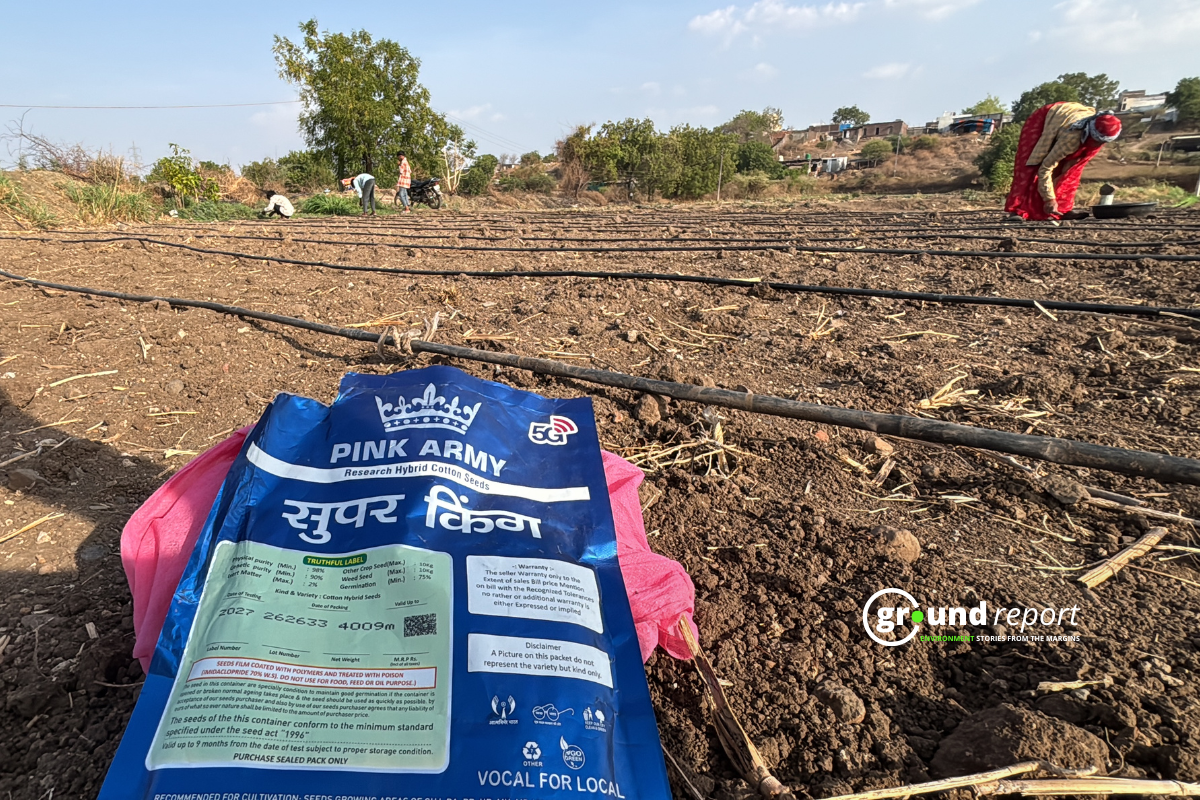
The second packet, labelled ‘Jaguar 5G’, carried none of this. There was no manufacturer’s address, no mention of GEAC approval. It said it was released solely for “trial and demonstration among farmers”. Yet Narendra paid ₹1,000 for it, more than the ₹901 he paid for Asha-1.
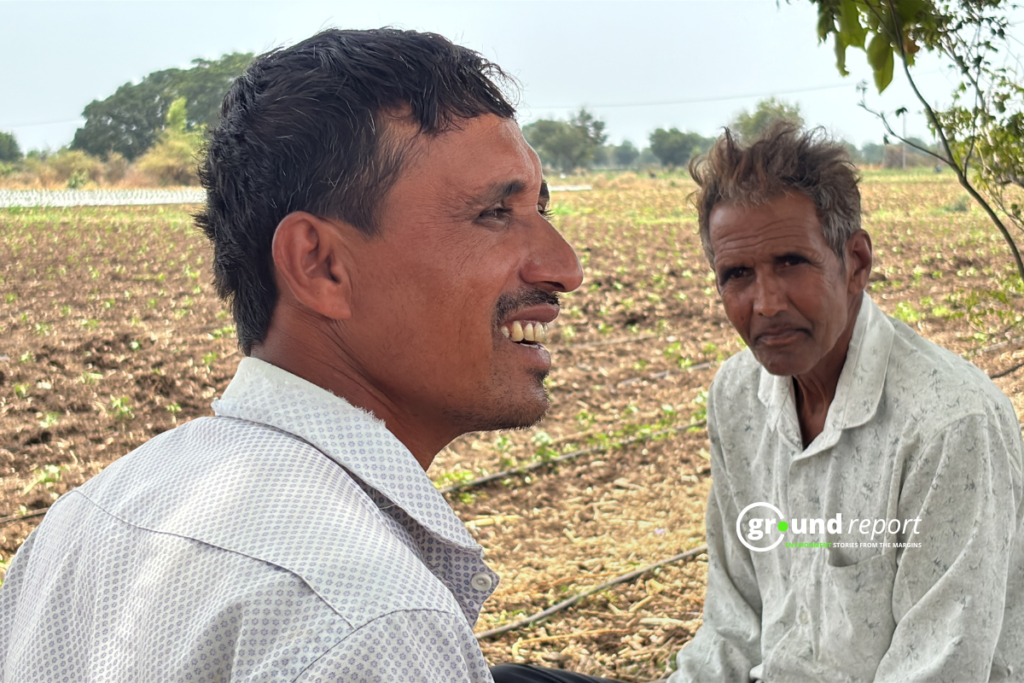
“This time I sowed Nuziveedu company’s Asha One and two packets of Jaguar’s ‘5G’,” he said. “If the results are good again this time, next season I’ll plant 5G across the entire field. It’s better than Asha.”
Pandhari Patidar of Idartpur Badi Chhalpa, Khargone, said a farmer spent up to ₹5,000 in a single season just on weed removal. “These [5G] seeds made it possible to destroy weeds at a lower cost,” he said.
Unlike conventional Bt cotton, which could not withstand herbicide sprays, the ‘Jaguar 5G’ variety allows farmers to spray glyphosate-based herbicide – sold as ‘Roundup’ – directly onto the standing crop. The herbicide kills the weeds but leaves the cotton plant unharmed. This, in turn, cuts the need for expensive manual weeding.
Dr Rajiv Kumar Singh, a scientist at the Krishi Vigyan Kendra in Khargone, confirmed that weeds growing alongside cotton competed for water and nutrients. This leads to yield losses if not regularly removed, and the labour cost of weeding is a constant pressure on farmers. Amidst this, an herbicide-tolerant (Ht) seed is attractive.
Though the central government had not yet granted permission to cultivate this variety commercially.
A Ground Report investigation found packets of unapproved herbicide-tolerant cotton seeds – known among farmers simply as ‘5G’ – available over the counter in Khargone’s markets. They are sold without bills, labels, or any regulatory approvals required by Indian law.
The seeds, developed by Monsanto, have been pending government clearance for over a decade. They have quietly spread across India’s cotton belt since at least 2010.
Farmers wanted it legalised. Experts warned it should not be.
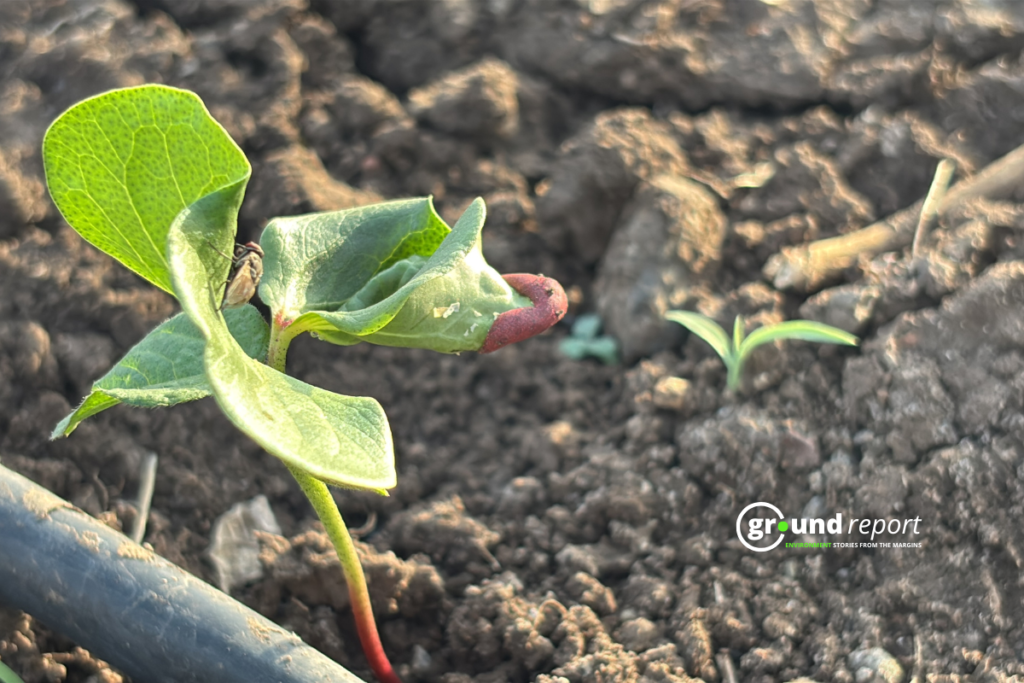
What Is ‘5G Cotton’, and Why Is It Illegal?
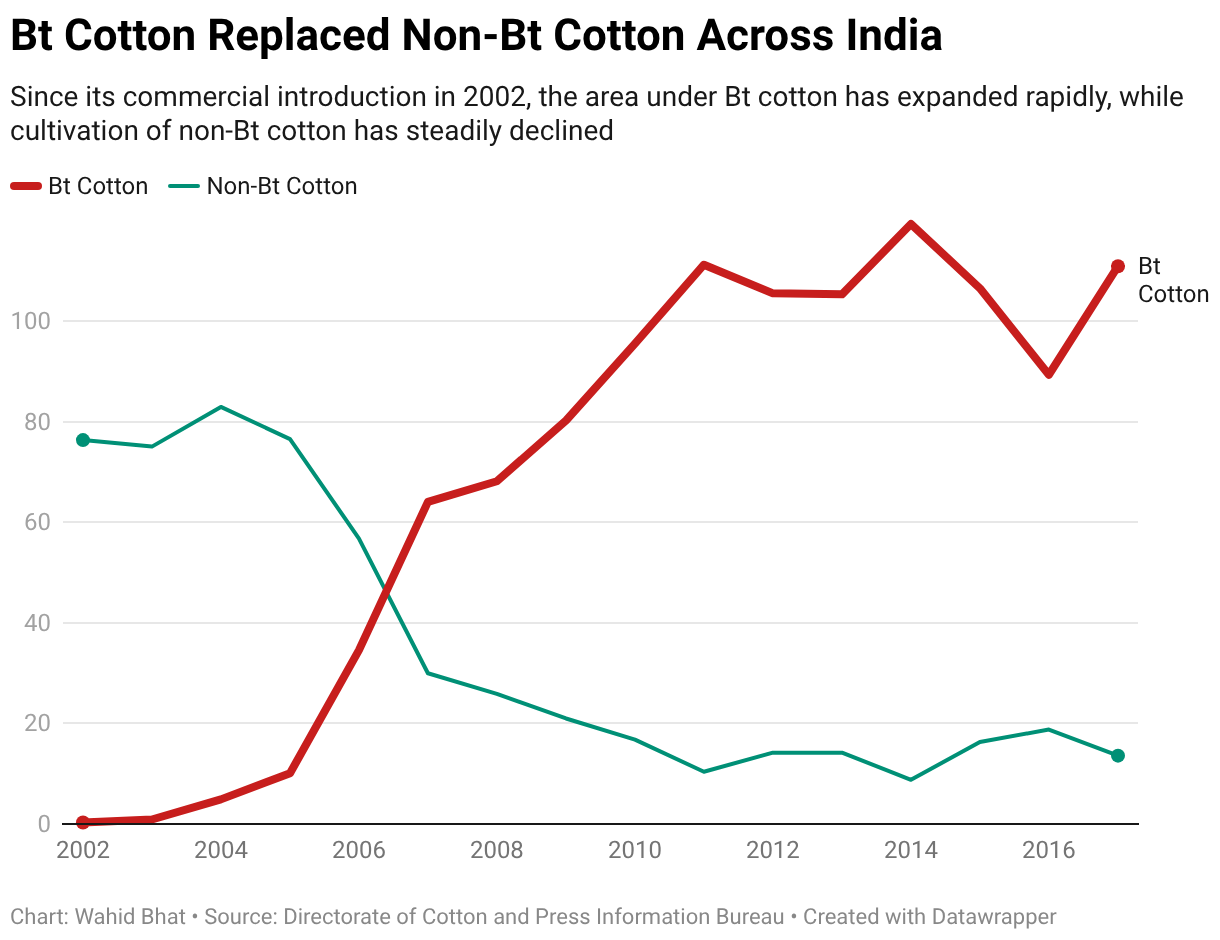
India’s first and only approved genetically modified (GM) crop is Bt cotton, which received regulatory clearance in 2002. All Bt cotton plants carry one or more foreign genes from the soil bacterium Bacillus thuringiensis, which causes cotton plant cells to produce crystal insecticidal (Cry) proteins that protect against major pests such as tobacco budworm, bollworm, and pink bollworm. Varieties with the Cry1Ac protein — marketed as Bollgard-I — were approved in April 2002.
A second generation carrying two Bt genes, Bollgard-II, arrived in India in 2006.
By 2010, 85% of Indian cotton had been converted to Bt cotton, according to the National Seed Association of India (NSAI). At the time of this reporting, about 95% of all cotton grown in India was Bt cotton.
The variety being sold as ‘5G cotton’ in Khargone was a different product altogether: Bollgard-II Roundup Ready Flex (BG-II RRF), developed by Monsanto. Unlike standard Bt cotton, it contains the CP4-EPSPS gene sequence, which makes the crop resistant to glyphosate – the active ingredient in ‘Roundup’.
Officially, ‘Roundup‘ was developed by Bayer, a German company with interests in agriculture, health, and nutrition, which acquired Monsanto in June 2018.
Monsanto applied for GEAC approval in 2007 for a new GM cotton variety and submitted biosafety data by 2013. But then withdrew its application.
In our reporting across various villages of Khargone, this variety was sold under different names: Sikandar-5G, Rudra, and Super King. Packets varied in name and colour, but all carried the label ‘5G’. Among farmers, it was simply known as ‘5G cotton’.
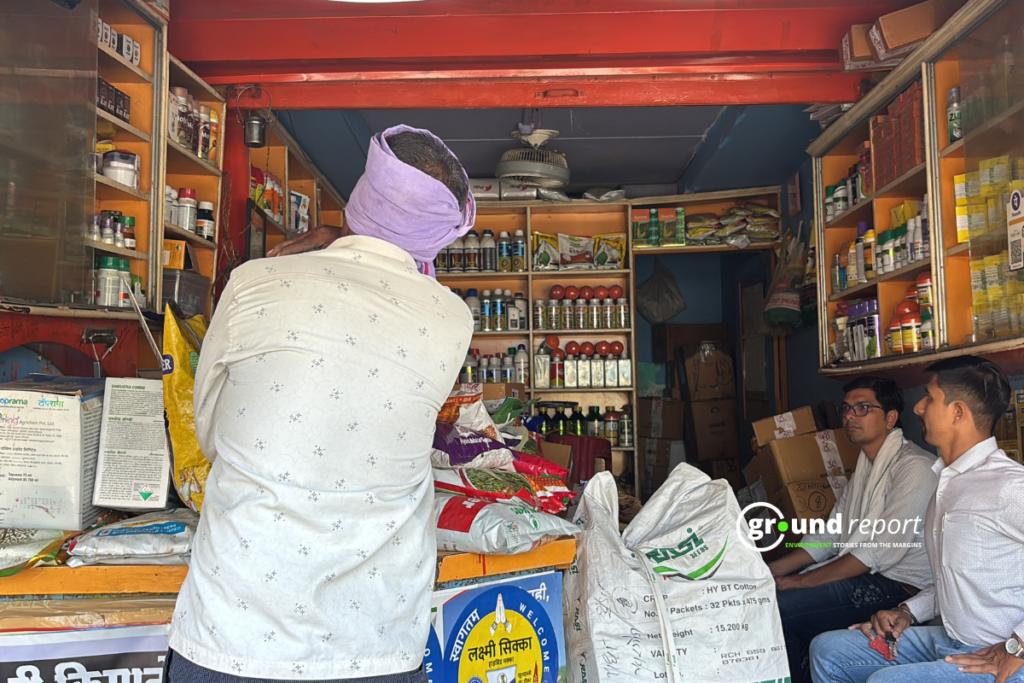
How We Found the Seeds
In May–June, we visited seed shops in various villages of Khargone and asked for ‘5G cotton’. Most shopkeepers asked for our address and denied any knowledge of such seeds. The same response came from shops near the bus stand and the agricultural produce market in Khargone town.
We then sent a farmer to Renuka Enterprises, a shop near the bus stand. After brief questioning, the shopkeeper handed over two packets of ‘Sikandar 5G’, without a bill, for ₹1,000 per packet.
Dashrath Rathod of Devli, who farms cotton on 4 acres, also conducted his own sting operation near his village of Barud. In the video, he asked a shopkeeper about the availability of 5G cotton. The shopkeeper quoted ₹1,100 per packet, conditional on purchasing more than one, and offered to procure more from Khargone City on request.
Dashrath said he had never planted ‘5G cotton’ himself. “Buying seeds without a bill left me with no recourse in case of crop failure or compensation claims,” he said.
A Decade of Illegal Spread
Dashrath first heard about ‘5G cotton’ in 2022. “It was May, sowing time for cotton,” he recalled. “I was sitting at a tea stall with fellow farmers. We were talking about the difficulty of finding labourers for fieldwork. Then one farmer mentioned that a seed called ‘5G’ had come, in which you could apply herbicide.”
But the seeds had been circulating far longer than that.
Dr D. Narsimharao Reddy of Coalition for a GM-Free India said that in 2013, members of the Coalition for a GM-Free India learned that farmers in Andhra Pradesh were cultivating HT Bt seeds. A team was then formed, comprising coalition member Kavitha Kuruganti, a representative from Safe Food Alliance, and a local activist to investigate the leads.
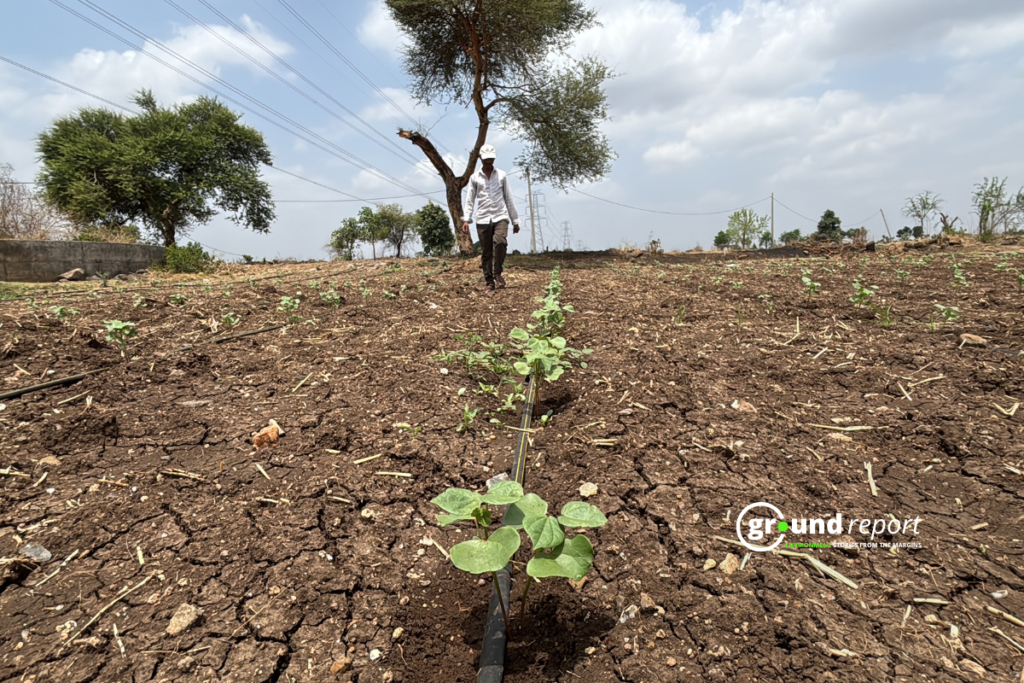
The fact-finding report, accessed by Ground Report, found that farmers in Srikakulam district of Andhra Pradesh had been growing the variety, locally called ‘Gaddi Bt’, since 2010.
Influential local people had brought in the seeds and were acting as distribution agents.
Reddy said that this report was also sent to the central government at the time. But he received no official response. The government then formed its own committee in 2017.
What the Government Probe Found
In 2017, the Department of Biotechnology under the Union Ministry of Science and Technology formed the Field Inspection and Scientific Evaluation Committee (FISEC) to assess the true extent of 5G cotton cultivation.
The committee investigated fields across Andhra Pradesh, Telangana, Maharashtra, Punjab, and Gujarat.
It found that 15% of the cotton-growing area in Andhra Pradesh, Gujarat, Maharashtra, and Telangana was under this variety, and 5% in Punjab. Farmers had received seeds in unmarked packets without bills or proper labelling.
The committee also found that certain seed companies, those with access to parent lines carrying the Roundup Ready Flex gene, were involved through organised breeding activities.
It was not, however, Mahyco (Maharashtra Hybrid Seeds Company), which had applied formally for approval of the variety, that was behind the illegal supply. The documents available to Ground Report did not specify which companies were responsible.
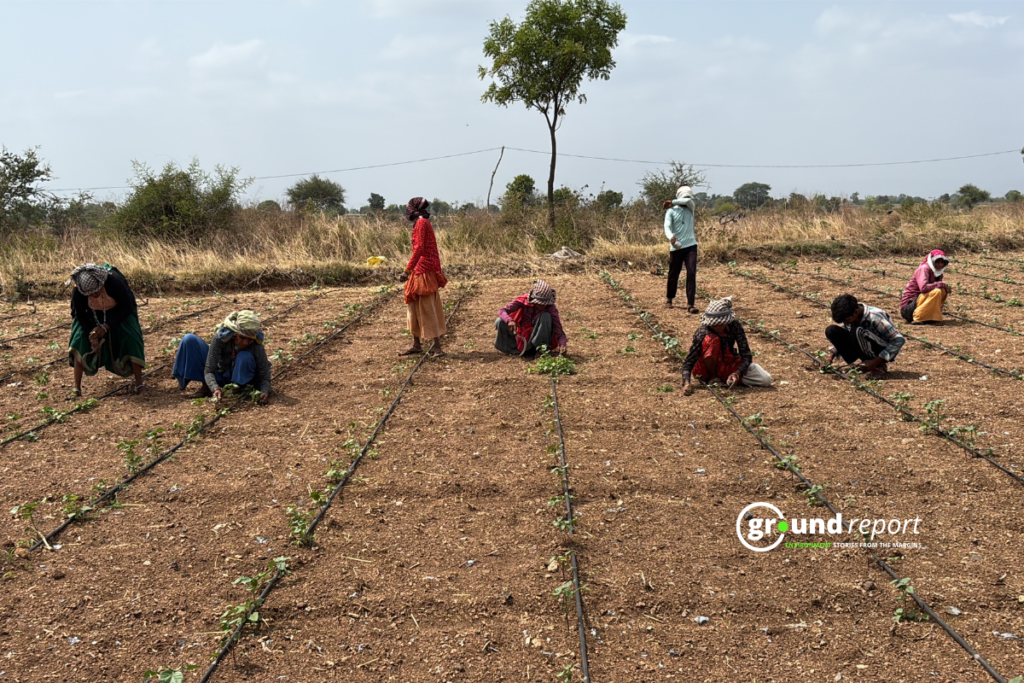
In May 2018, the committee submitted its report and recommended action points for implementation by central and state government departments.
The report declared herbicide-tolerant cotton seeds and their parental lines illegal. State governments were told to act before the 2018 sowing season. They had to find such seeds anywhere in the supply chain. They had to seize and destroy them. This was meant to stop the seeds from spreading further.
The report also called for stricter labelling rules for GEAC-approved seeds. The goal was to keep biosafety data and the identification of commercial hybrids consistent.
This applied to approved events like BG-I and BG-II. It had to stay the same across all seed batches. The report further recommended strict enforcement of label rules for glyphosate herbicides, such as Roundup. This was based on the Insecticides Act, 1968, and its related government rules.
Even before the committee submitted its report, the Maharashtra government had already formed a Special Investigation Team (SIT) in February 2018 to probe the sale of herbicide-tolerant cotton seeds. According to a Times of India report, authorities seized 1.8 crore HT Bt seeds in Maharashtra between April and June 2018.
Andhra Pradesh acted too. In February 2019, the state cancelled one company’s licence over illegal HT Bt sales. It also suspended the licences of 13 other companies for a year.
Parliament received further figures in July 2019; Maharashtra had seized 9,387 illegal cottonseed packets and 1,087 kilograms of loose cottonseed, together worth Rs 102.87 lakh. Police filed 20 FIRs against the accused across various stations.
The state government in Gujarat reported eight cases of HT cotton seeds between 2018 and 2019. Officials filed seven FIRs against those accused of selling HT cotton seeds in Vadodara, Kutch, Sabarkantha, and Gir-Somnath, while one case remained under investigation in Bhavnagar district.
Telangana’s enforcement was the most extensive of all. The state tested 302 seed samples in 2019, and 8 came back positive for the HT trait. Officials registered 40 cases and arrested 44 people. They also took administrative action against 7 seed licences. In total, they seized 29,647 quintals of HT-trait seed stock, worth Rs 907 lakh.
On 10 August 2021, the government told the Lok Sabha that no state had reported the production of unapproved Bt cotton seeds.
Still Waiting for Approval
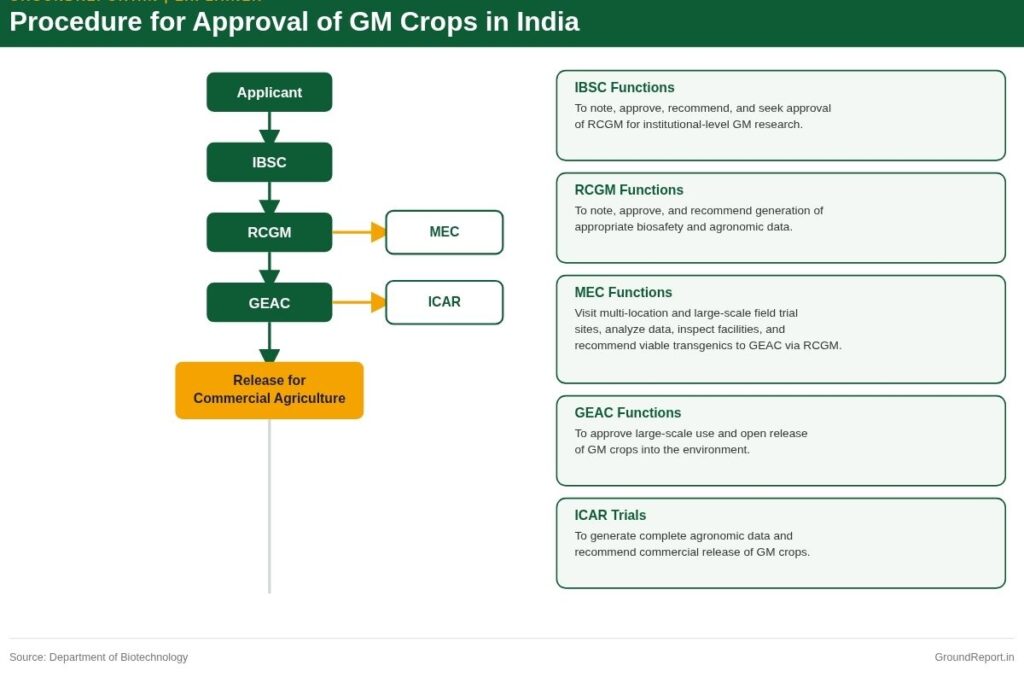
Under the Environment (Protection) Act, 1989, India has a multi-stage statutory process for granting legal approval to GM crops. A proposal goes first to the Institutional Biosafety Committee (IBSC), which recommends it to the Review Committee on Genetic Manipulation (RCGM).
The RCGM oversees biosafety and agronomic data collection. During this process, the Monitoring cum Evaluation Committee (MEC) visits field trials and forwards safe varieties to the RCGM. Final approval, for what is called “environmental release,” or commercial cultivation, rests with the GEAC.
In April 2016, the central government cut the trait value (royalty) on a 450-gram packet of Bt cotton seeds. The royalty dropped from Rs 174.40 (for northern India) and Rs 163.28 (for the rest of India) to Rs 49 per packet.
Seed companies pay this royalty to Mahyco Monsanto Biotech (India) Private Limited (MMB), a joint venture between Mahyco and Monsanto, to sell BG-II seeds.
The Agriculture Ministry issued a notification in May 2016 under the Essential Commodities Act. This notification stripped MMB of its patent rights on Bt cotton technology, in effect.
On July 6, 2016, Monsanto withdrew its proposal to the GEAC for approval of HT Bt cotton. Company spokesperson Christi Dixon told Bloomberg the company cited “regulatory uncertainty and ongoing discussions” as the reason.
However, in 2022, MMB applied to the GEAC once again for approval of HT Bt cotton. The company’s managing director, Shirish Barwale, told NDTV Profit, “Driven by farmers’ concerns, we have reapplied in good faith.”
Union Minister of State for Agriculture and Farmers’ Welfare Bhagirath Choudhary informed the Lok Sabha on 5 August 2025 that a proposal for the environmental release of BG-II RRF was still under consideration.

Health, Yields, and Accountability
A parliamentary reply on 12 August 2025 confirmed that the Seed Industry Association and some farmers’ groups were actively demanding its release.
Shetkari Sanghatana, a Maharashtra-based farmers’ organisation, ran a campaign against the state government’s moves to ban these seeds.
Farmers themselves were split on whether the variety delivered on its promises.
Dr Reddy said that since India lacks detailed research on the outcomes of this cotton variety, its use in fields is dangerous. He believes that the farmers are putting themselves at risk. His specific concern was glyphosate.
In March 2015, the International Agency for Research on Cancer (IARC) classified glyphosate as “probably carcinogenic to humans” (Group 2A) based on limited evidence in humans and sufficient evidence in experimental animals.
A 2019 meta-analysis by Zhang et al., published in Mutation Research, found that heavy exposure to glyphosate-based herbicides was associated with a 41% increased relative risk of non-Hodgkin lymphoma (NHL), a form of blood cancer.
The World Health Organisation’s Joint FAO/WHO Meeting on Pesticide Residues concluded in 2016 that glyphosate was “unlikely to pose a carcinogenic risk at doses relevant to human dietary exposure”.
The Administration’s Response
SS Rajput, deputy director of the Farmer Welfare and Agricultural Development Department in Khargone, said information about cotton seeds being sold under the name ‘5G’ had come to his notice.
He stated that teams had been formed across all development blocks in the district to search shops, but no seeds had been found. The farmers questioned had also not provided any information.
“If seeds by the name 5G are found, action will be taken,” he said.
To find out what action the central government has taken so far on complaints about the sale of herbicide-tolerant seeds outside Madhya Pradesh. And, whether the GEAC has made any progress on approving this variety, we tried to reach Union Agriculture Minister Shivraj Singh Chouhan through his aides.
However, we were unable to get in touch with him.
Note – Amit Bhatore, a senior journalist based in Khargone has provided the filed support to this reporter.
Support Us To Sustain Independent Environmental Journalism In India.
More Ground Reports
Rajgarh’s Groundwater Campaign Is Pushing Wastewater Underground
Why Is India’s Solar Push Ignoring Surface Water, Canal Farmers?