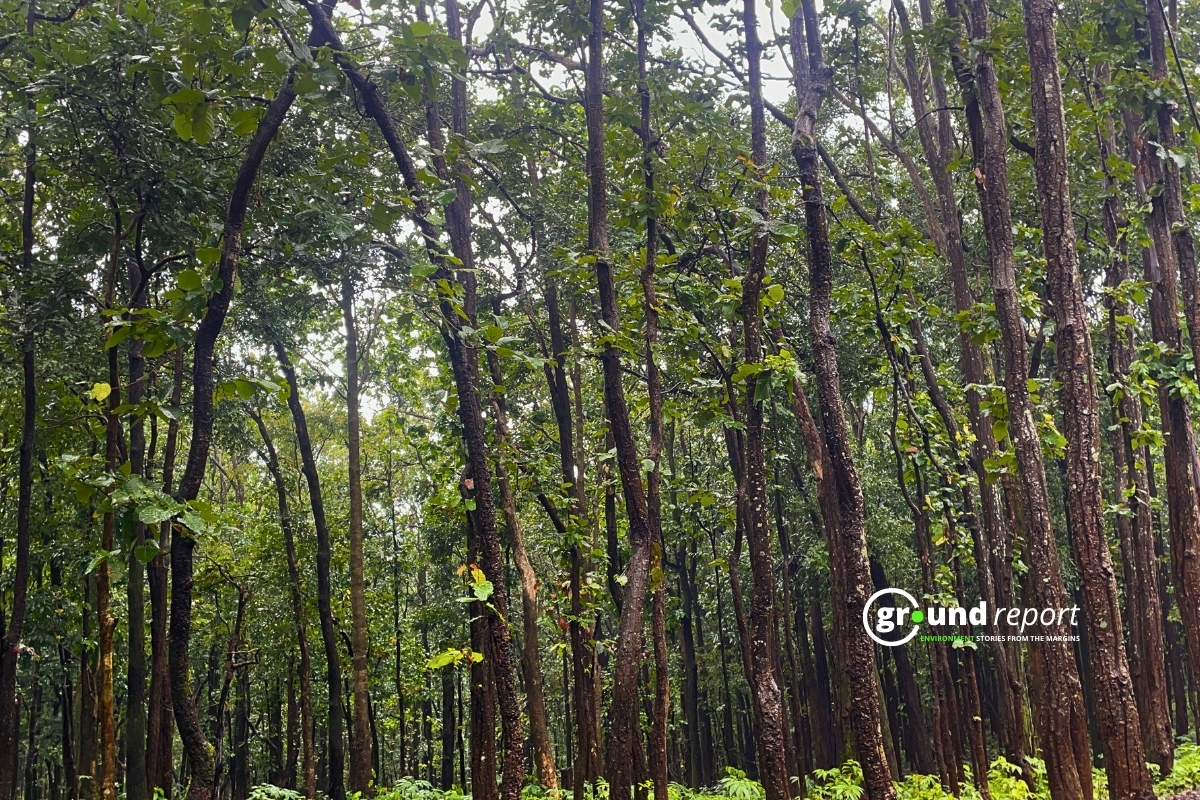
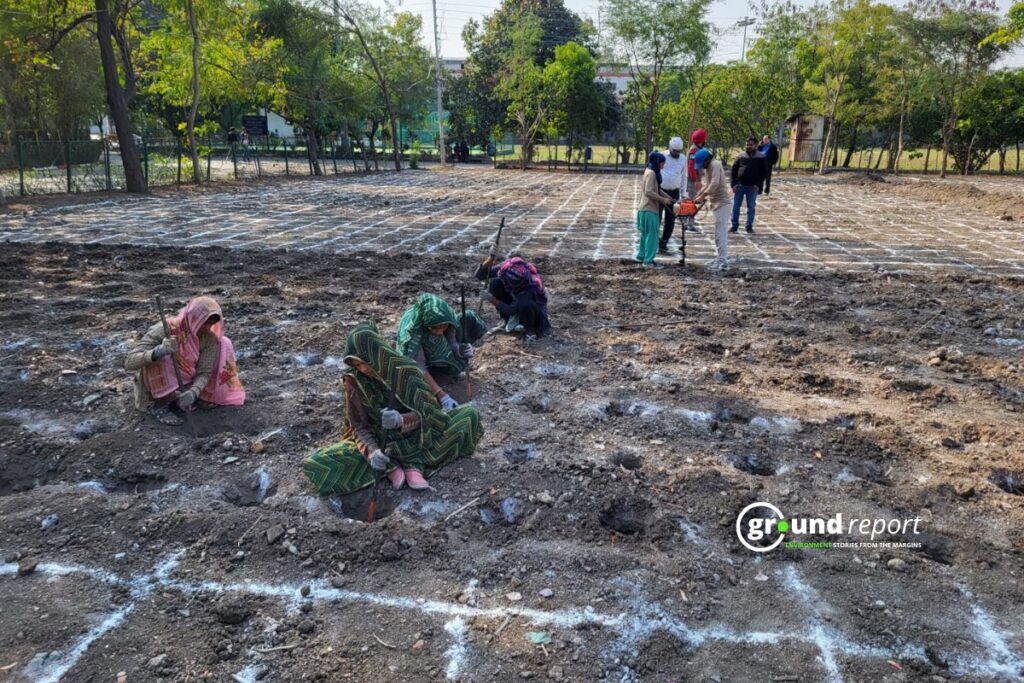
In February 2024, Shri G S Institute of Technology and Science (SGSITS), a government-aided autonomous institute in Madhya Pradesh, launched a five-day plantation drive. “Around 3,500 people participated: planting 8,000 saplings of 65 species, including 25 endangered ones,” said Neetesh Purohit, director of SGSITS.
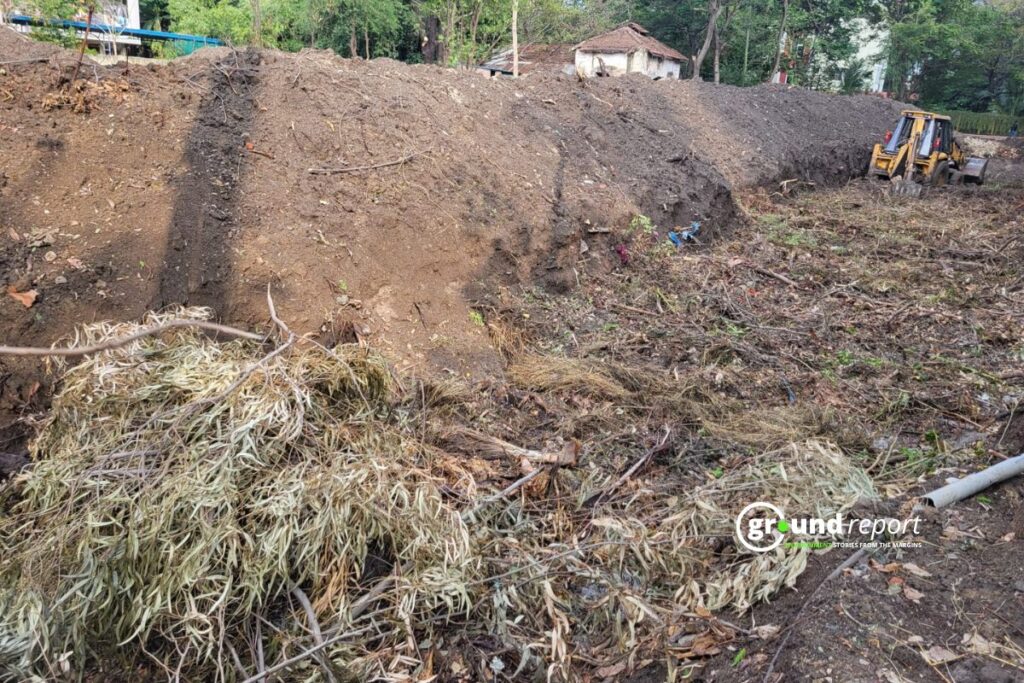
Alex Mundapuzha, who is in charge of the forest at SGSITS, dug five-foot holes and layered the soil five times—dry leaves collected from SGSITS’s own 30-acre campus, roughly 200 trolleys’ worth, topped with black soil, waste organic matter from Indore’s Choithram Mandi market, vermicompost, and compost.
He looked for plants that once grew naturally in and around Indore but have largely vanished due to urbanization—species like sesame and mulberry. The late Dr. R.K. Saxena, then director of SGSITS, motivated and supported the project from the start.
Two years after the urban forest was open to the public. “About 90 per cent of those saplings survived. Many reached 15 to 20 feet tall,” Purohit said. “The media itself measured a difference of at least two to five degrees,” Mundapuzha said. “We published the same thing on Environment Day.”
The forest was developed using the Miyawaki technique—a Japanese method, developed by Japanese botanist Akira Miyawaki, that plants native saplings in dense clusters, forcing them to compete for light and grow up to ten times faster than conventional plantations—with support from HDFC Bank’s Corporate Social Responsibility (CSR) initiative.
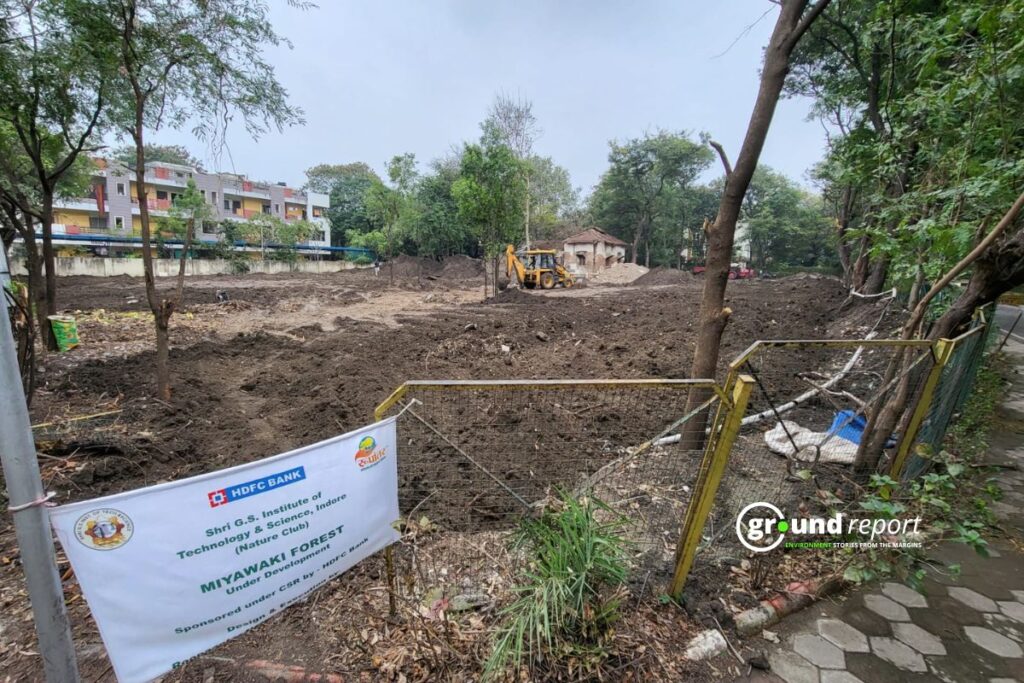
Indore’s groundwater has dropped to 160 meters—nearly double the 2012 level—and extraction exceeds the sustainable limit by 20 percent, leaving Miyawaki forests dependent on borewells facing a challenge. “The bigger the plant, the more water it needs… That is the main challenge we are facing,” Mundapuzha said.
India’s cities are getting hotter and denser, but greener only on paper. Urban green cover is shrinking as construction expands. Temperatures in cities like Indore regularly breach 44 degrees Celsius in summer. The demand for fast, affordable green spaces has never been higher.
In India, Mumbai has over 64 Miyawaki forests. In 2024, the National Highways Authority of India identified over 53 acres near Delhi-NCR for Miyawaki plantations. Madhya Pradesh has projects running in Bhopal and Indore, mostly funded by CSR grants. At a global level, Japan, Brazil, Chile, and Jordan have adopted it.
But Fazal Rashid, an ecological gardener working across Central India and Rajasthan, is skeptical. “Take any piece of land, put money and energy into it for three years, do anything, and there will be some improvement,” he told Ground Report. “What is your benchmark? On what basis are you calling it successful?”
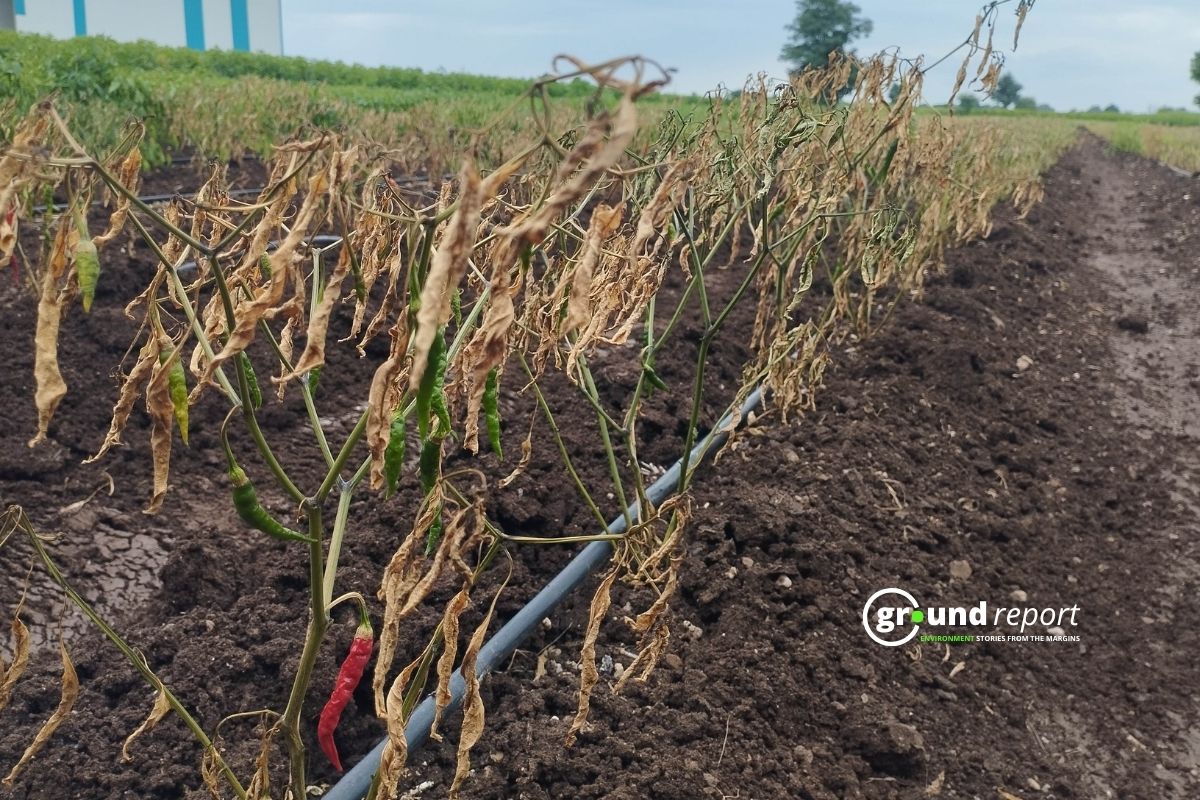
The critics argue that many companies use Miyawaki forests as a public relations tool. Rashid said the model can serve as greenwashing and give governments and corporations a way to avoid accountability. Many scientists, ecologists, and on-the-ground practitioners say the Miyawaki method carries serious problems that its growing popularity has buried. They say the evidence of success is “weak,” the costs are “prohibitive,” and the claims are “huge.”
Evidence, or lack thereof
“Miyawaki created this formula for his own region after 30 to 40 years of deep work,” Rashid said. “You cannot just lift that formula and drop it into a completely different landscape.”
In December 2025, the Journal of Applied Ecology published a systematic review of the Miyawaki method titled “Tiny Forests, Huge Claims.” The study was led by Narkis S. Morales, Ignacio C. Fernández, Leonardo Durán, and Dylan Craven—researchers from New Zealand, Chile, and Germany.
They examined 51 documents—scientific papers, project reports, and grey literature published about the method worldwide. Only 41 per cent provided any measurable data at all.
Only about one-third of the studies compared Miyawaki forests against a control plot—a similar area left untreated or planted differently. Fewer than 15 percent repeated the experiment across multiple sites, limiting confidence that the results were not simply due to chance.
The study concluded that the reported outcomes provided weak to null evidence for most of the method’s claimed benefits.
Karen D. Holl, a professor of environmental studies at the University of California, Santa Cruz, who has studied reforestation for 30 years, said
“People make big claims, but I’ve always been a bit skeptical because it’s so densely planted,” she said. “When that paper came out saying the claims were not supported, I was not surprised.”
The same 2025 study found that eight of 51 papers claimed Miyawaki forests enhance carbon sequestration. Yet only two studies directly measured carbon stocks, and neither found a statistically significant advantage over other planting methods.
Ecological Niche and The Grassland vs Wasteland Question
Open grassy plots are routinely misclassified as wasteland and converted into Miyawaki sites. Grasslands are complete ecosystems with birds, insects, and soil organisms.
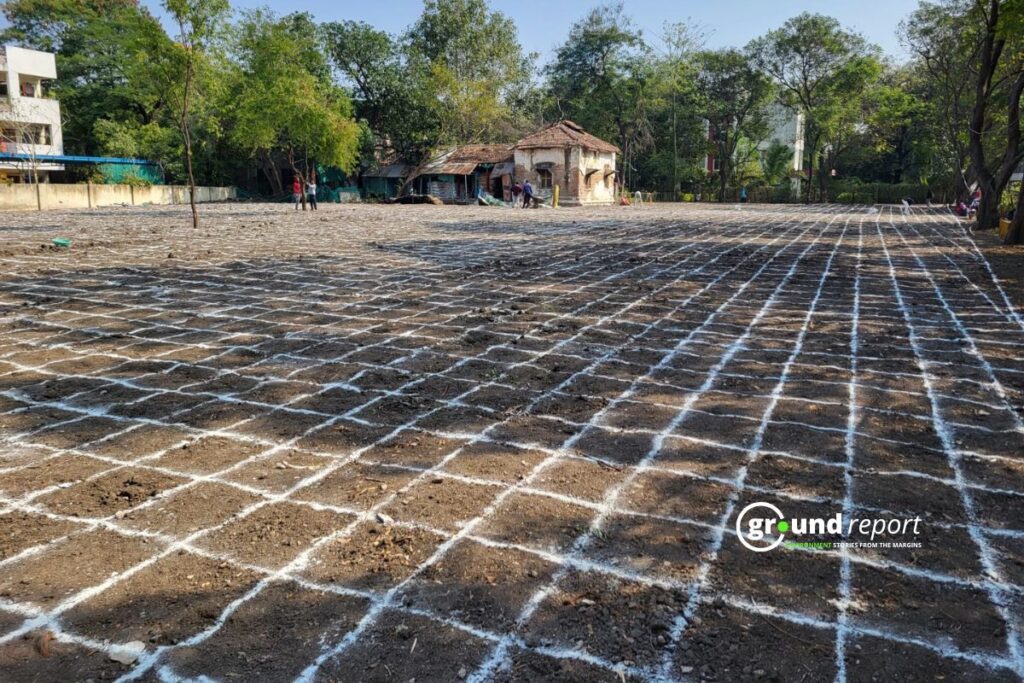
Anirban Roy, a doctoral researcher at the Ashoka Trust for Research in Ecology and the Environment (ATREE), Bengaluru, who studied Miyawaki forests in South India, told Ground Report, “Planting dense tree cover on naturally open land can reduce native grass and shrub diversity, threaten species that depend on open habitats, modify hydrological processes, and in some cases reduce ecosystem resilience to climatic variability.”
Ignacio Fernández C, who co-authored the same study, said the method was originally designed for light-limited ecosystems. In places where water or temperature are the main constraints—like much of India—it may simply not work. Narkis Morales, a forest ecology researcher who led the 2025 review, said, “Does every sick person need the same treatment? Probably not.
Morales told Ground Report each site must first be evaluated on its own—what it needs and what the goal is—and only then should anyone decide which method to use.
That’s what Fazal Rashid and Somil Daga wrote in The Wire Science. They said Indian practitioners routinely ignore what they call “ecological niches”—the specific soil type, drainage, and salinity that determine whether a tree survives.
Rashid visited a three-year-old Miyawaki site near Jaipur. The moisture-loving trees—babool and moringa—had taken over the canopy. He claims that, because of this ignorance, the plants from rocky, open areas were dying in the shade below.
Hall said planting trees in grasslands and scrublands is one of the biggest concerns she sees globally. “A lot of grasslands are very biodiverse habitats. They also store a lot of carbon in the soil,” she told Ground Report. “If you plant trees that transpire a lot of water into drier lands, you can actually reduce the water supply.”
Mannvir Singh Khanuja, founder of Green Heaven Creations, a Startup India-registered firm in Indore that implements Miyawaki forests, says, “You look at individual plantations in Indore—on Road 140, there are Gulmohar trees on both sides,” Khanuja told Ground Report. “It works like a green barrier. It can make a slight difference in temperature. But it cannot create that moisture, that biodiversity.”
Supplying Native Species
For three to four years, Rashid supplied native saplings to Miyawaki projects across India. “The supply of true native species is very low. There are very few people who actually grow them,” he said. “The actual saplings that come in large numbers are very rare. So, they take whatever is available from a nursery and adjust it to fit their list.”
Shubhendu Sharma, founder of Afforestt, an organization to bring back “lost native forests,” dismisses criticism of the technique.
Sharma was an industrial engineer when he attended Miyawaki’s lecture in Bengaluru in 2008. Though he agrees with “finding the native species in a region is a complex process,” he told Good Food Movement. “Many who say they practice Miyawaki don’t take it seriously and go to a nearby nursery. Identifying the right species and the combination of plants that can go together is the crux.”
According to their website, Afforest has planted forests across Asia, Africa, Europe, and the Americas, from the drylands of Rajasthan to urban pockets in the Netherlands. In an earlier interview, Sharma said Afforest has planted around 5 lakh trees across 150 forests in 50 cities worldwide. Their website also notes that Sharma created his own forest in Uttarakhand in 2010.
Still Betting Big
Despite criticism and failure of existing Miyawaki forests in Delhi—including concerns that they introduced non-native species and failed to restore local ecosystems—the approach continues to gain official backing. The Municipal Corporation allocated funds for five new Miyawaki forests in 2025–26, while the Delhi government plans two more near Najafgarh.
“Before committing public funds at scale…” Morales said they [policymakers] should also consider whether any demonstrated advantages justify its substantially higher costs.”
In the recently updated Nationally Determined Contributions (NDCs), India plans to “create a carbon sink of 3.5 to 4.0 billion tonnes of CO₂ eq. through Forest and tree cover by 2035 from the 2005 level.” For this reason and more, an urban forest would be essential.
The WHO recommends nine square meters of green space per person. Most Indian cities fall far short. According to the India State of Forest Report 2023, among the six megacities, Delhi has the largest forest cover at 194 sq km, followed by Mumbai at 110 sq km and Bengaluru at 89 sq km.
Indore, the state’s largest city, has just 9.3 per cent green cover — well below the national guideline of 12 to 18 per cent for urban areas. Bhopal, the state capital, covers about 11 percent of its district area under forests. Ujjain has just 0.59 percent. Madhya Pradesh ranks first in forest cover, but its cities are lagging in green space.
Rashid said, “Instead… we need to accept that rewilding is more about local people reconnecting with their local ecologies and beginning the slow process of restoring a relationship with each other and the land.”
Mundapuzha understands all the criticism levied on Miywaki as well. At the same time, Mundapuzha is confident in his achievement in Indore. Trees are flourishing, and recently, a jackal found it worth living in them. Some might consider that a genuine contribution.
And, for Indore, India’s cleanest city, which is at the forefront of the climate crisis, this would mean more than something. And what does the government need to scale it up? “Dedicated people,” Mundapuzha said, “without that, the success rate will be low.”
Roy also said most Miyawaki forests are too young and too small to prove anything yet. “Smaller forest patches often experience stronger edge effects and limited ecological connectivity,” he said. “We are still too early in the life cycle of most Miyawaki stands in India to draw definitive conclusions.”
“We are not against the Miyawaki method,” Fernández said. “But we are worried that a method that was designed for specific conditions is being applied everywhere.”
Support Us To Sustain Independent Environmental Journalism In India.
More Ground Reports
He Was Married as a Child, Now Manish Dangi Helps Stop It for Others
Despite The Ban, How Gutkha Became MP’s Most Common Household Habit