

On 17 April, a national report on India’s bats delivered an urgent warning for Madhya Pradesh, a cave in Jabalpur that once sheltered one of the world’s rarest bat species may now be empty.
The Durga Das’s Leaf-nosed Bat, known only from a handful of sites in India, was last documented in a narrow cave on a limestone hillock in Jabalpur district. The State of India’s Bats (2024-25) report calls for an immediate re-survey of the site. Urban expansion has swallowed much of the bat’s former habitat since 2013, and researchers believe the species may have disappeared from the area entirely.
Madhya Pradesh carries a second loss. Historical records show that the Champa Baoli monument once hosted colonies of Black-bearded Tomb Bats and Leschenault’s Rousettes. Both colonies are now gone. Researchers attribute their disappearance to mounting tourism pressure at the site.
The State of India’s Bats (2024-25) is the first comprehensive national bat assessment in nearly two decades. Thirty-six bat experts from 27 institutions compiled the 200-page report over two years. The Nature Conservation Foundation (NCF), Bat Conservation International (BCI), WWF-India, and the Centre for Wildlife Studies released it jointly on 15 April.
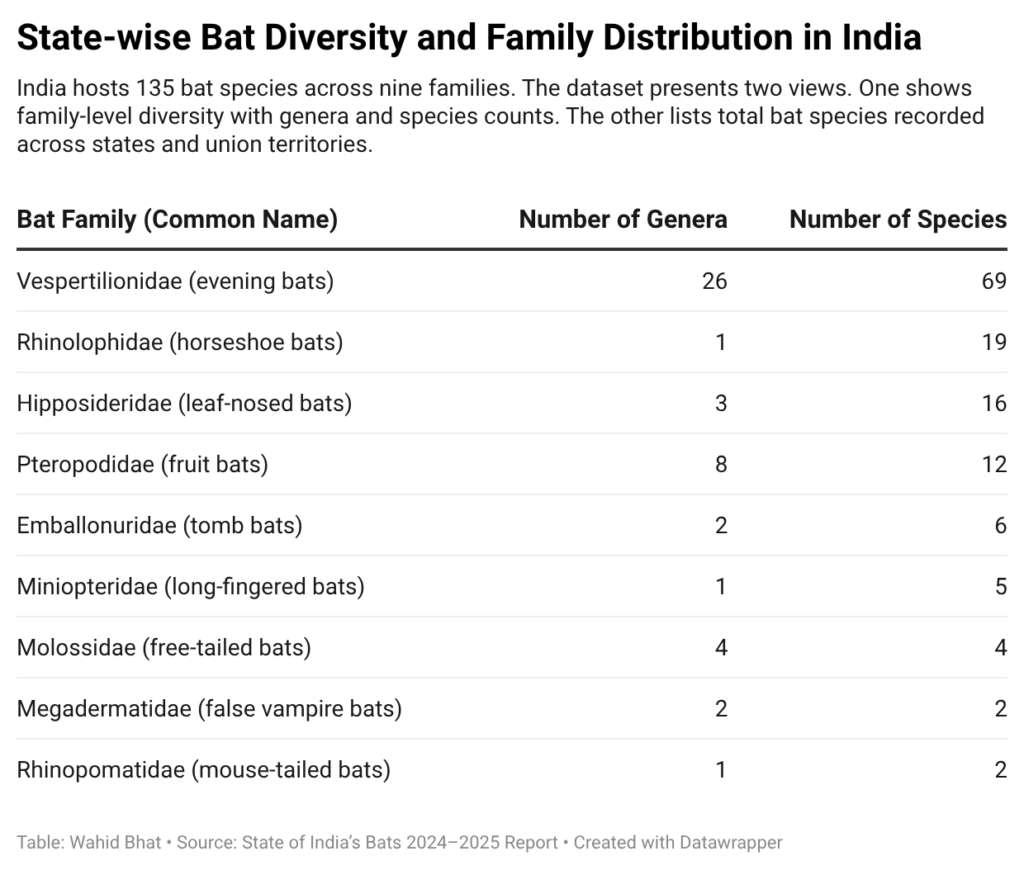
India is home to at least 135 bat species, more than any other mammal group in the country. Of these, 16 are found nowhere else on Earth. Seven are officially classified as threatened by the International Union for Conservation of Nature. A further 35 species carry so little data that their conservation status remains unknown.
Fewer than 50 dedicated bat researchers work across the entire country.
Rohit Chakravarty, bat researcher at NCF and BCI and a lead author of the report, said the shortage of researchers puts lesser-known species at serious risk. “There are seven species that are data-deficient and endemic to India. They are all extremely rare and we know far too little to claim that they are safe or threatened,” he told Ground Report.
“One of them, Peter’s Tube-nosed Bat, has not been seen since 1872. We need to train more people on the ground to ensure these species are not lost in oblivion,” he said.
Aditya Srinivasulu, a research affiliate at the Zoo Outreach Organisation in Hyderabad and a contributor to the report, said the data gap runs deep. “We have extremely limited government data. When a sighting is made, or we need information, most bat researchers reach out among themselves,” he said.
Caves, Monuments, and Vanishing Roosts
The report maps where bats live, and where they are losing ground. Most species roost outside protected forests, in caves, tree hollows, temples, old buildings, and historical monuments.
The critically endangered Hipposideros hypophyllus is known from just one cave at the base of a granite hill in Kolar district, Karnataka. The vulnerable Durga Das’s Leaf-nosed Bat shared that cave and also used the now-threatened Jabalpur site.
The Durga Das’s Leaf-nosed Bat (Hipposideros durgadasi) lives only in India. Scientists first found it in Jabalpur, Madhya Pradesh, in 1970. No one has confirmed a sighting there since the early 1990s. Urban expansion has destroyed its cave roosts. Only 150 to 200 mature individuals are believed to survive today, and that number is falling.
The IUCN lists it as Vulnerable, with a decreasing population and no known population estimate. Researchers later found it in Kolar, Karnataka, where illegal granite mining now threatens its remaining caves. No conservation measures currently protect this species.
“As of 2021, colleagues confirmed the Durga Das’s Leaf-nosed Bat was still being seen in Katangi, near Jabalpur. Unfortunately, the two sites within Jabalpur city where it was previously found, Richhai and Katanga, have been completely developed,” Chakravarty said.
“The species is now known to be more widespread than previously thought. We have confirmed it in Kolar, Karnataka, and in Mirzapur district in Uttar Pradesh. So the species is no longer at risk of going extinct, but we need to monitor these populations closely to prevent future threats,” he said.
In Mahabaleshwar, Maharashtra, Robber’s Cave holds what may be the largest known single roost of Phillip’s long-fingered bat, an estimated one lakh individuals during the breeding season.
Urban India presents a different picture. Delhi has 15 bat species, the highest count among all Union territories. But the city’s monuments, on which many of these bats depend, have become contested ground. The Archaeological Survey of India has, in multiple cases, removed bats from protected sites by installing bright lights, sealing roosting spaces, and using chemical cleaning to remove droppings.
“At sites like Qutb Minar, Khirki Mosque, Feroz Shah Kotla, and Agrasen ki Baoli in Delhi, and Daulatabad Fort in Maharashtra, restoration efforts have disrupted resident bat colonies,” the report stated.
In only rare cases have bats been allowed to remain. Golconda Fort in Hyderabad and Delhi’s Zafar Mahal are among the exceptions.
What Bats Do, and Why Losing Them Matters
Bats pollinate plants, disperse fruit seeds, control agricultural pests, and contribute to soil nutrition through their droppings. The report stresses that these services are poorly quantified, which weakens their use in conservation policy and public awareness.
Flying foxes in Delhi have been found carrying traces of mercury, copper, chromium, and manganese, all linked to environmental pollution. Their IUCN status has already shifted from least concern to near threatened.
Chakravarty said the threats are compounding. “Flying foxes have gone from ‘least concern’ to ‘near threatened’,” he said.
“Bats are facing severe threats from urbanisation, even renewable energy infrastructure. The perception around the creatures needs to change to understand their ecosystem services,” he said.
Chakravarty added that pollution in the Yamuna River also harms bats directly. Many species skim the surface of rivers to catch insects and end up drinking contaminated water.
The report also acknowledges that the Covid-19 pandemic deepened public fear of bats by framing them as disease carriers. The WHO has stated that available evidence suggests the virus spilled over from bats, either directly or through an intermediate host.
But the report argues this attention worsened an already difficult research environment. Obtaining research permits remains slow due to bureaucratic hurdles. Until 2022, most bat species were legally classified as vermin under India’s Wildlife Protection Act, 1972, leaving them without protection and open to being hunted without a licence.
Where Diversity Lives & Where Research Does Not Reach
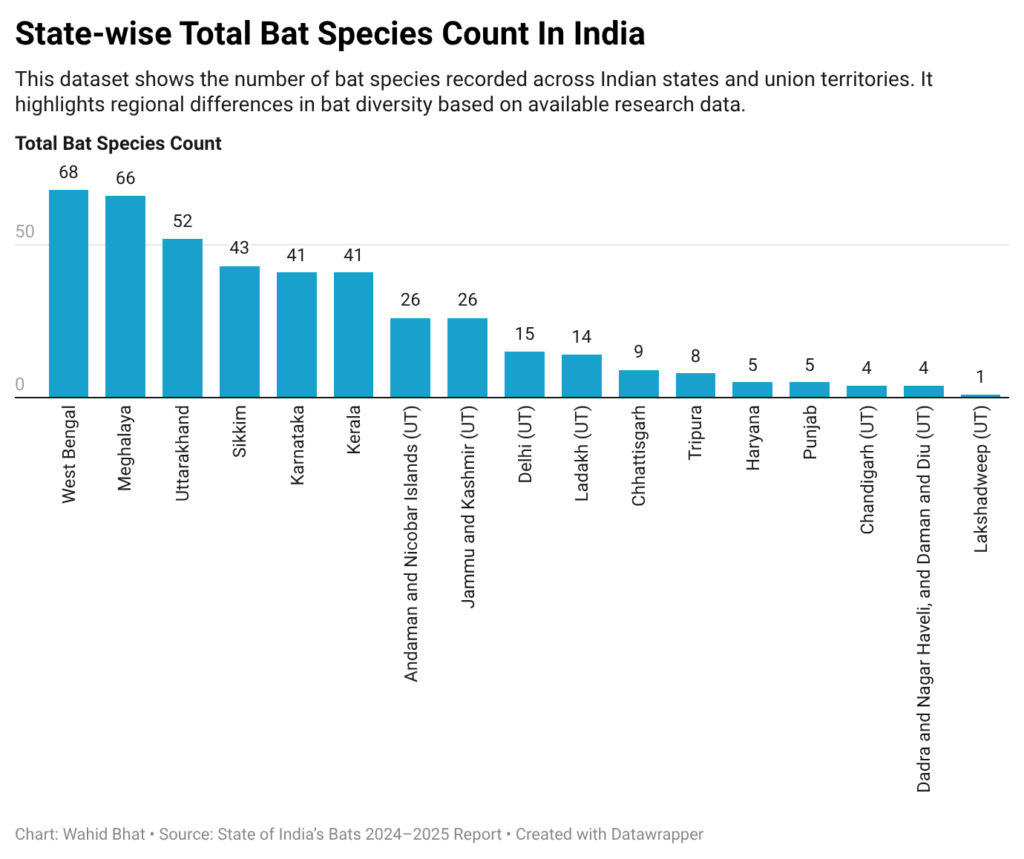
West Bengal leads the country with 68 bat species, followed by Meghalaya with 66 and Uttarakhand with 52. Kerala and Karnataka record 41 each. Punjab and Haryana have only five recorded species each, reflecting limited forest cover and expanding agricultural land.
Most bat research has concentrated in southern India, particularly the Western Ghats biodiversity hotspot. The Himalayas, Northeast India, and the Andaman and Nicobar Islands remain comparatively understudied. States within the Eastern Ghats and the Terai lowland regions are among the least surveyed.
The report calls for expanded acoustic monitoring to study bat echolocation calls, improved taxonomic research, stronger legal protection, and better public engagement. It also recommends increased surveillance for pathogens in Northeast India and the Western Ghats to reduce the risk of zoonotic disease outbreaks.
On monuments specifically, the report calls on the ASI to work with researchers and conservationists to develop ethical tourism guidelines around bat colonies, and to find ways to prevent structural damage without evicting the animals.
“Large bat colonies may cause structural damage to monuments and deter tourists from visiting,” the report stated. “ASI can work with bat researchers and conservationists to use these sites as an opportunity for bat-related education.”
Chakravarty said the report’s recommendations to ASI are yet to be formally communicated. “Reports will be sent to select ASI circles soon,” he said.
Chakravarty said the data gaps alone justify urgent intervention. “A number of these species are endangered and hard to find. Thirty-five species are data deficient, which essentially means there is limited data around them. They require attention,” he said.
More Ground Reports
What does Ramsar status actually change for Bihar’s wetlands?
MP Poshan Aahar Closures Put Rural Women’s Livelihoods at Risk