India’s rivers are running out of oxygen and the Ganges is leading the collapse. Earlier this century, the heavily polluted Ganges was losing oxygen more than 20 times faster than the global average. A new study published May 15 in Science Advances shows this is not an isolated crisis. It is a global emergency and India sits at its epicentre.
Researchers at the Nanjing Institute of Geography and Limnology, Chinese Academy of Sciences, spent four decades watching the world’s rivers slowly suffocate. Led by Prof. Kun Shi, with Dr. Qi Guan as first author, the team analysed dissolved oxygen levels across 21,439 river systems worldwide between 1985 and 2023 the most comprehensive study of its kind ever conducted.
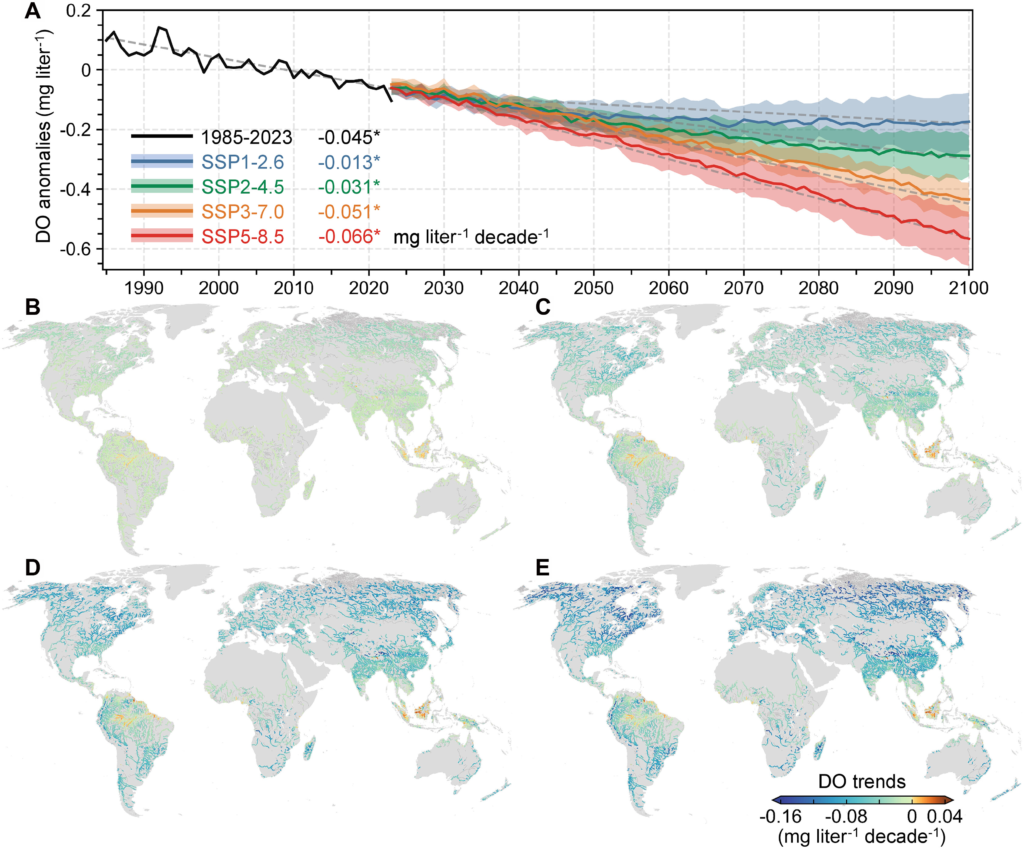
River oxygen levels declined at an average rate of minus 0.045 milligrams per litre per decade, with 78.8 percent of the studied rivers showing signs of deoxygenation.
The number sounds small. The consequences are not.
India: Ground Zero
Of all the countries in the study, India’s rivers recorded the steepest oxygen declines. Under moderate-to-high carbon dioxide emission rates — not the worst-case scenario rivers in India are projected to lose about 10 percent of their oxygen by the end of the century.
Under the worst-case trajectory, the decline exceeds 12 percent in parts of India. Dissolved oxygen levels could fall below 5 milligrams per litre — the threshold at which aquatic ecosystems begin to collapse. That means fish kills. Species loss. Drinking water degradation affecting hundreds of millions.
“Deoxygenation is a very slow process. If we have a long period, the negative impact will attack the river ecosystems,” said Dr. Qi Guan, the study’s lead author and an environmental scientist at the Chinese Academy of Sciences. “The low level of oxygen can cause a series of ecological crises such as biodiversity decline, water quality degradation and maybe some fish will die.”
Why Tropical Rivers Are Hit Hardest
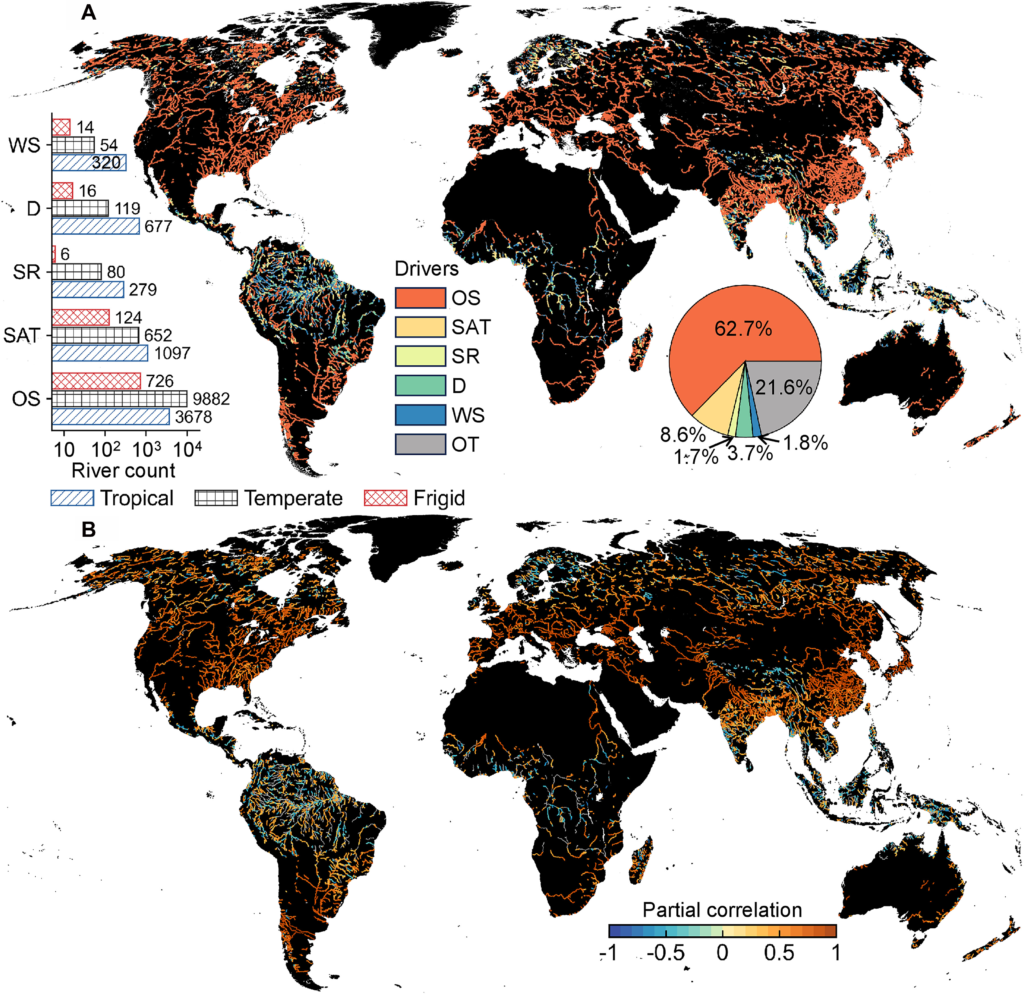
The study overturns a widely held assumption. Scientists had expected high-latitude rivers where warming is most intense to face the greatest oxygen loss. Instead, tropical rivers, those between 20 degrees south and 20 degrees north, are the most vulnerable. India’s major river systems fall squarely in this band.
Tropical rivers already tend to have lower oxygen concentrations, making them especially vulnerable when levels continue to drop. Combined with faster deoxygenation rates, these conditions increase the likelihood of hypoxia events when oxygen becomes too scarce to support many forms of aquatic life.
The danger is compounded by pollution and population pressure. India’s rivers don’t just face warming. They face warming on top of decades of industrial discharge, untreated sewage, and agricultural runoff.
What Is Driving the Loss
The primary culprit is physics. As water warms, it holds less oxygen. Declining oxygen solubility — driven directly by rising temperatures — accounts for 62.7 percent of observed global oxygen loss.
Ecosystem metabolism contributes 12 percent. In tropical rivers, respiration increasingly outpaces photosynthesis, consuming oxygen faster than it can be replaced.
Heatwaves account for 22.7 percent of global river deoxygenation, the study found. During extreme heat events, oxygen loss accelerates sharply — and India is experiencing more frequent and more intense heatwaves every year.
Karl Flessa, geoscientist at the University of Arizona and an independent reviewer of the study, does not mince words. Losing oxygen in rivers means “a future of more stinky dead zones, especially during heat waves,” Flessa said. Some rivers are in such bad shape that “a small change can tip them into the danger zone. If your favourite fishing hole gets too warm, oxygen levels will go down and there won’t be any fish to catch.”
Dead zones — stretches of water so starved of oxygen that fish cannot survive — have already appeared in the Gulf of Mexico, Chesapeake Bay, and Lake Erie. The study warns India’s rivers could face the same fate within decades.
Dams Make It Worse
Over 50,000 dams operate worldwide, and India is home to thousands of them. The study finds dam impoundment accelerates oxygen loss in shallow reservoirs and 70 percent of the world’s dams have reservoirs shallower than 30 metres. More than 3,700 new dams are planned or under construction globally.
In deeper reservoirs, impoundment helps slow oxygen loss. But most dams on India’s rivers do not meet that threshold.
The study projects oxygen decline continuing through 2100 under every climate scenario modelled. Aggressive emissions cuts hold the global average loss to 1.1 percent. A high-emissions future pushes that to 4.7 percent globally and past 12 percent in India.
India’s rivers face drops that could render stretches entirely uninhabitable for aquatic life. For a country where river ecosystems underpin fisheries, agriculture, and drinking water for over a billion people, the science is no longer abstract.
The oxygen is leaving. The Ganges is already gasping. The question now is how much longer the world waits before it acts.
Support Us To Sustain Independent Environmental Journalism In India.
More Ground Reports
He Was Married as a Child, Now Manish Dangi Helps Stop It for Others
Despite The Ban, How Gutkha Became MP’s Most Common Household Habit