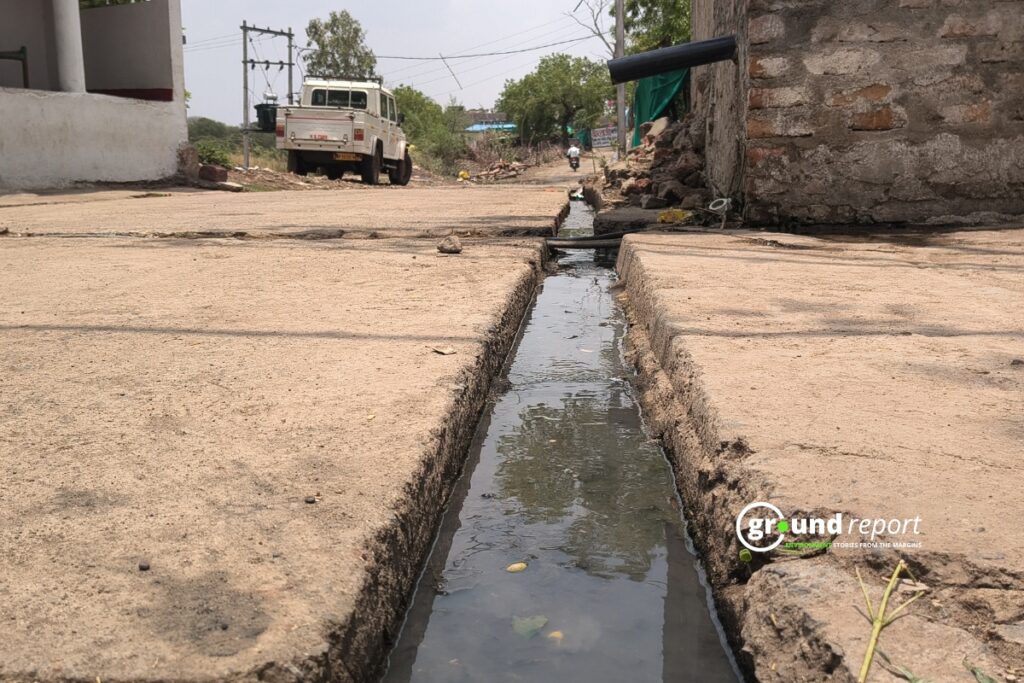
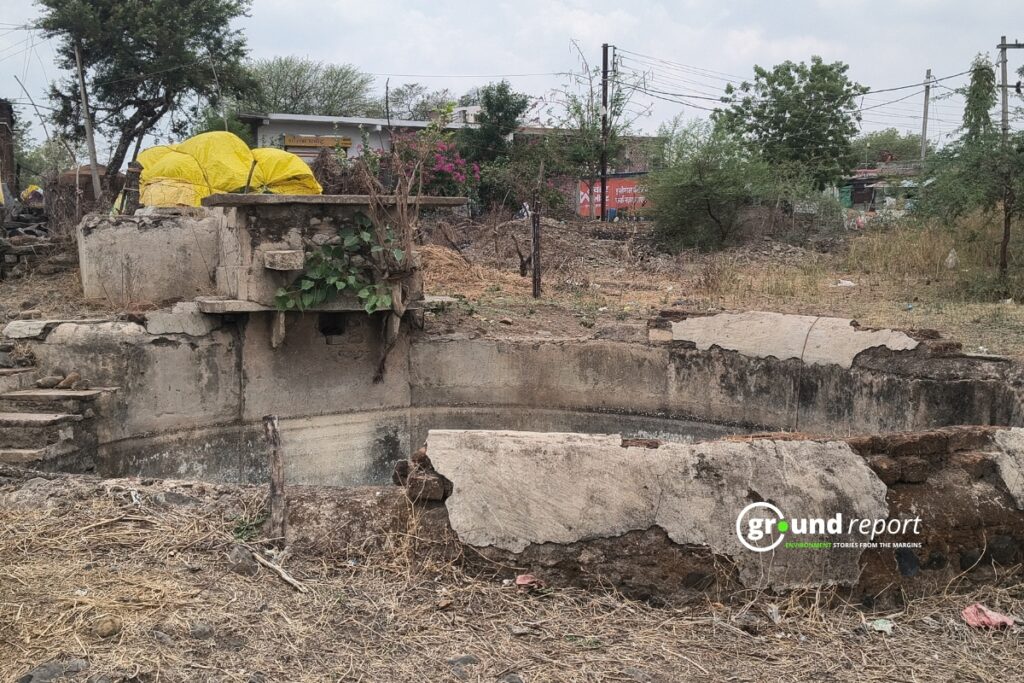
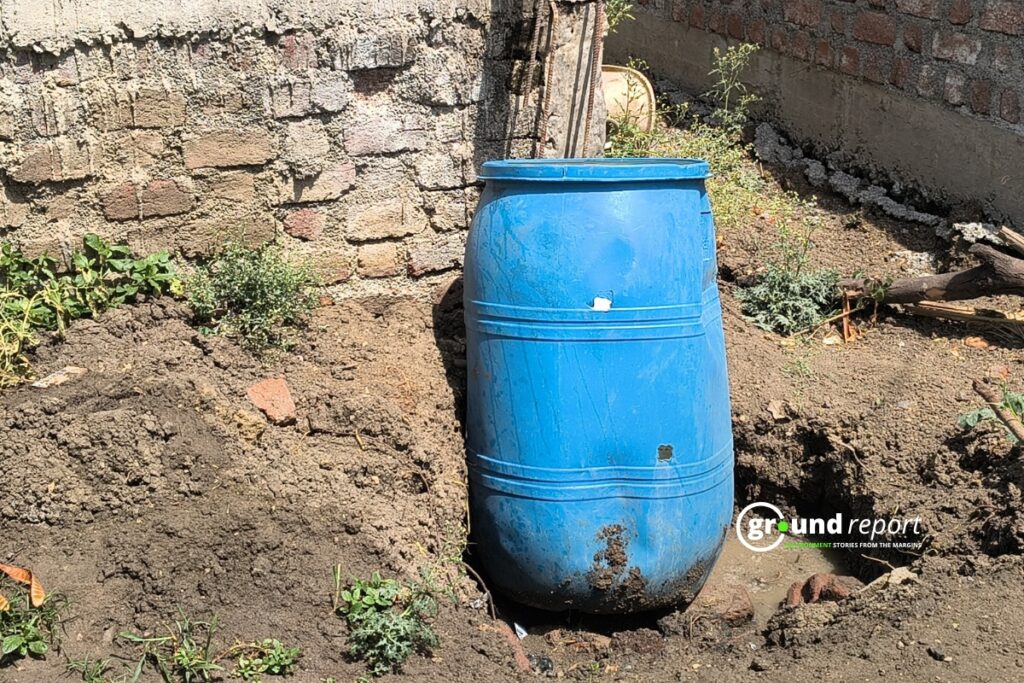
In Phoolkhedi gram panchayat, under Rajgarh Janpad Panchayat, wastewater from a drain flows across the road. From there, it empties into a pit dug close to the panchayat office.
“This pit had been dug to build a Magic Soak Pit — a tank still needs to be installed,” Ramnivas, the assistant secretary of the gram panchayat, said. “The idea was that the village’s water would stay within the village and would seep directly into the ground, raising the water table.”
His panchayat covered three villages; each had 20, nearly 10-foot-deep, pits.
Across Rajgarh district, the scene repeated itself. Under the state government’s Jal Ganga Samvardhan Abhiyan, roughly 40,000 Magic Soak Pits have been built across 622 gram panchayats. These were designed, the administration said, to push 75 lakh litres of daily household wastewater into the ground and raise a falling water table.
The district administration’s figures showed that of 37,355 Magic Pits sanctioned, 33,956 had been built; of 191 recharge shafts approved, 135 had been completed; of 473 rooftop rainwater harvesting systems planned, 444 were in place. Of 2,277 farm ponds sanctioned, 1,920 had been completed, and of 3,698 wells identified for recharge, 3,641 had been completed.
| Structure | Sanctioned / Planned | Completed |
| Magic Pits | 37,355 | 33,956 |
| Recharge Shafts | 191 | 135 |
| Rooftop Rainwater Harvesting Systems | 473 | 444 |
| Farm Ponds | 2,277 | 1,920 |
| Wells Identified for Recharge | 3,698 | 3,641 |
The district administration’s April 23 press note described the campaign as “an effective and exemplary model for balancing groundwater levels while advancing sanitation, water management, and environmental conservation.”
But groundwater scientists and conservation experts warned the campaign was doing the opposite. They felt, without any technical oversight, that this could lead to contamination of the very aquifers it claimed to protect.
The Problem on the Ground
In Limboda gram panchayat, wastewater connections from homes feed directly into the pits. Assistant Secretary Ashok Carpenter said 20 to 25 Magic Soak Pits had been built at every point where water was flowing through the village.
In Narsinghgarh block’s Mengladip, Mundla Barol, and Tajipura gram panchayats, pits were already complete. The sarpanches—the heads of the gram panchayats—and their representatives acknowledged that the pits were connected to rooftop rainwater as well as wastewater from toilets and drains.
Dr. R.G. Nagar, Rajgarh’s groundwater scientist, said he knew nothing about the Magic Soak Pits until he was asked. “The responsible officials and gram panchayats did not seek any technical guidance from me before building these. They constructed the pits entirely on their own initiative.”
This mattered because the Collector’s office order appointed Nagar himself as the nodal officer for the campaign. His own guidelines explained that bore wells or handpumps near dirty drains, where chemical or bacterial contamination was likely, must not be selected as recharge sites.
For recharge structures, he said, the Ridge to Valley Watershed Management Plan recommends building only where the possibility of contaminated water entering is negligible.
Dr. Nagar explains what proper groundwater recharge requires: a study of the subsurface geology — strata, lithology, soil, and rock — using toposheets, HGM maps, remote sensing, and GIS. Recharge structures must be aligned with lineaments, the subsurface fracture zones where water accumulates. None of this was done here.
Why Wastewater Cannot Go Underground
Ravindra Swarup Sinha, founder of the Ground Water Action Group and a former World Bank project consultant, explained that the filter media — the layered gravel, coarse sand, and ballast used to clean water before recharge — can only trap suspended solids. It cannot remove dissolved chemicals, bacteria, or turbidity.
“If polluted water reaches the aquifer — even by mistake — that same polluted water will come back up through bore wells and tube wells, and we will drink it,” he said.
Water unfit for drinking must not be used for recharge. He added that this kind of faulty recharge is dangerous for future generations.
Sinha cited Prime Minister Modi’s “Catch the Rain, Where It Falls, When It Falls” campaign as a scientifically sound call. “The meaning of ‘where it falls’ is that we must conserve rainwater using whichever methods are appropriate to the geographical conditions, water scarcity situation, and geological conditions of that place,” he said.
What is needed instead, he argued, is controlled extraction and expansion of surface water availability through large reservoirs and check dams.
Groundwater Crisis
The Central Ground Water Board’s 2025 report placed Rajgarh among 39 districts that moved directly from “safe” to “semi-critical.” Four blocks — Rajgarh, Jirapur, Biaora, and Khilchipur — were semi-critical; Narsinghgarh was critical; Sarangpur had reached over-exploited status.
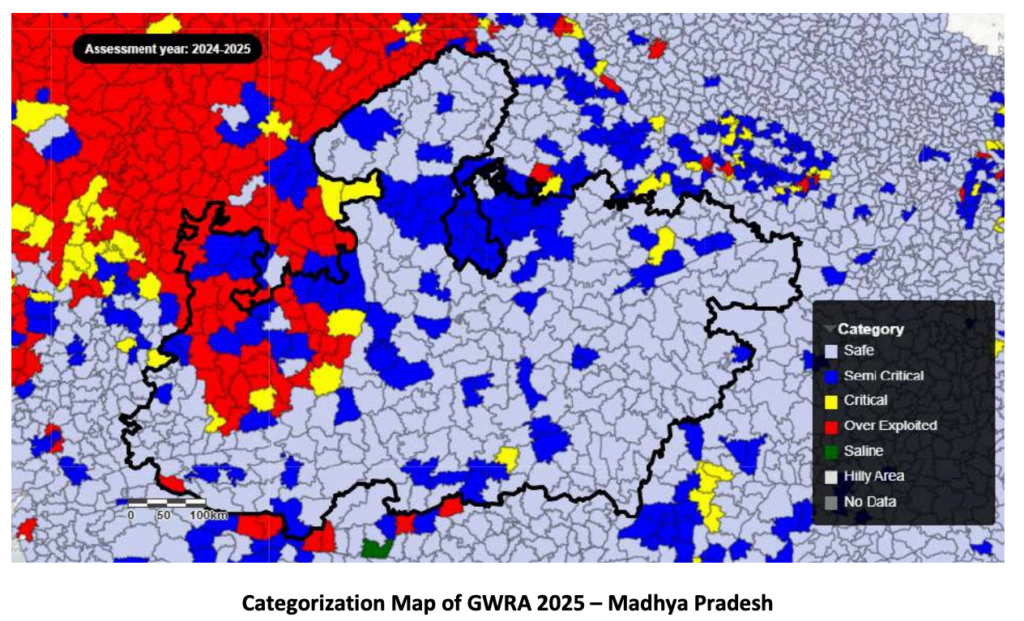
The Malwa region has basaltic hard and compact massive rock, with thick lava flows extending approximately 30 to 50 metres deep. In many places, there is virtually no soil layer beyond 2 to 3 metres below the surface.
For nearly 20 years, our district has been excessively extracting groundwater through tubewells. Here, the piezometer depth itself is around 60 metres, and while a piezometer at 60 metres records the water table at 25 metres, nearby private borewells go deeper than 100 metres.
Borewell depths in this area are typically around 200 metres. The Central Ground Water Board’s planning is based on a depth of 60 metres, and the work being done in Rajgarh follows that framework.
Sinha argued that if water was being extracted from 200 metres, piezometers should be installed at the same depth.
Nagar pointed out that in Shajapur, Ratlam, and Indore in Madhya Pradesh, borewells were now being drilled to 300 metres.
Administration Acknowledges the Error
Basant Kumar Suryavanshi, Executive Engineer of the Rural Mechanical Services Division, said he would gather detailed information about what guidelines were issued and what was happening on the ground.
“Channeling wastewater from drains and other sources into the aquifer — beyond rainwater — is technically wrong. It should not be happening.”
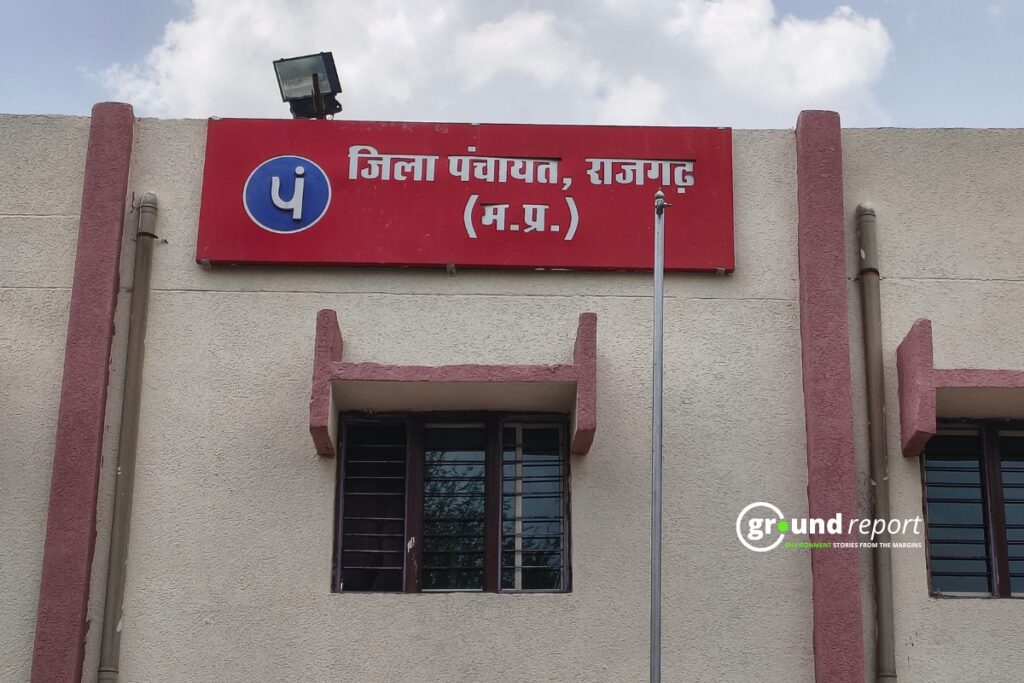
Jeet Panwar, Mahatma Gandhi National Rural Employment Guarantee Scheme (MGNREGA) Data Manager at the district panchayat, said connections carrying anything other than clean rainwater into the pits would be immediately disconnected and rerouted from rooftops.
District Panchayat CEO Dr. Ichchhit Gadhpale did not respond to two calls.
At the meeting, both Ravindra Swaroop Sinha and hydrogeologist Dr. R.G. Nagar agreed on one point: any recharge structure built to channel water underground must not let polluted or contaminated water enter the subsurface.
Sinha questioned whether there was interconnectivity at 40 to 50 metres with borewells that go down to 150 to 200 metres. Nagar responded that their recommendation was for depths of 60 to 150 metres. But, given the budget constraints under which gram panchayats were building 40 to 50 magic pits.
They had instead advised building recharge shafts carefully upstream of villages — in locations where contaminated water could not conceivably reach.
Near village ponds, officials identified the weathered zone—the upper layer of broken rock that helps recharge groundwater. The work was carried out using funds from the 15th Finance Commission, as no separate budget had been allocated.
Nagar clarified that his role was limited to providing scientific guidance and raising awareness — specifically, that contaminated water must not enter the ground through recharge structures. Scientists said addressing the district’s groundwater crisis required putting only clean water into the earth.
Despite this, across Madhya Pradesh, structures are built in arbitrary locations with no regard for scientific principles. There was little he could do about it; his function was only to offer technical guidance, and only when he was consulted.
Support Us To Sustain Independent Environmental Journalism In India.
More Ground Reports
He Was Married as a Child, Now Manish Dangi Helps Stop It for Others
Despite The Ban, How Gutkha Became MP’s Most Common Household Habit