Every summer, as heatwaves sweep across India. With heat, another invisible killer rises: ground-level ozone (O₃). Ozone is a highly reactive gas with three oxygen atoms that protects us from ultraviolet (UV) rays coming from the sun in Earth’s stratosphere. On the ground, up close, ozone is considered to be highly toxic and even fatal.
With its increase in the immediate environment, an individual can inhale high concentrations into their lungs. That can oxidize tissue and inflame blood vessels and is linked to thousands of deaths each year.
When sunlight reacts with pollutants such as nitrogen oxides and volatile organic compounds (VOCs) released by vehicles, power plants, and factories, it creates ozone near the ground. Needless to say, a higher temperature means the reactions will be faster. Faster reactions mean more ozone.
A new study published in npj Clean Air shows the problem is getting worse.
The research spans two decades, from 2004 to 2024, and is the first national assessment linking heatwaves directly to surface ozone spikes across India.
India’s continuous ground-level ozone measurements remain limited. As satellite tracking of ozone precursors began in 2018, the researchers had just six years of data.

“Six years of data is not enough to make a scientific conclusion,” said Jayanarayanan Kuttippurath, professor at the Centre for Oceans, Rivers, Atmosphere and Land Sciences at IIT Kharagpur and co-author of the study. “That is why we used 20 years of reanalysis data.”
India recorded 188 heatwave events between 2004 and 2024. Every heatwave drives ozone beyond safe limits, the study finds. And the researchers used that data to estimate, for the first time, how many deaths ozone exposure may cause during these events.
What the Study Found
The researchers tested a long-held assumption, that sunlight during heat waves speeds up ozone production, and found strong evidence to back it up. The study measured ground-level ozone against three thresholds: 60, 70, and 100 μg/m³. “There is no universal number,” Kuttippurath said. “What studies show is that beyond 60… There will be health issues.”
The World Health Organization’s (WHO) interim safe limit is 70 μg/m³ over eight hours, meant to protect health under normal conditions. 100 μg/m³ is the upper limit, the point beyond which the risk becomes severe. India’s national ambient air quality standard for ozone sits at 100 μg/m³, 30 points above the WHO’s.
Yash Dahima, a doctoral researcher studying air quality at Ahmedabad University, pointed to the study’s regional approach as one of its strengths. The researchers grouped India into zones where temperatures behave similarly, rather than treating the whole country as one block.
“The northwest region—Gujarat, Rajasthan, Madhya Pradesh, and Haryana—these regions are experiencing more of this,” Dahima said.
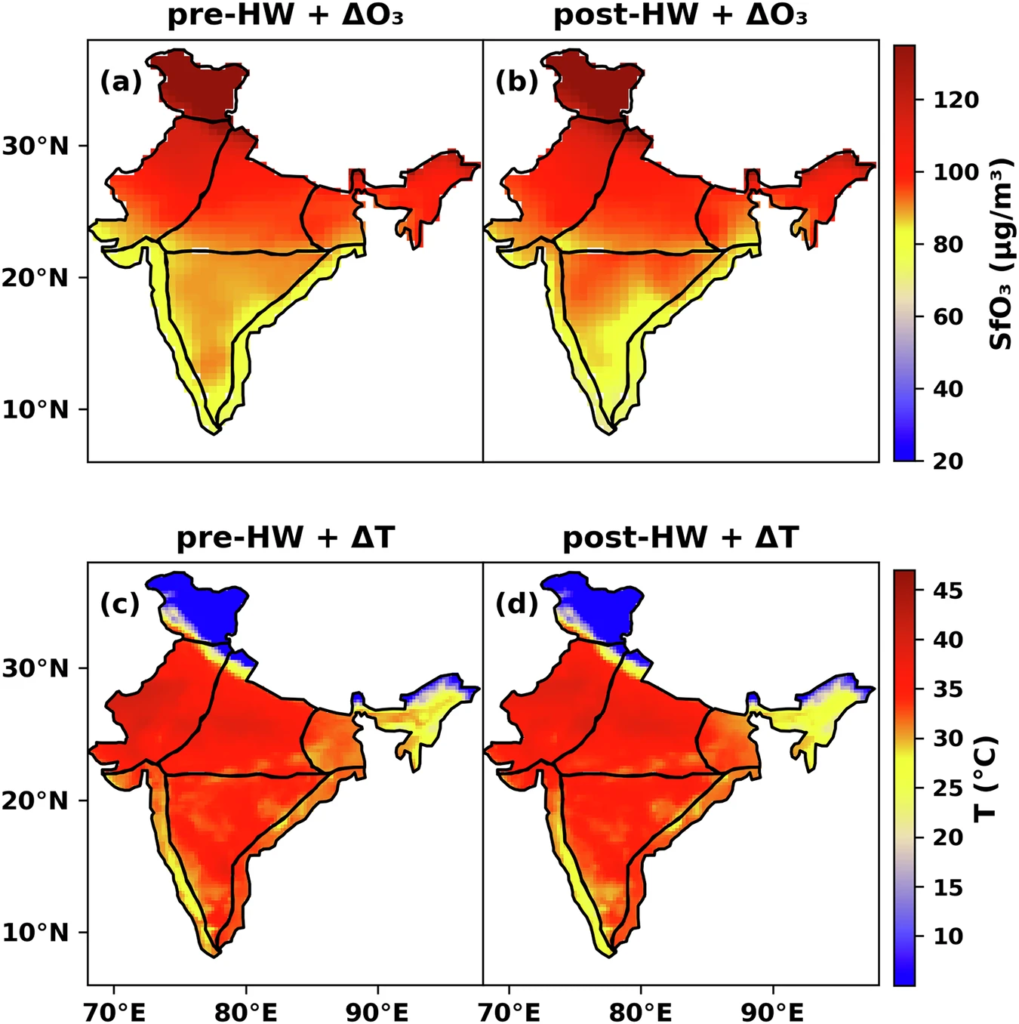
The Indo-Gangetic Plain, the densely populated belt stretching from Delhi through Uttar Pradesh and Bihar, recorded the highest ozone concentrations. It reached 120 μg/m³ when heatwave temperatures peaked.
In northern India, surface ozone remains between 85 and 110 μg/m³ during active heatwaves. The Western Himalayas recorded the most alarming levels, reaching roughly 150 μg/m³ during the 2024 heatwave.
The study noted that the polluted air from the Indo-Gangetic Plain travels north and rises along the Himalayan slopes. Here, the stratospheric ozone descends through natural exchange processes.
Mountain terrain amplifies solar radiation as the thinner air at higher altitudes absorbs and scatters less sunlight before it reaches the ground. And the stronger sunlight speeds up the same reaction, which forms surface ozone. They also restrict air circulation by trapping air instead of allowing it to disperse. Together, this pushes ozone past the WHO’s absolute maximum threshold of 100 μg/m³ by up to 50 percent.
Hamza Varikoden, a senior scientist studying monsoon variability and climate change at the Indian Institute of Tropical Meteorology, reviewed the study’s findings on the Himalaya independently for this story.
He said the mountains themselves work like a trap. “Mountain valleys act as a natural basin,” Varikoden said. “The surrounding terrain restricts horizontal air movement and limits the exchange of air with the open atmosphere.” During heatwaves, high temperatures and weak winds make this worse, he said, creating still, stagnant air that lets ozone build up instead of clearing away.
“Even if you do not have that much anthropogenic pollution [in the mountains], trees can emit VOCs [volatile organic compounds], Kuttippurath explained. “That is why some regions have high ozone production even without heavy industry.”
This study’s 20-year data found that the ozone in the Western Himalaya rose faster than anywhere else in India. Every year, since 2004, the concentration has increased by 0.98 μg/m³, and during 2024 heatwaves, it exceeded the WHO’s interim limit by 115%.
Ozone levels exceeded the WHO threshold in every region of India during heatwave periods.
What Ozone Does to the Body
Ozone reacts aggressively with the lining of the airways. A single exposure can cause coughing, a sore throat, chest tightness, and difficulty in deep sighs. These symptoms can appear even in people with no history of lung disease.
Children, older adults, and people with existing respiratory conditions face the greatest risk. Long-term exposure narrows airways permanently, accelerates lung deterioration, and drives cardiovascular disease.
“Over time, that inflammation can spread deeper into the lungs and cause chronic obstructive pulmonary disease, or COPD, a long-term lung condition that makes breathing difficult,” Kuttippurath explains. “But ozone also enters the bloodstream through the lungs and damages blood vessels, raising the risk of heart attack.”
During a heatwave, the body is already under cardiovascular stress, i.e., the heart pumps harder to cool the skin, and blood pressure rises. And ozone adds to that stress.
A 2022 study in Science of the Total Environment, led by Amir Sapkota at the University of Maryland, found that ozone exposure raises mortality risk during extreme heat.
The researchers took existing death rates for these two diseases—ischemic heart disease and chronic obstructive pulmonary disease—from the Global Burden of Disease database. And then, they calculated the toll ozone exposure at heatwave levels could account for. It is the same method the WHO uses worldwide to estimate air pollution deaths.
“In 2024 alone, ozone exposure during heatwaves was associated with 15,615 deaths from ischemic heart disease and another 10,898 deaths from chronic obstructive pulmonary disease—a combined toll of more than 26,500,” said P. Sangeetha of the Kerala University of Fisheries and Ocean Studies, Kochi, co-author of the study.
El Niño and Ozone Forecast
El Niño is a natural climate pattern where parts of the Pacific Ocean warm up more than usual every few years. It changes the weather around the world — including India’s. It tends to bring less rain, clearer skies, and higher temperatures.
In India, four years stood out for having far more heatwaves than usual—2010, 2016, 2019, and 2024—consistently following strong El Niño events. “If there is El Niño, you have higher temperatures and more ozone production,” Kuttippurath said.
“If there is El Niño, you have higher temperatures and more ozone production,” Kuttippurath said. “In polluted regions, we have more pollutants and more effects.”

La Niña years bring relief, but not everywhere. “We usually get good rainfall, more than average,” he said. “Rainfall settles down precursor pollutants through wet deposition. That means ozone concentration will decrease. “But in cities with heavy traffic and industry, enough pollutants remain in the air that ‘ozone can persist even when rainfall is present,'” he said.
Varikoden also confirmed the study’s link between El Niño and heatwaves matches established patterns in Indian climate research. “El Niño events are frequently associated with warmer and drier conditions over large parts of India, increasing the likelihood and intensity of heatwaves,” he said.
A weak or delayed monsoon makes things worse on two fronts, he said — less rain means less cloud cover, which means more sunlight reaching the ground to fuel ozone formation, while weaker monsoon winds also fail to clear pollution away. “Together, these factors create an environment conducive to sustained and elevated surface ozone concentrations,” he said.
India’s Heat Action Plans, now covering more than 250 districts, forecast heat, not ozone.
“Even after the heatwave, the pollution persists for at least three to four days. That means the health risk is still there,” Kuttippurath said. “When you look at temperature, humidity, wind, and rain for forecasting, all of these affect the pollutants as well…You have to look at the climate part and the pollution together.”
“Just imagine one person with asthma, exposed to high heat, and then to ozone at the same time. That will be exacerbated. It is a big threat. ” The IMD and NDMA should forecast ozone during heatwaves so that people know there is ozone and that it is a problem. “Then they can reduce their exposure.”
Support Us To Sustain Independent Environmental Journalism In India.
More Ground Reports
He Was Married as a Child, Now Manish Dangi Helps Stop It for Others
Despite The Ban, How Gutkha Became MP’s Most Common Household Habit