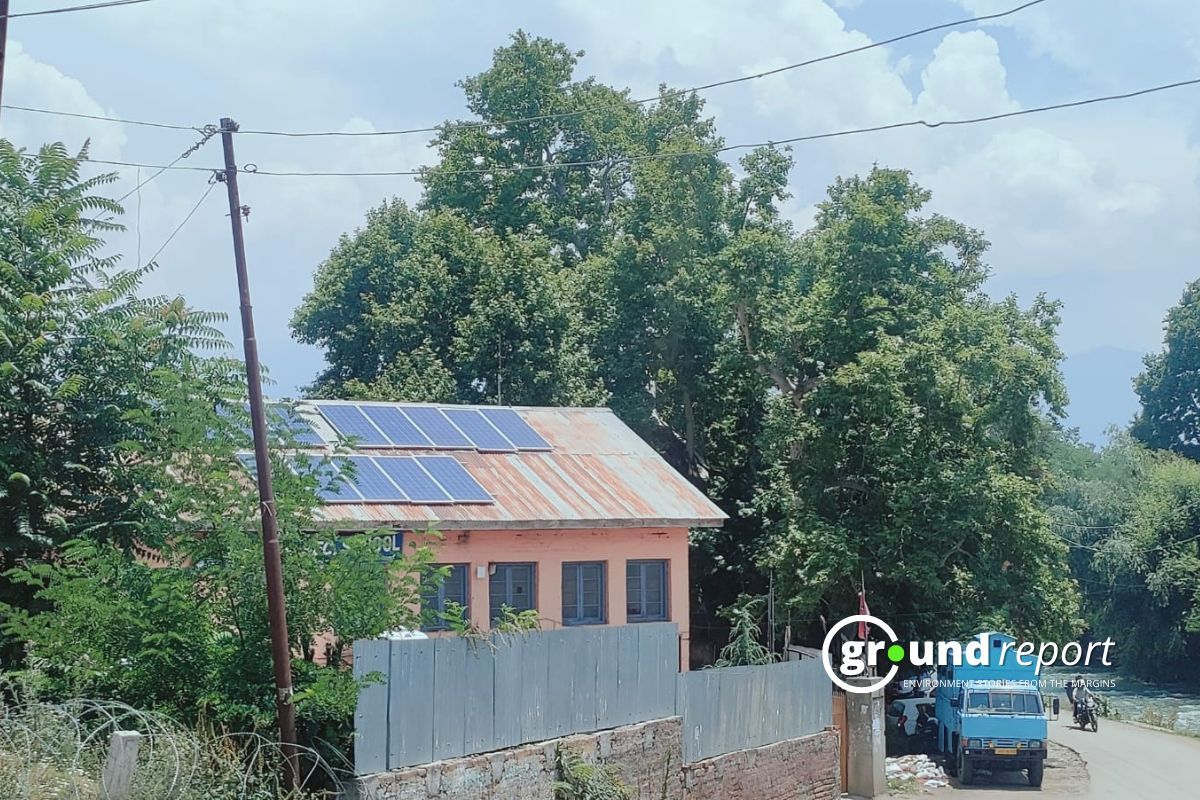
More than 26,700 households across Jammu and Kashmir have received rooftop solar connections under the central government’s PM Surya Ghar Muft Bijli Yojana, according to data tabled in the Rajya Sabha on March 24, 2026. But the district-wise breakdown reveals a sharp gap between urban centres and remote border districts.
The figures were shared by Minister of State for New and Renewable Energy Shripad Yesso Naik in response to a question by Rajya Sabha member Shri Gulam Ali, who asked about renewable energy schemes in the union territory.
Where the Benefits Are Going
Srinagar leads all districts with 4,538 beneficiary households, followed by Jammu with 3,881 and Kupwara with 2,494. Together, these three districts account for nearly 40 percent of the total 26,730 beneficiaries recorded as of March 18, 2026.
At the other end, Poonch has just 317 beneficiaries, Kishtwar 374, and Ramban 439 — all remote districts with difficult terrain and limited infrastructure.
District-Wise Beneficiaries Under PM Surya Ghar Muft Bijli Yojana, J&K
| District | Beneficiary Households |
|---|---|
| Srinagar | 4,538 |
| Jammu | 3,881 |
| Kupwara | 2,494 |
| Anantnag | 1,881 |
| Kathua | 1,571 |
| Baramulla | 1,506 |
| Budgam | 1,334 |
| Pulwama | 1,311 |
| Shopian | 970 |
| Doda | 1,073 |
| Kulgam | 719 |
| Ganderbal | 714 |
| Rajouri | 844 |
| Samba | 843 |
| Udhampur | 722 |
| Bandipora | 799 |
| Reasi | 400 |
| Ramban | 439 |
| Kishtwar | 374 |
| Poonch | 317 |
| Total | 26,730 |
The ministry released ₹59.85 crore for rooftop solar and PM Surya Ghar in J&K in 2024-25, up sharply from ₹1.20 crore in 2022-23. No funds were released in 2023-24 under either scheme. Under PM KUSUM, which supports solar power for farmers, ₹15.69 crore was released in 2022-23 and ₹12.90 crore in 2024-25.
What Power Is Already Installed
As of February 28, 2026, J&K has 3,629 megawatts of installed renewable energy capacity. Large hydropower dominates at 3,360 MW. Solar power stands at just 79.48 MW, while small hydro contributes 189.93 MW — highlighting how much room remains for solar expansion across the territory.
What the Government Says It Is Doing
The ministry told Parliament it provides higher rates of central financial assistance to J&K compared to other states under several schemes. It also cited a range of national policy measures, including green energy open access rules, transmission infrastructure funding under the Green Energy Corridor Scheme, and viability gap funding for offshore wind projects.
The government said these steps support India’s broader target of reaching 500 gigawatts of non-fossil energy capacity by 2030.
Support Us To Sustain Independent Environmental Journalism In India.
More Ground Reports
Panna: Villagers Protest Irrigation Projects, Demand Documents, and Transparency
Fulkai Maai Demands the Return of Crèches for Malnourished Korku Children
Stay Connected With Ground Report For Underreported Environmental Stories.
Support Us To Sustain Independent Environmental Journalism In India.