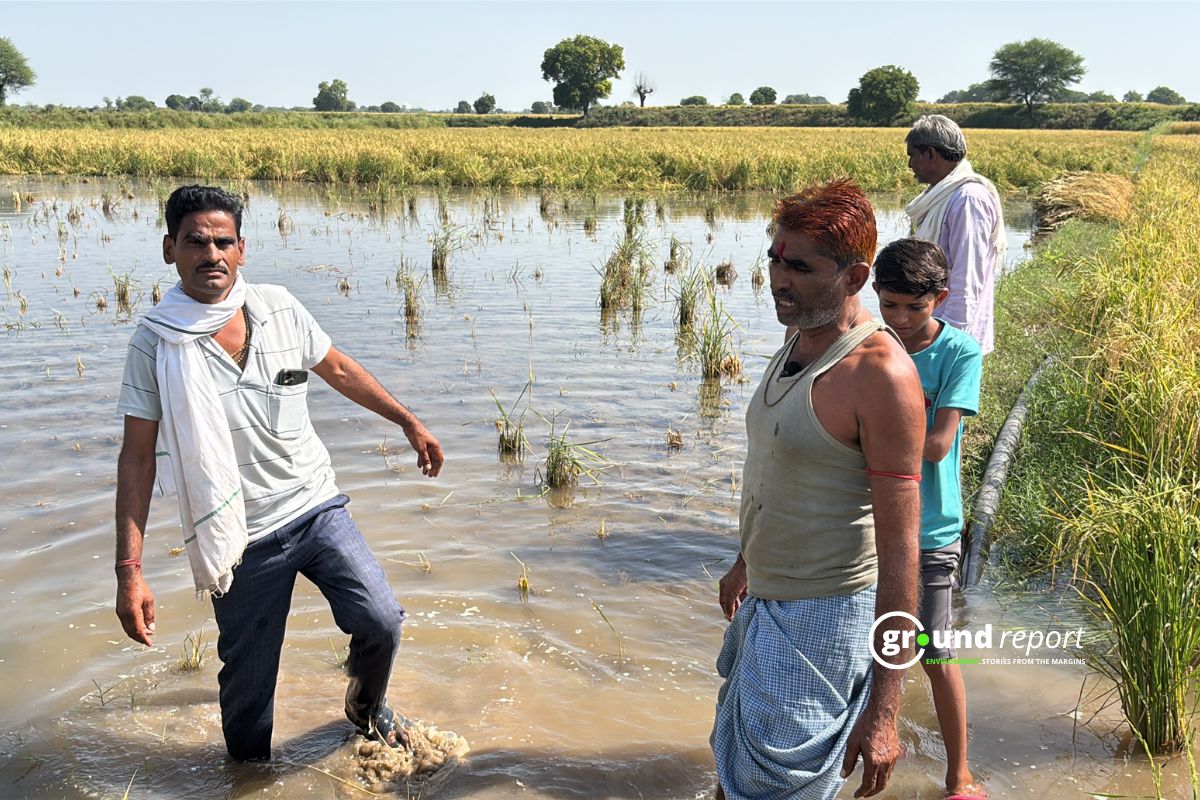
Severe floods have caused major losses in rice production for decades, with impacts rising sharply in recent years. A new study published on November 14 in Science Advances reports that prolonged flooding now poses a clear threat to regions that rely on rice, including India. The research shows that young rice plants submerged for a week or more suffer losses that weaken food security across major growing areas.
The study from Stanford University found that global rice yields fell by an average of 4.3 percent per year between 1980 and 2015 due to severe floods. This equals about 18 million tons of rice lost each year. The losses increased after 2000 as extreme rainfall became more frequent across major rice-growing basins.
Researchers also measured the impact of drought, which reduced rice yields by 8.1 percent per year during the same period. While drought has long been recognized as a major risk, the study highlights a second threat from long-duration floods.
Steven Gorelick, senior co-author of the study, said flood impacts have been overlooked. “While the scientific community has focused on damage to rice yield due to droughts, the impacts of floods have not received enough attention,” he said. “Our research documents not only areas where rice yields have suffered due to past flooding, but also where we can anticipate and prepare for this threat in the future.”
Defining Rice-Killing Floods
The study introduces a clear definition of what it calls “rice-killing floods.” These events occur when crops are completely submerged for at least seven days. Lead author Zhi Li said the seven-day threshold marks the point at which survival becomes unlikely. “When crops are fully submerged for at least seven days, most rice plants die,” Li said. He explained that this definition allowed the team to quantify how specific floods reduce yields.
The researchers used data on rice growth stages, global flood and drought records dating back to 1950, annual yield data, a flood dynamics model, and soil moisture simulations. These sources helped them measure how submergence during key growth periods affected yields.
The analysis also suggests that in the coming decades, the most extreme week of rainfall across major rice-growing basins could increase by 13 percent compared with the 1980–2015 average.
India’s Exposure to Long-Duration Floods
India appears prominently in the study. The researchers note that the Sabarmati Basin experiences some of the longest rice-killing floods in the world, with water remaining over the fields for more than 30 days during severe events. These long-duration floods have a direct effect on yields.
West Bengal is identified as one of the regions with the largest losses. India’s overall rice production is affected by repeated submergence events, especially along major river systems tied to the monsoon. The study’s simulations align closely with past flood reports. The 2008 floods damaged about 1 million hectares of rice fields, and the model estimated 1.03 million hectares. The 1987 floods damaged around 0.7 million hectares, with the model showing about 0.8 million hectares.
Some regions show a different pattern. In the Pennar Basin, floods appear to increase yields. The authors suggest this may be due to the basin’s hot and dry climate, which allows standing water to evaporate quickly and reduces the duration of submergence.
The study also shows that India is the only major rice-growing country where the intensity of rice-killing floods has decreased in recent years. This trend differs from research showing increased national flood frequency. The authors explain that their analysis focuses only on rice-growing regions, which may experience different flood conditions than other parts of the country.
Developments from Global Findings
Across major rice-producing countries, flood-related losses are rising. The study found that parts of Southeast Asia saw losses around 7 percent in flood years. Some regions in East China and parts of India recorded losses of up to 15 percent.
The analysis also shows that flood duration matters. Floods that last longer than seven days cause major damage, and the impact rises as water stays over the crop. The study found that rice-killing floods around the world last an average of 15.4 days.
Rice-killing floods tend to occur during the main growing season. In India, they occur between July and September, in line with the monsoon peak. During these periods, rainfall can shift rapidly from normal to extreme.
Human Impact & Economic Strain
Rice supports more than half of the world’s population and is central to diets in India. Any decline in production affects farmers and consumers.
Li said the scale of the losses was surprising. “That’s a huge impact,” he said, noting the risk to local food security.
Economists warn that declines in rice supply can lead to price increases. Anna Josephson, an associate professor at the University of Arizona, told ABC News that “any large shock of any type can have implications for the food system.” She said price increases would make it harder for families to afford food.
Cristina Connolly of the University of Connecticut said reduced yields weaken local economies. When farmers harvest less, they spend less money in nearby shops. This can lead to job losses and further reduce household spending.
The study links yield declines with national economic costs. India is estimated to lose around 29 million dollars per rice-killing flood. In Northeast India, where losses reach 7 percent, costs rise even higher.
Flood-Resistant Varieties as a Possible Solution
The study identifies flood-resistant rice varieties as a potential tool to reduce damage. These varieties can survive submergence for up to 10 to 14 days by slowing their growth. Others grow taller during long floods to maintain access to air and sunlight.
Tests show that these varieties can significantly reduce flood-related damage. According to the study, yield losses fall by 75 percent in India when flood-resistant rice is used. Field results in India support this, with the Sub1 variety reducing losses by 77 percent.
Researchers note that adoption remains uneven. Some farmers prefer traditional varieties that have been used for generations. Connolly said cultural habits may limit changes in planting. “Culturally, rice is very important,” she said. She also noted that genetically engineered seeds tend to be more costly.
Climate Pressures Beyond Study Period
Li said yield losses have accelerated since the study period ended in 2015, as temperatures have continued to rise. Josephson said the study’s results reflect only conditions up to that point. “This could be considered a lower bar, since we only know up to that point,” she said.
Climate researchers report that extreme rainfall events are becoming more frequent and more intense. These shifts increase the likelihood of major floods across Asia. In 2023, more than 80 percent of hydrometeorological hazards reported in Asia were flood or storm events, according to the World Meteorological Organization.
The study shows that severe floods have placed increasing pressure on India’s rice production. It also shows that regions such as the Sabarmati Basin and West Bengal face some of the highest risks from long-duration flooding. While some regions such as the Pennar Basin show different responses, most of India’s rice-growing areas remain vulnerable.
The findings underline the need to understand how rice responds to extreme rainfall, drought, and rapid shifts between the two. The research points to flood-resistant varieties as one method to reduce losses. The authors also note the challenge of managing the combined effects of climate extremes as they become more frequent across major rice-growing regions.
Support us to keep independent environmental journalism alive in India.
Keep Reading
Small Wild Cats in Big Trouble: India’s First National Report Released
After Tragedy, Families Face Delays in Tiger Attack Compensation
Stay connected with Ground Report for underreported environmental stories.
Follow us onX, Instagram, and Facebook; share your thoughts at greport2018@gmail.com; subscribe to our weekly newsletter for deep dives from the margins; join our WhatsApp community for real-time updates; and catch our video reports on YouTube.
Your support amplifies voices too often overlooked, thank you for being part of the movement.