
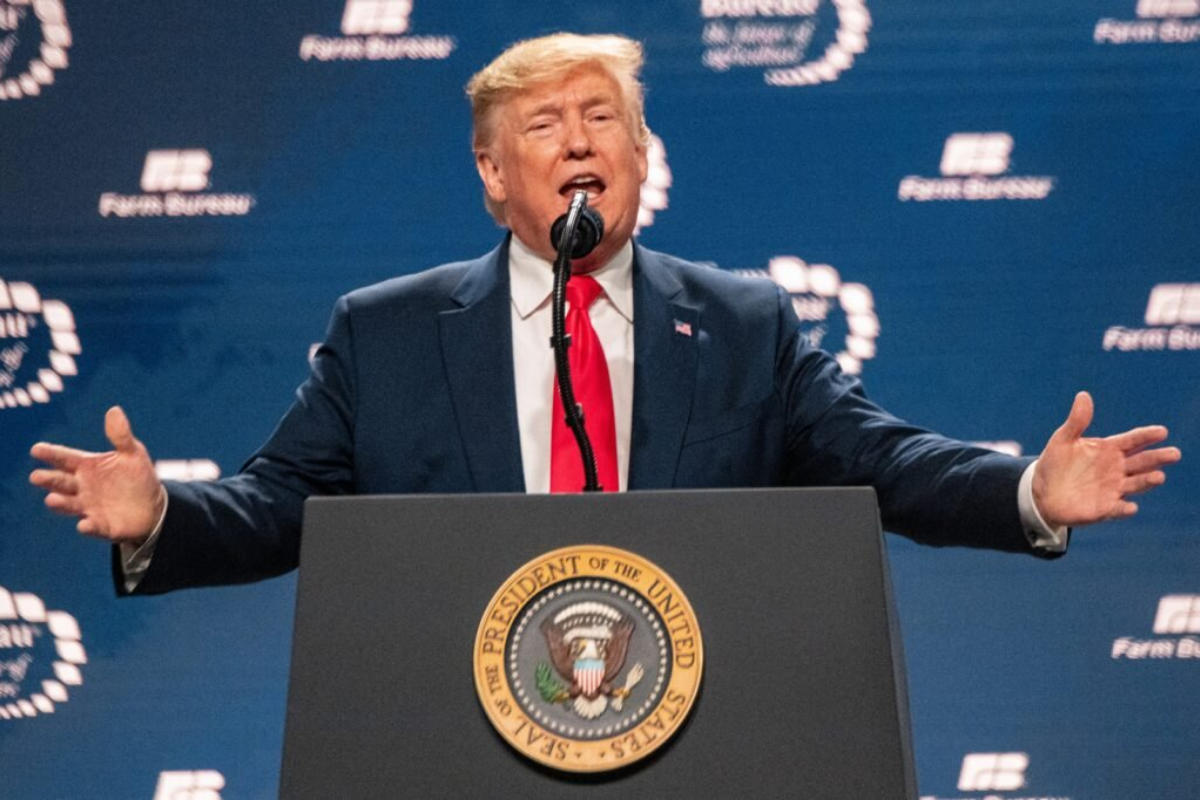
President Donald Trump says his economic plan has sparked $17 trillion in new investments. He credits his tariffs, tax cuts, and direct outreach to CEOs and world leaders for the surge.
“Under eight months of Trump, we’ve already secured commitments of $17 trillion coming in,” he said last month. “There’s never been any country that’s done anything like that.”
But a closer look suggests the number may not hold up.
Disputed Figures
The White House website lists total investments at $8.8 trillion, less than half of Trump’s claim, and some of those projects were first announced under President Joe Biden. The administration has not provided any breakdown or data to explain how Trump reached the $17 trillion figure despite repeated requests for clarification.
Economists say the president’s math is inflated. Adam Posen, president of the Peterson Institute for International Economics, said the real number may be in the hundreds of billions. He warned that using threats and tariffs to force other countries to invest could damage long-term U.S. relationships. “You’re turning allies into colonies,” Posen said. “Twisting arms won’t get the payoff you want.”
Public confidence in Trump’s handling of the economy is also slipping. Only 37% of Americans approve of his economic performance, according to a September poll by the AP-NORC Center for Public Affairs. That’s down from 56% in early 2020 during his first term, a period Trump often cites as evidence of his economic success.
The Trump administration says tariffs are central to its plan to bring in foreign investments. Officials argue that Trump’s leadership ensures that money will start flowing next year, boosting jobs and wages. “The difference between hypothetical investments and ground being broken is good leadership and sound policy,” said White House spokesman Kush Desai.
Little Evidence of Economic Impact
According to the administration, Japan will invest $1 trillion, the European Union $600 billion, the United Arab Emirates $1.4 trillion over ten years, Qatar $1.2 trillion, Saudi Arabia $600 billion, India $500 billion, and South Korea $450 billion. But many of these pledges lack detailed agreements. Some numbers appear inflated or unrealistic. Qatar’s promise, for instance, exceeds five times the country’s annual economic output.
South Korea has already disputed its commitment, saying it’s $100 billion lower than the White House’s figure. Tensions rose after U.S. agents raided a Hyundai plant in Georgia and detained Korean workers.
So far, there’s no clear sign that Trump’s claims are translating into real economic growth. Business investment still makes up about 14% of the U.S. economy, roughly the same level as before Trump took office. Economists also say Trump’s team is counting projects that began during Biden’s presidency or were already planned because of the rise of artificial intelligence.
For example, Global Foundries’ $16 billion chip investment includes $13 billion announced during Biden’s term and funded partly by CHIPS Act grants. Micron’s $200 billion commitment also overlaps with earlier announcements made before Trump’s return.
Credit to Tariffs
Still, the White House insists tariffs are driving results. Officials say companies fear new import taxes if they don’t invest in the U.S. Pfizer CEO Albert Bourla backed the approach after announcing $70 billion in new U.S. investments and receiving a three-year exemption from tariffs. “The president was absolutely right,” Bourla said. “Tariffs are the most powerful tool to motivate behavior.” Trump echoed that message, saying, “The tariffs played a big role.”
For now, much of the promised money remains uncertain, and the impact on jobs and wages has yet to appear. Whether Trump’s $17 trillion claim becomes reality—or remains campaign rhetoric—will depend on whether those promises ever turn into actual projects.
Support us to keep independent environmental journalism alive in India.
Keep Reading
Highway Halt Puts Kashmir’s Fruit Economy at Risk
MP brings back Bhavantar as farmers lose soybean harvests
Stay connected with Ground Report for underreported environmental stories.
Follow us onX, Instagram, and Facebook; share your thoughts at greport2018@gmail.com; subscribe to our weekly newsletter for deep dives from the margins; join our WhatsApp community for real-time updates; and catch our video reports on YouTube.
Your support amplifies voices too often overlooked, thank you for being part of the movement.