The National Green Tribunal (NGT) did not give a favourable order to any environmental or public-interest party in the merit appeals it decided during the first six months of 2026, according to an analysis by the South Asian Reporter for Environment Laws (SAREL), published on September 17.
The SAREL analysis examined 119 appeals decided by the NGT’s five benches between January and June 2026. Of these, 67 were heard by the NGT, which examined the arguments and facts presented by both sides before giving its decision. Environmental and public-interest parties filed 16 of these appeals, while project proponents, industries and property owners filed 51. The remaining 52 appeals were closed on procedural grounds.
According to the findings, none of the 16 appeals filed by environmental or public-interest parties received a favourable order. Project proponents, industries and property owners received favourable orders in 30 of their 51 appeals, giving them a success rate of 58.8 per cent. In another 6 per cent of their cases, the existing status quo was maintained.
The environmental or public-interest side can include environmental activists, groups, local organisations and individuals who approach the NGT to challenge projects or government decisions they believe could harm forests, wildlife, water or local communities.
The other side can include companies, project developers, industries and property owners. They can approach the NGT when government decisions affect their projects or when they challenge orders passed against them.
What Petitioners Say
Ajay Dubey, an environmental activist who has filed several cases before the NGT, said the findings are similar to what he has seen in his own cases.
Dubey said the difference in legal resources can affect how cases are fought. “Industrialists and corporates who represent them are very good advocates. They have their money power, their influence in the market,” he said.
He said companies can hire experienced lawyers and legal teams, while activists and individual petitioners often have fewer resources. “Their legal teams are very sophisticated and well-defined,” he said.
The NGT was set up under the National Green Tribunal Act, 2010, to deal with environmental disputes and provide relief and compensation for environmental damage.
The NGT is made up of judicial members and expert members. Judicial members are judges or former judges, while expert members have experience in fields related to the environment, science and other areas. Both types of members hear environmental cases before the Tribunal.
Dubey also raised questions about the previous government roles of some NGT members. He said many had worked as government officials before joining the Tribunal. “Mostly they are officers who are part of the decision-making process, and post-retirement, the NGT process receives it,” he said. “So, this is a disadvantage. Will they favour their own system or will they listen to the common man’s complaints?” he said.
When Cases Do Not Reach the Main Issues
The analysis also looked at the 52 appeals that did not reach the main issues. SAREL found that around 44 per cent of the 119 appeals were closed because of limitation, jurisdiction, maintainability or withdrawal.
Dubey said this can create difficulties for people who approach the NGT. “Not going into the merits itself shows how much the NGT is interested in examining the facts produced by the petitioner,” he said.
His own case involving a coal mining project in Singrauli, Madhya Pradesh, is one example. Dubey challenged a May 9, 2025 approval issued by the Ministry of Environment, Forest and Climate Change for diversion of forest land for a coal mining project.
He filed his appeal before the NGT on February 23, 2026 and asked the Tribunal to accept the delay in filing it. He said he became aware of the issue later, when deforestation activity began.
The NGT dismissed the appeal on April 22, 2026. The Tribunal said the approval was uploaded on the ministry’s website on May 9, 2025, while Dubey filed his appeal 259 days later.
Under Section 16 of the NGT Act, an appeal can normally be filed within 30 days. The Tribunal can allow another 60 days if there is a valid reason for the delay.
The NGT order said the Tribunal could not allow a delay of more than 90 days and dismissed the appeal. It therefore did not examine the environmental issues raised by Dubey. Dubey later approached the Madhya Pradesh High Court. The court dismissed his petition on July 10, 2026.
Results Across NGT Benches
The analysis also showed differences across the NGT’s benches. At the Principal Zone Bench in Delhi, project proponents, industries and property owners received favourable orders in five of 10 merit appeals. Both environmental appeals were dismissed.
The Western Zone Bench in Pune dismissed all nine environmental or public-interest merit appeals. The other side received favourable orders in 15 of 24 cases.
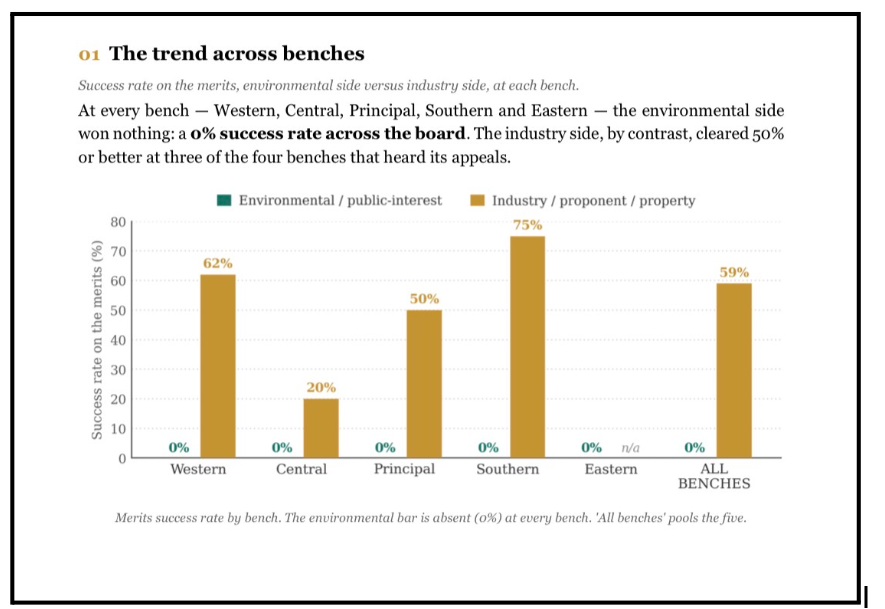
The Southern Zone Bench in Chennai dismissed the only environmental or public-interest merit appeal. Project proponents, industries and property owners received favourable orders in nine of 12 cases. The Central Zone Bench in Bhopal dismissed all three environmental or public-interest merit appeals. The other side received a favourable order in one of five cases.
The Eastern Zone Bench in Kolkata decided only one appeal during the period. It was filed by the public-interest side and was dismissed.
What the Six-month Record Shows
The findings were released around the time the NGT held its international conference on The Future of Environment and Climate Dynamics in New Delhi on September 19 and 20.
Chief Justice of India Surya Kant, speaking at the conference, said courts need to find a way to balance environmental protection with development.
For Dubey, the figures reflect the difficulties individual petitioners can face when taking on large companies. “The petitioners and activists cannot do that much work. They only believe that their facts are correct and who can raise their voice,” he said.
Support Us To Sustain Independent Environmental Journalism In India.
More Ground Reports
He Was Married as a Child, Now Manish Dangi Helps Stop It for Others
Despite The Ban, How Gutkha Became MP’s Most Common Household Habit