Women’s T20 cricket is no longer treated as a side story in India’s sporting calendar. It has become faster, louder, easier to follow, and more visible across television, digital platforms, stadium crowds, and social media. Fans searching for Cricket Women T20 now find proper match build-up, player debates, tactical analysis, and year-round discussion rather than occasional tournament coverage.
The rise of women cricket in India comes from a simple shift: the game now has structure behind the excitement. Better scheduling, stronger domestic pathways, the Women’s Premier League, equal match-fee policy at international level, and rising public interest have turned women’s T20 from a promising product into a serious cricket property.
Why T20 Has Changed the Audience
T20 fits modern attention better than any other cricket format. It is short enough for casual viewers, intense enough for serious fans, and tactical enough for analysts. A match can change in one over, but it still gives space for skill: powerplay planning, spin match-ups, death bowling, field placement, and finishing under pressure.
This matters even more for women’s cricket because shorter formats reduce entry barriers. A new fan does not need five days to understand the story. Runs required, balls left, wickets in hand, and fielding pressure are clear within minutes. That makes the format friendly without making it shallow.
The popularity of cricket in India gives women’s T20 a powerful base. Indian fans already understand the language of the game. They know what a good yorker means, why a dropped catch hurts, and how a chase can turn. Once women’s matches became easier to watch and follow, the audience did not need to be taught cricket again. It only needed access.
Several factors are driving attention:
- Short Match Window: Fans can watch a full game after work, college, or school.
- Clear Match Stakes: T20 makes pressure visible through every over and every field change.
- Recognisable Players: Stars such as Smriti Mandhana, Harmanpreet Kaur, Shafali Verma, Jemimah Rodrigues, Richa Ghosh, Deepti Sharma, and Renuka Thakur now have strong public recall.
- Digital Clips: Sixes, wickets, catches, and celebrations travel quickly on social platforms.
- League Pathways: WPL gives domestic players a high-pressure stage before international cricket.
The format also makes personality easier to notice. A batter’s intent, a spinner’s courage, a keeper’s energy, or a captain’s field change can become part of the story quickly. That is valuable in a country where fans follow characters, not just scorecards.
The 2026 Season as a Bigger Stage
The story of India Women cricket 2026 is not only about fixtures. It is about whether the team can convert visibility into results. India have the talent, but the next step is consistency: winning pressure phases, closing tight matches, and carrying form from bilateral cricket into global events.
The year gives India a serious platform. The team has England conditions to handle, a major T20 event to prepare for, and a public that expects more than brave defeats. That expectation is healthy. It means the audience sees the team as contenders, not guests at the table.
T20 cricket asks India to sharpen decisions. Who attacks in the first six overs? Who controls the middle? Who finishes if two wickets fall early? Which bowler owns the 18th over? These are not abstract questions. They decide tournaments.
India’s strongest sides have always had individual brilliance. The current challenge is to turn that brilliance into a repeatable match method. A great fifty can win one game. A clear system can win a tournament.
World Cup Pressure and Short-Format Timing
The T20 Cricket World Cup Women in 2026 gives the format its biggest stage of the year. England hosting the tournament adds another layer because conditions can change quickly. Cloud cover, used pitches, boundary sizes, and cooler weather can all affect how teams bat and bowl.
India must treat the tournament as a test of adaptability. A flat surface may reward Shafali’s power. A slower pitch may bring Deepti’s control into focus. A moving new ball may make Mandhana’s judgment vital. A tight chase may need Richa’s finishing. The best T20 teams do not depend on one script.
World Cups also test emotional control. India will face matches where public expectation is heavy and margins are thin. That is where fielding standards, running between wickets, and calm bowling plans become as important as star names.
The team’s preparation should focus on three areas: cleaner starts, stronger middle-over rotation, and better death-overs execution. If those parts improve together, India can be dangerous against any opponent.
Indian Players Are Becoming Clearer Brands
The rise of Indian women cricketers is central to the format’s growth. Fans follow players when they understand their roles. Mandhana is not only an opener; she is a tone-setter. Harmanpreet is not only captain; she is a pressure player. Shafali is not only aggressive; she changes powerplay fields. Deepti is not only an all-rounder; she gives tactical balance.
This role clarity helps new fans. It also helps the market around the sport. A player with a defined style is easier to remember, discuss, and support. That is why women’s T20 now has more visible individual identities than it did a decade ago.
Richa Ghosh is a good example. Her finishing role gives India something they have often needed: late-over power without hesitation. Renuka Thakur brings another kind of value with new-ball movement. Jemimah Rodrigues connects phases with placement and tempo. Shreyanka Patil adds spin with wicket-taking intent. These are different skill types, and that variety makes the team easier to follow.
The WPL Effect on Skill and Confidence
The Women’s Premier League has changed how Indian players experience pressure. A domestic player no longer has to wait for international selection to face big crowds, elite overseas players, television scrutiny, and tactical match-ups. WPL compresses that education into a short, intense window.
That matters because T20 careers are built on repeated exposure. A young bowler learns what happens when a set batter attacks. A batter learns how to rebuild after a 20 for 2 start. A fielder learns that one saved boundary can decide a match. These lessons are sharper when the league has real attention.
WPL has also created stronger competition for national spots. That is good for India. Selection should feel earned. If a player knows that another performer is close behind, standards rise naturally.
The league’s strongest contribution may be confidence. Players who perform in WPL walk into international cricket with proof behind them. They have already handled cameras, crowds, and pressure overs. That does not guarantee success, but it reduces fear.
Why Fans Are Watching More Closely
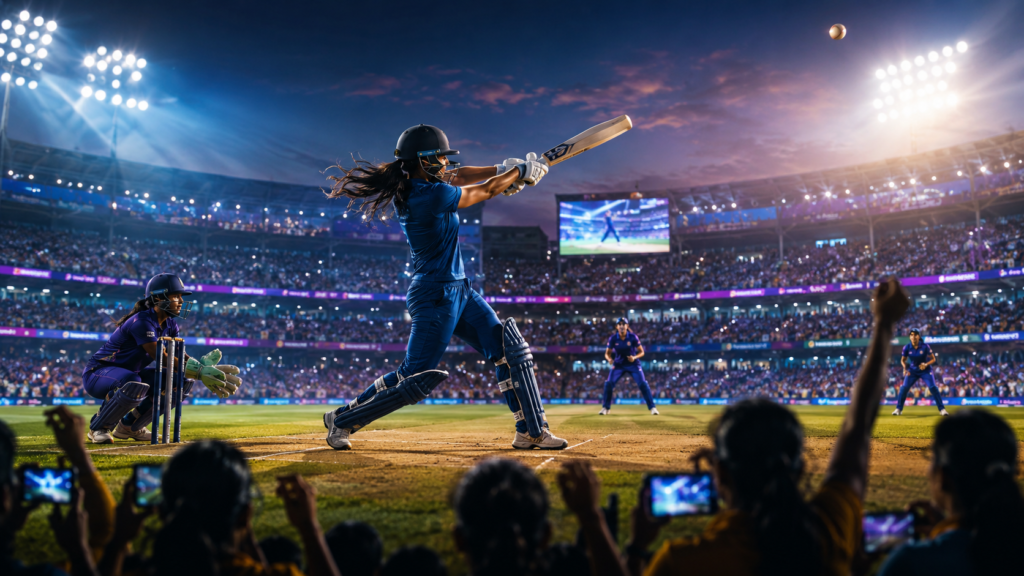
Women’s T20 is gaining attention because the viewing experience has improved. Better broadcasts, cleaner graphics, commentary, highlights, interviews, and social media coverage make it easier for fans to stay connected. The sport is not hidden behind poor access anymore.
The fan base is also changing. Younger viewers are more comfortable following women’s sport as part of the normal cricket cycle. They do not need a special reason to watch. If the match is competitive and the players are good, that is enough.
Families also respond to women’s cricket differently now. A girl watching Mandhana, Harmanpreet, Richa, or Renuka sees a possible sporting identity. That emotional impact cannot be measured only through ratings. It changes what cricket can mean inside homes, schools, academies, and local grounds.
Women’s T20 has become easier to discuss because the cricket itself has become sharper. The batting is bolder. The bowling plans are clearer. Fielding has improved. Captains are more tactical. Close finishes feel earned, not accidental.
What India Must Do Next
Attention is useful, but it must lead somewhere. India need to keep improving the product on the field and the system around it. The next phase should not depend only on a few stars. It should create a deeper pool of players who can handle international speed.
The priorities are clear:
- More Quality Domestic Matches: Players need regular pressure before national selection.
- Better Fitness Systems: T20 demands speed, power, recovery, and injury prevention.
- Sharper Fielding Standards: Saved runs matter more in short formats.
- Role-Based Coaching: Players should train for specific match phases, not generic improvement.
- Stronger Fan Access: Fixtures, highlights, statistics, and player stories should remain easy to find.
India also need to protect multi-format balance. T20 may drive attention, but ODIs and Tests still develop patience, technique, and temperament. A strong national setup should not become one-dimensional.
The best future is one where T20 brings fans in, WPL develops players, domestic cricket builds depth, and international matches define standards. Each part has a job. If they work together, women’s cricket will not need occasional campaigns to feel important. It will stand on its own calendar.
The Bigger Meaning of the T20 Rise
Women’s T20 is gaining attention in India because it now offers what Indian fans respect most: skill under pressure. The format is quick, but it is not simple. Every over asks for judgment. Every mistake is visible. Every strong performance travels fast.
The rise also shows that visibility can change value. Once matches are shown properly, players are discussed seriously. Once players are discussed seriously, young girls see a pathway. Once a pathway feels real, more talent enters the system. That is how a sport grows beyond one tournament.
India already has the audience. It has the cricket culture. It has players with star quality and a league that can sharpen the next group. The task now is to turn attention into excellence. If India do that, women’s T20 will not be seen as a growing segment for long. It will simply be part of the country’s main cricket conversation.
Disclaimer: This content is branded and does not reflect the views or opinions of Ground Report. No journalist is involved in creating branded material and it does not imply any endorsement by the editorial team. Ground Report Digital LLP. takes no responsibility for the content that appears in branded articles and the consequences thereof, directly, indirectly or in any manner. Viewer discretion is advised.
Support us to keep independent environmental journalism alive in India.
Stay connected with Ground Report for underreported environmental stories.