India’s National Forest Policy has a simple goal: one-third of the country’s land under forest or tree cover.
The country is nowhere near it.
India currently sits at 21.76% forest cover. Add tree cover on top and it reaches 25.17%. The policy target is 33%. That leaves a gap of more than 7 percentage points at the national level, and the picture gets sharper when you break it down by state.
AT A GLANCE
| 21.76%India’s current total forest cover | 33%National Forest Policy target | 17States & UTs that cross the forest line |
What 33% actually means
The 33% goal comes from the National Forest Policy of 1988. It counts forest and tree cover combined, not forest alone. FSI tracks them separately: forest cover (canopy density above 10%, patches above 1 ha) and tree cover (smaller patches outside recorded forest areas).
India’s forest cover alone: 7,15,342.61 sq km. Tree cover adds another 1,12,014.34 sq km. Combined: 8,27,356.95 sq km, or 25.17% of geographic area. The policy measures the combined figure. Even on that generous reading, the country is 7.83 percentage points short.
Who made the club
The top three are not surprises if you know India’s geography.
Lakshadweep leads at 91.33%. It is a coral archipelago with a total geographic area of under 30 sq km. Almost all of it is tree cover. The number is real, but the context matters: it is a tiny island territory with no agricultural land to speak of.
Mizoram comes second at 85.34% and is the more instructive case. It is a landlocked state in the Northeast with a population of just over 1.2 million. Dense forest cover has persisted here despite shifting cultivation pressures that have reduced cover in neighbouring states.
The Andaman and Nicobar Islands sit at 81.62%. Like Lakshadweep, geography does a lot of work: remote location and limited access kept development low.
Eight of the top 12 are from the Northeast or island territories. Low agricultural pressure and difficult terrain kept forests where development never arrived.
The pattern in the top half of the table is consistent. Northeastern states dominate: Arunachal Pradesh (78.67%), Meghalaya (75.65%), Manipur (74.28%), Nagaland (73.72%), Tripura (72.33%). Then come the high-altitude and forested mainland states: Goa (61.20%), Kerala (56.78%), Sikkim (47.33%), Uttarakhand (45.44%), Chhattisgarh (41.28%).
Who did not
The bottom of the table tells a different story.
Haryana and Punjab are essentially tied at the bottom: 3.65% and 3.67%. Together they cover nearly 95,000 sq km of land but hold under 3,500 sq km of forest between them. These are the states that led India’s Green Revolution. Every expansion of cropland over four decades came directly at the cost of tree cover.
Rajasthan is at 4.84%. Most of that is Thar Desert, so the geographic area itself inflates the denominator. But even adjusted for ecology, Rajasthan has not made meaningful progress in the non-desert regions.
Gujarat sits at 7.65% and Uttar Pradesh at 6.24%. Both are large, densely agricultural states with historical land-use patterns that left little room for forests.
The size trap
The biggest source of confusion in forest reporting is confusing area with coverage.
Madhya Pradesh has more forest by area than any other state in India: over 77,000 sq km. That sounds like a conservation success. In percentage terms it is 25% of the state’s geographic area, which puts it at rank 20 out of 36.
Maharashtra has around 50,000 sq km of forest. That is 16.5% of its land. Maharashtra frequently makes lists of India’s most forested states in total area terms. It does not belong in the 33% Club.
A large state can hold enormous forests in raw area and still fail to meet the national target. The percentage is the only honest metric here.
The Northeast carries the country
The 8 northeastern states cover just 7.98% of India’s land area. They account for 21.08% of the country’s total forest and tree cover. Remove the Northeast from the national average, and India’s forest cover figure drops well below 20%.
Forest cover in the Northeast as a region: 1,74,394.70 sq km. That is 67% of the region’s geographic area, double the national target. The region is losing ground, though. The current assessment shows a decrease of 327.30 sq km in forest cover across the Northeast compared to the previous cycle.
Ranking of All 34 States and UTs
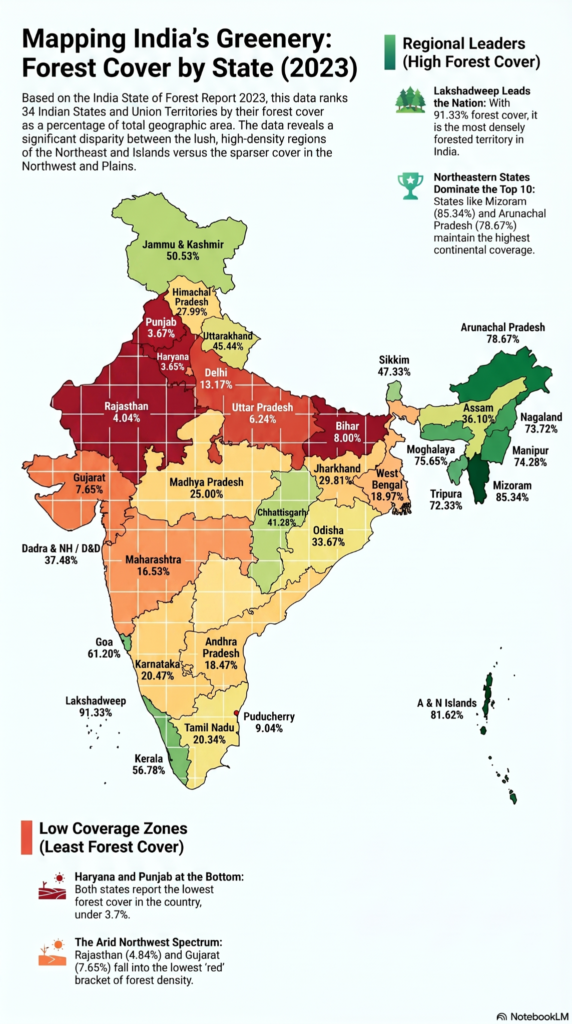
Forest cover as a percentage of total geographic area. Source: India State of Forest Report 2023, Vol. 1, Forest Survey of India.
| Rk | State / UT | Type | Forest Cover % |
| 1 | Lakshadweep | UT | 91.33% |
| 2 | Mizoram | State | 85.34% |
| 3 | A & N Islands | UT | 81.62% |
| 4 | Arunachal Pradesh | State | 78.67% |
| 5 | Meghalaya | State | 75.65% |
| 6 | Manipur | State | 74.28% |
| 7 | Nagaland | State | 73.72% |
| 8 | Tripura | State | 72.33% |
| 9 | Goa | State | 61.20% |
| 10 | Kerala | State | 56.78% |
| 11 | Jammu & Kashmir | UT | 50.53% |
| 12 | Sikkim | State | 47.33% |
| 13 | Uttarakhand | State | 45.44% |
| 14 | Chhattisgarh | State | 41.28% |
| 15 | Dadra & NH and D&D | UT | 37.48% |
| 16 | Assam | State | 36.10% |
| 17 | Odisha | State | 33.67% |
| 18 | Jharkhand | State | 29.81% |
| 19 | Himachal Pradesh | State | 27.99% |
| 20 | Madhya Pradesh | State | 25.00% |
| 21 | Chandigarh | UT | 21.93% |
| 22 | Karnataka | State | 20.47% |
| 23 | Tamil Nadu | State | 20.34% |
| 24 | West Bengal | State | 18.97% |
| 25 | Andhra Pradesh | State | 18.47% |
| 26 | Maharashtra | State | 16.53% |
| 27 | Delhi | UT | 13.17% |
| 28 | Puducherry | UT | 9.04% |
| 29 | Bihar | State | 8.00% |
| 30 | Gujarat | State | 7.65% |
| 31 | Uttar Pradesh | State | 6.24% |
| 32 | Rajasthan | State | 4.84% |
| 33 | Punjab | State | 3.67% |
| 34 | Haryana | State | 3.65% |
Who is moving in the right direction
The states showing the largest absolute increase in forest and tree cover in the latest assessment cycle:
Chhattisgarh: +683.62 sq km. Uttar Pradesh: +559.19 sq km. Odisha: +558.57 sq km. Rajasthan: +394.46 sq km.
The states showing the largest decreases are Madhya Pradesh (-612.41 sq km), Karnataka (-459.36 sq km), Ladakh (-159.26 sq km), and Nagaland (-125.22 sq km).
Note the tension: two states already in the 33% Club (Nagaland at 73.72%, Karnataka at 20.47%) are losing ground, while states far below the threshold (Uttar Pradesh, Rajasthan) are gaining. Gain in absolute area does not automatically move the percentage needle for large states.
The gap in plain numbers
Closing the gap from 21.76% to 33% means bringing an additional 2.37 lakh sq km under canopy cover.
For reference, that is roughly 14 times the total forested area of Rajasthan. Or about three times the size of Jharkhand.
The national forest and tree cover combined (forest plus small patches outside recorded forest areas) reaches 25.17%. Even using that more generous measure, the gap to 33% is still nearly 8 percentage points and roughly 2.55 lakh sq km.
The country is adding forest. Between the last two assessments, forest cover grew by 156 sq km nationally. At that pace, the 33% target is not a near-term story.
The growth is real and worth acknowledging. States like Chhattisgarh, Uttar Pradesh, and Odisha have shown meaningful increases. But the scale of the gap means the 33% Club will stay at 17 members for a long time unless land-use policy in the large agricultural states changes substantially.
Research Paper By Forest Survey of India and Analysis by GrabOn.
Support Us To Sustain Independent Environmental Journalism In India.
More Ground Reports
He Was Married as a Child, Now Manish Dangi Helps Stop It for Others
Despite The Ban, How Gutkha Became MP’s Most Common Household Habit