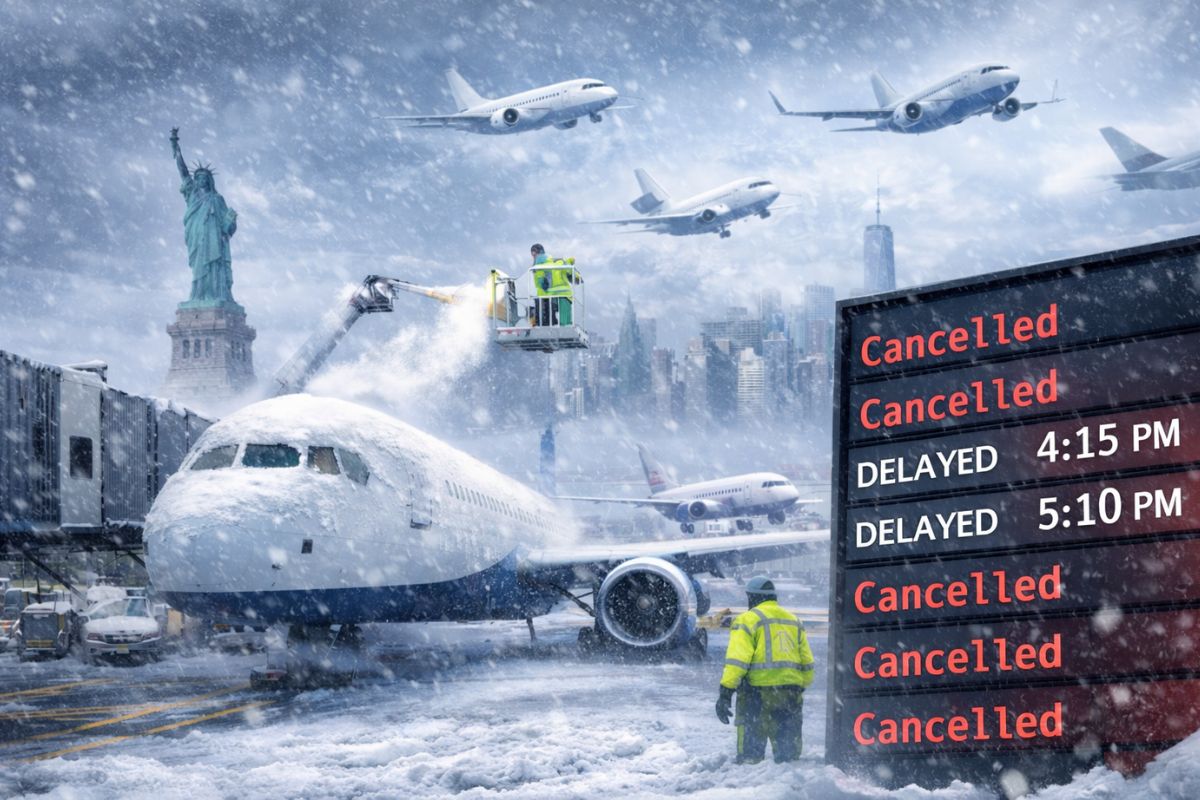
A powerful blizzard swept across the northeastern United States this week, cancelling thousands of flights, bringing New York City to a near standstill, and triggering travel bans across multiple states. The storm has caused one of the worst aviation disruptions the region has seen in years.
What Happened
The storm — classified as a bomb cyclone — brought record-breaking snowfall to the entire Northeast corridor. Central Park in New York City recorded nearly 19 inches of snow. Rhode Island was the worst hit, with Providence receiving 36 inches, breaking its previous single-storm record of 28.6 inches set in February 1978.
“It completely smashed it,” said Candice Hrencecin, a meteorologist with the National Weather Service in Boston. “We were just as shocked as everyone else.”
More than 600,000 properties along the US east coast lost power. Massachusetts Governor Maura Healey imposed a travel ban across the state, warning residents to stay off roads entirely.
“White-out conditions are making travel extremely dangerous,” Healey said. “If you get stuck, help will have a hard time reaching you.”
New York City also implemented a travel ban, closing all roads, highways, and bridges before lifting it at noon local time on Tuesday.
Why Were Flights Cancelled
The snowfall made runway operations at New York’s three major airports — John F. Kennedy International Airport, LaGuardia Airport, and Newark Liberty International Airport — extremely dangerous. Planes required de-icing. Snow removal crews worked around the clock. Staff struggled to reach airports during the storm.
The scale of cancellations was staggering. On Monday alone, 5,706 flights were cancelled across the United States. LaGuardia saw 98% of its outbound flights cancelled. JFK recorded a 91% cancellation rate. Newark, Boston, and Philadelphia were also severely affected.
By Tuesday, more than 2,000 additional flights had already been cancelled, with Newark and Boston facing the heaviest impact. Across Sunday to Tuesday, the total number of US flight cancellations exceeded 12,000.
Air India cancelled all flights to and from New York City and Newark on February 24. In a statement, the airline said severe weather caused runway closures due to snow accumulation.
Who Was Affected
The disruption hit the roughly 335,000 passengers who pass through New York’s airport hubs daily. Major carriers including American Airlines, Delta Air Lines, United Airlines, JetBlue Airways, and Southwest Airlines all cancelled flights or issued travel waivers allowing passengers to rebook without change fees.
Sandra Wu, a resident of Long Island, described the situation at home. “My husband went out early through the garage to start digging us out, but it was pointless,” she told Reuters. “I have never seen a storm this bad.”
Boston resident Bradley Jay said the storm made him feel like a prisoner. “I won’t be able to really walk around town for another ten days,” he said.
When Will Flights Resume
Airports began resuming operations around noon on Tuesday, February 24. However, a full return to normal will take time. Aircraft and crew are out of position, creating a domino effect across the network.
Airlines are adding extra flights to clear stranded passengers. Most carriers have waived fare differences for rebooking on affected routes through February 26. Passengers whose flights were cancelled are legally entitled to a full refund if they choose not to travel.
Experts expect major recovery within two to three days. Full normalcy is expected by Friday or Saturday, provided no new weather system arrives.
What Travellers Should Do Now
Passengers are advised to check flight status on airline apps before leaving for the airport, turn on notifications, and avoid assuming flights are operating on schedule. Rebooking through mobile apps is faster than calling customer service. Those with flexible schedules should consider travelling mid-week or later for a smoother experience.
Support Us To Sustain Independent Environmental Journalism In India.
Keep Reading
Highway Halt Puts Kashmir’s Fruit Economy at Risk
Railway line expansion plan put Kashmir’s apple orchards at risk
Warmer winters in Kashmir raise concerns over apple and crop yields