India’s flood managers, dam engineers, and agricultural planners have spent decades making decisions based on climate models that cannot see a Himalayan valley. A team at the Indian Institute of Technology Roorkee has now built one that can.
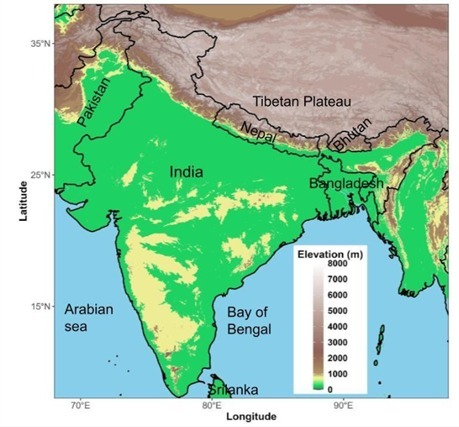
The dataset, named INDRA-CMIP6, maps daily rainfall and temperature forecasts across the entire Indian subcontinent at a resolution of 10 kilometres free to any planner, researcher, or policymaker who needs it. It runs from 1950 through 2100 under four greenhouse gas emission scenarios.
The team published the work in Scientific Data, a peer-reviewed journal in the Nature Portfolio.
Standard global climate models project broad regional trends. A single grid cell in many of them spans more than 300 kilometres — too wide to capture the cloudburst that triggers a landslide in Uttarakhand or the temperature spike that wilts a crop in Madhya Pradesh.
That resolution gap is not a technical abstraction. It is the reason flood infrastructure gets undersized, drainage systems get overwhelmed, and roads get built to standards that extreme weather has already made obsolete.
“India is already witnessing rising temperatures, shifting rainfall patterns, urban flooding, heat stress and increasing pressure on water resources,” said Ankit Agarwal, associate professor in the Department of Hydrology at IIT Roorkee and the study’s corresponding author. “National-scale or coarse global projections are often insufficient for local-level planning, especially in disaster-prone Himalayan regions.”
How the Team Built It
The research was led by Joyjit Mandal, Divya Sardana, and Akash Singh Raghuvanshi, all from the Department of Hydrology at IIT Roorkee, with Agarwal as the supervising and corresponding author.
The team started with outputs from 14 CMIP6 global climate models the internationally coordinated framework that fed the United Nations’ most recent climate assessment and processed them using a statistical method called Double Bias-Corrected Constructed Analogue, or DBCCA.
The method was chosen because it outperforms alternatives at the task that matters most: accurately reproducing extreme climate events at local scales. It corrects errors across multiple grid cells at once, preserving the spatial relationships between them rather than treating each location in isolation a critical distinction when modelling how rainfall moves across a mountain range.
The team calibrated the method against reference data from 1979 to 2000 and validated it against the period from 2001 to 2014.
What the Numbers Prove
Before downscaling, the raw ensemble of 14 models underestimated monsoon rainfall by a mean error of 0.38 millimetres per day. Maximum temperatures were overestimated by 0.76 degrees Celsius. Minimum temperatures were underestimated by 1.47 degrees Celsius throughout the year.
After DBCCA correction, rainfall error fell to 0.24 millimetres per day. Maximum temperature error dropped to 0.20 degrees Celsius. Minimum temperature error fell to 0.16 degrees Celsius.
The improvement was largest where it matters most days that exceed the 95th percentile of historical records. Those are the extreme events that destroy infrastructure and kill people. They are also where standard models fail most consistently. INDRA-CMIP6 substantially reduced both the average bias and the spread between individual models for all three variables.
Built for the People Who Decide
Both ensemble mean data and all 14 individual model outputs are publicly available, allowing users to compare projections and evaluate uncertainty rather than depend on a single forecast.
Urban drainage planners need to know not just that extreme rainfall will increase, but where and at what intensity because drainage systems are designed to handle specific rainfall rates, not averages. Agricultural authorities need district-level temperature projections sensitive enough to reflect crop heat thresholds. In Himalayan states, where weather shifts dramatically over a few kilometres, infrastructure engineers need watershed-scale data to assess whether a dam or a road will hold under future conditions.
“Fine-scale climate projections such as INDRA-CMIP6 are critical for translating global climate science into actionable information for planners, researchers, and policymakers,” Agarwal said. “Open access to such datasets strengthens scientific collaboration and supports informed climate adaptation strategies.”
The dataset’s geographic coverage extends beyond India’s borders. Bangladesh, Nepal, Bhutan, and parts of Tibet and Myanmar are all included. The underlying code is publicly available on GitHub, allowing research teams in other climate-vulnerable regions to apply the same framework.
Real Test Comes Next
India’s National Disaster Management Authority, state water commissions, urban local bodies, and agriculture ministries at both central and state levels all run planning cycles that depend on exactly the kind of district-scale, long-range climate data INDRA-CMIP6 now provides.
The dataset is built. The precision is verified. The decision to use it belongs to someone else.
Support Us To Sustain Independent Environmental Journalism In India.
Keep Reading
How Solar Solutions Are Helping Protect Crops from Wild Animals
Pench Tiger Reserve: How a Man Survived a Tiger Attack
Stay Connected With Ground Report For Underreported Environmental Stories.
Author
Support Ground Report to keep independent environmental journalism alive in India
We believe climate change should be the basis of current discourse, and our stories attempt to reflect the same.
Connect With Us
Send your feedback at greport2018@gmail.com
Newsletter
Subscribe our weekly free newsletter on Substack to get tailored content directly to your inbox.
When you pay, you ensure that we are able to produce on-ground underreported environmental stories and keep them free-to-read for those who can’t pay. In exchange, you get exclusive benefits.
Your support amplifies voices too often overlooked, thank you for being part of the movement.