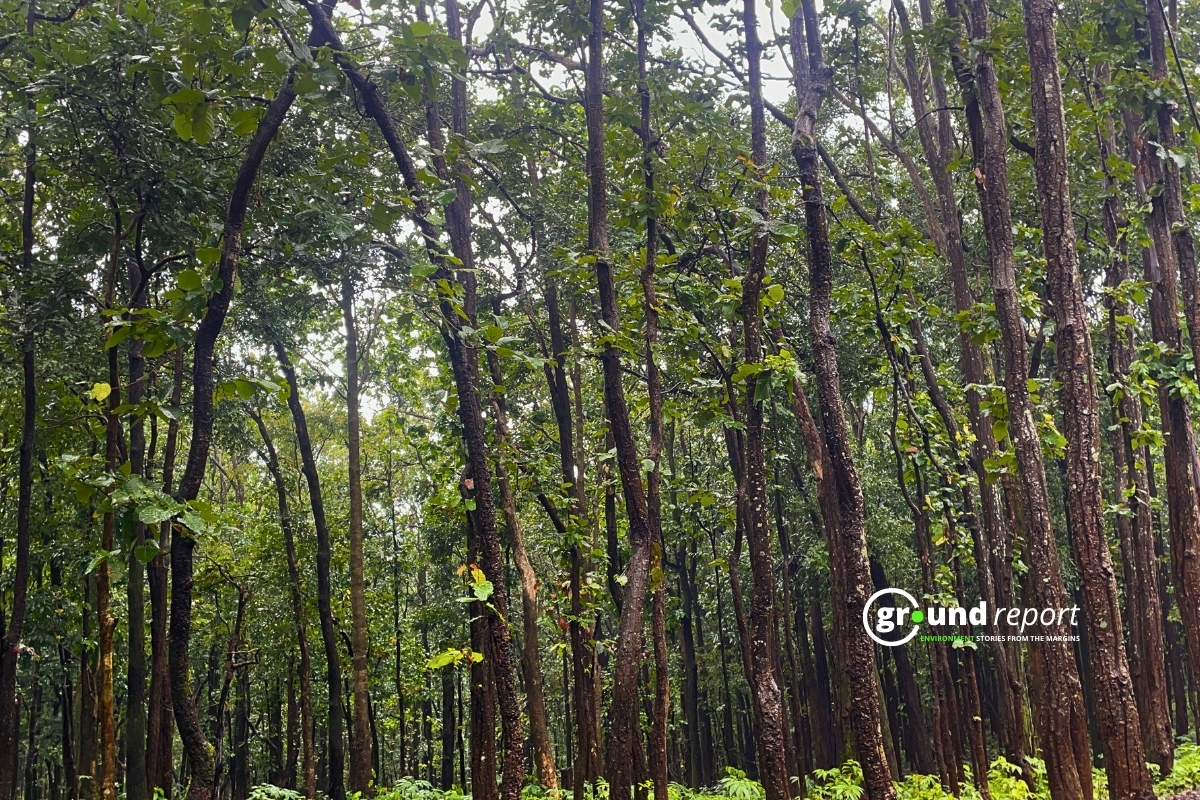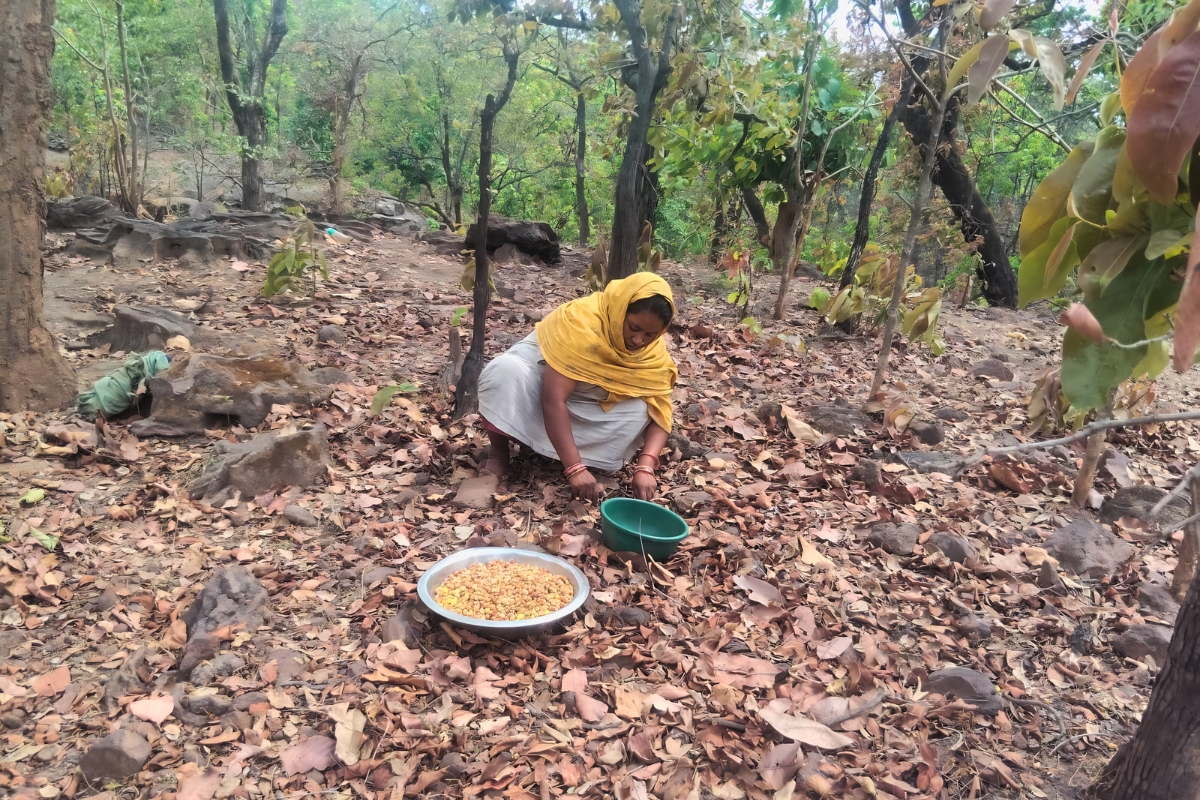
Reported from Singrauli, Madhya Pradesh | At 4 a.m., Anita Kushwah heads into the Mahan forests of Singrauli with a basket on her head and her four-year-old daughter in her arms. She is here to collect mahua flowers—a routine that partially supports her family’s entire year. Her husband, by a bitter irony, works day-wage labor at a nearby coal company.
The same industry is now proposing to mine beneath the very forest she depends on.
“We need the coal job to keep the stove running,” she says, “but we need this forest to eat.” Then she asks: “If they hollow out the ground under these trees, will the mahua survive?” About 50,000 tribal and forest-dependent people, including Anita, across 54 villages in the Mahan region share that worry.
The project
JK Cement Limited has proposed an underground coal mine in the Mahan coal block in Singrauli, Madhya Pradesh. The mine is expected to produce 1.2 million tonnes of coal per year and to cover 981.75 hectares, of which 975.5 hectares is dense forest. All mining activities will be confined within the approved mine lease area, with 24 hectares utilized for roads, underground entries, and associated infrastructure.
The Forest Advisory Committee (FAC) gave its conditional in-principle approval in January 2026. The company submitted its Stage-I forest clearance on February 16. Three days later, on February 19, the Ministry of Environment granted environmental clearance.
The project will require felling 9,787 trees. A compensatory plantation is planned on 24 hectares of non-forest land in Charbaheria village, Narsinghpur district, far from Singrauli.
A familiar fight, a new form
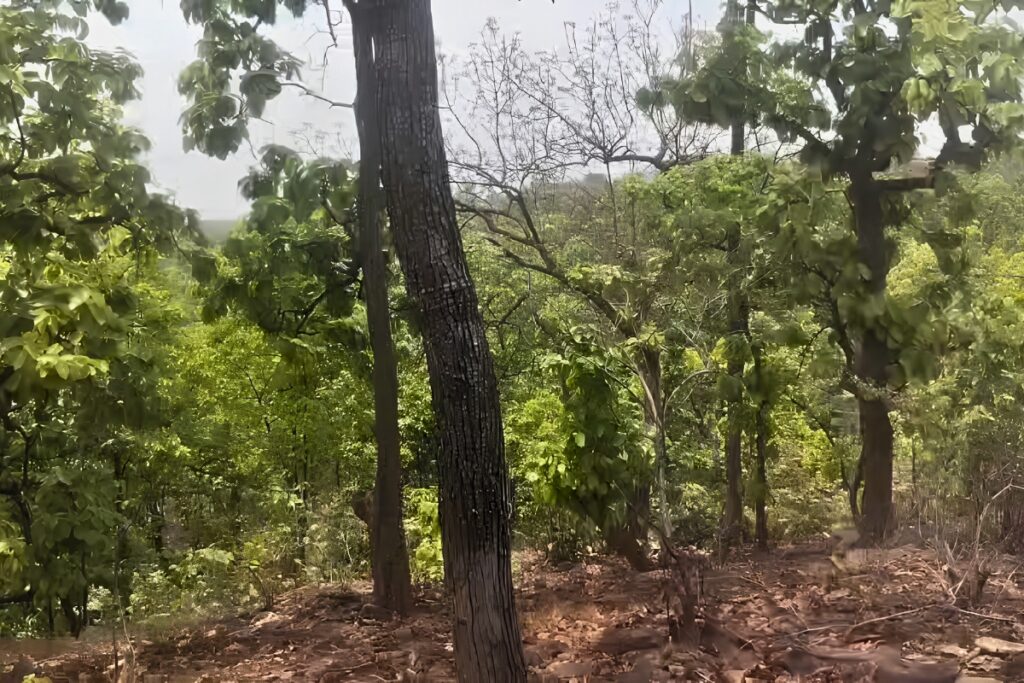
In 2006, the block was allotted to a joint venture of Essar Power and Hindalco — Mahan Coal Limited. In September 2014, the Supreme Court cancelled 204 coal block allocations, including this one, ruling the process arbitrary and illegal. By February 2016, the Ministry of Environment had also withdrawn the block’s Stage-II forest clearance. The block was then re-auctioned for underground mining, and JK Cement won the bid in late 2024.
And the history of community opposition runs deep. In 2013, villagers from 11 villages refused to leave their forest.
The Mahan Sangharsh Samiti (MSS) was formed in 2012-13 by villagers from 54 villages dependent on the Mahan forests of Singrauli (such as Amelia, Bandhora, Budher, Suhira, and Barvantola) to lead the villagers’ fight against the proposed coal mines in the Mahan’s pristine forests by Essar and Hindalco.
Activists alleged that Gram Sabha approvals used to push the earlier project through were forged, i.e., had fake signatures and, in some cases, had the names of people who had already died.
What goes underground doesn’t stay underground
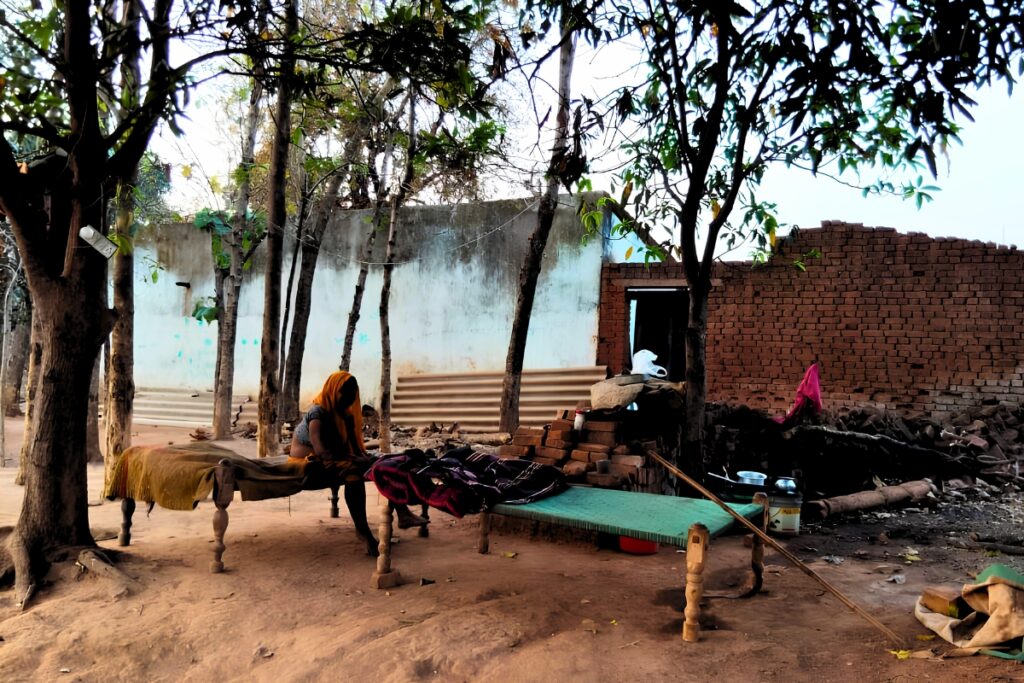
The mining method proposed is board-and-pillar with caving—coal is extracted from below, and the surface is allowed to sink in a controlled manner. The Forest Advisory Committee (FAC) documents themselves note a projected surface subsidence of 14.5 mm per meter and attach conditions for advanced monitoring of land settlement, seasonal streams, and natural drainage systems.
Environmental lawyer Sudeep Srivastava explains the specific risk to the forest. “Sal trees extend their roots more than four meters deep. When the ground sinks even one to one-and-a-half meters, the roots break. The trees die standing up,” Srivastava said.
A 2023 study in the journal Ecosystem Health and Sustainability was primarily conducted in the semi-arid regions of northwestern China, with large-scale underground coal mining. The researchers examined how land subsidence caused by mining affects topsoil and vegetation.
The study found that the cracks formed in the ground due to underground mining act as direct pathways for rainwater. Normally, water seeps slowly through the soil, but these cracks allow it to infiltrate rapidly into deeper layers—a process scientifically known as “preferential flow.” As a result, the upper layer of soil becomes completely dry and loses its essential nutrients. In the absence of moisture and nutrients, the network of plant roots begins to weaken. Eventually, the natural balance between the soil and vegetation breaks down, leading to the long-term collapse of the entire forest ecosystem.
Meanwhile, Odisha-based water activist Ranjan Kishore Panda views the impact of underground mining through the lens of water and warns, “Coal mining and the industries linked to it place immense pressure on water resources. In areas where mining takes place, people often become dependent on water tankers.”
He explains, “Cracks forming in the ground essentially mean that aquifers are being punctured. In other words, the water stored underground gradually starts seeping away and getting depleted. As a result, traditional water sources also slowly disappear.”
According to the project documents, mine operations will require 2.62 million litres (2620 KLD) of water every day. This water will be supplied through groundwater and mine sumps — the water that accumulates inside the mine during excavation and is later treated and used.
Explaining the consequences further, Panda adds, “In such situations, village wells and hand pumps gradually dry up. Many times, the water table falls so deep that it never returns.”
The corridor that moved on paper
The most pointed controversy involves elephants. An official letter dated August 21, 2025, with reference number V.Pra./Bhu-Prabandh/2025/4877, from the Principal Chief Conservator of Forests (Wildlife), Shubhranjan Sen, flags a striking inconsistency.
The letter contains a report regarding the diversion of forest land for JK Cement Limited’s Mahan coal mines. The mine inspection report (reference number /Tak./2025/5277) had been sent on August 13, 2025, by the field director of the Sanjay Tiger Reserve in the Sidhi District.
JK Cement’s mine is located in the Sarai and Mada tehsils of the Singrauli district. According to the report, the mining area does not fall within a 10-kilometer radius of any national park or wildlife sanctuary. It lies 45 kilometers from the boundary of Son Gharial Sanctuary and 44 kilometers from its eco-sensitive zone. It is 53 kilometers from the eco-sensitive zone of Bagdara Sanctuary, while the nearest eco-sensitive zone of Sanjay Tiger Reserve is 15 kilometers away.
However, the letter records a major change concerning the elephant corridor. According to the letter, under the earlier working plan (2008–19) prepared by the previous Chief Conservator of Forests, Working Plan Officer, Singrauli, Amitabh Agnihotri, the mining area formed part of an elephant corridor.
But under the currently operative working plan (2019–29), prepared by IFS officer Rajeev Mishra, the mine is now shown as being 10.5 kilometers away from the corridor. Rajeev Kumar Mishra, a 2003-batch Indian Forest Service (IFS) officer from the Madhya Pradesh cadre, is currently serving as the Chief Conservator of Forests (CCF), Working Plan, in Shahdol.
The Field Director of Sanjay Tiger Reserve confirmed the contents of the letter over the phone. According to him, “That area used to be part of an elephant corridor, but due to extensive construction and mining activities, elephants are no longer using it… Elephants have not been sighted in this region for years.”
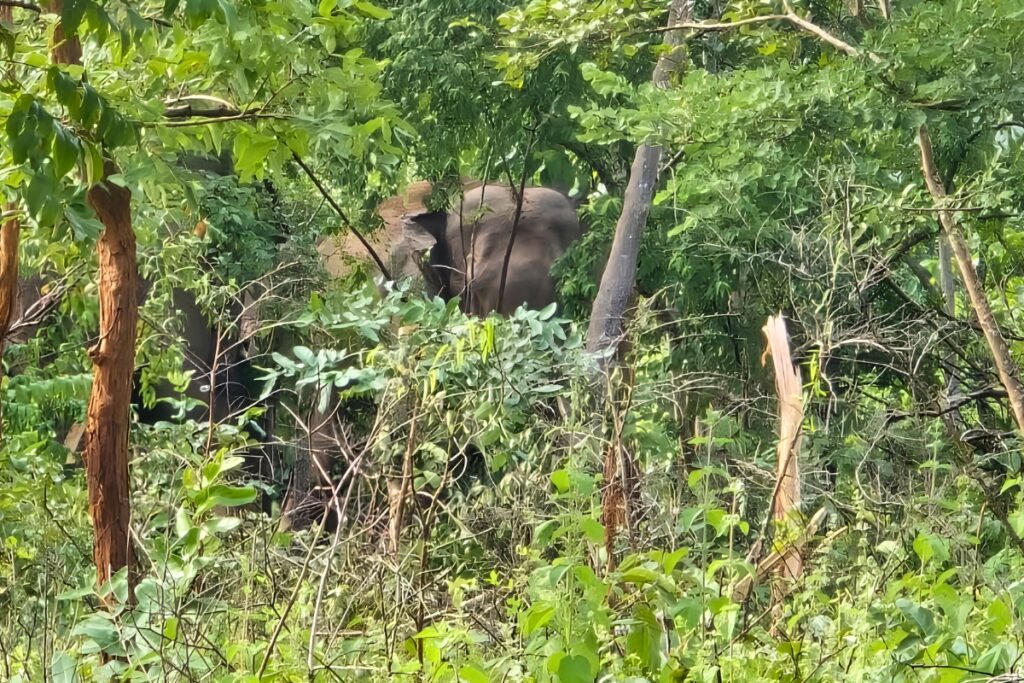
When asked that Amitabh Agnihotri’s working plan identifies the proposed mining area as falling within an elephant corridor, whereas Rajeev Mishra’s newer working plan—according to the letter issued by your office—states that the area is 10.5 kilometers away from the elephant corridor, the Field Director responded, “That will have to be checked in the documents,” before disconnecting the call.
Mandar Pingle of the Satpura Foundation says, “Removing a corridor on paper doesn’t change elephant behavior on the ground. If these routes are blocked, elephants will find new paths—and those paths will go through villages.”
Wildlife activist Ajay Dubey has filed a petition in the National Green Tribunal (NGT) over the elephant corridor issue—focused on the nearby Dhirauli mine—but activists say both projects affect the same landscape and cannot be evaluated in isolation.
Shubhranjan Sen agreed with the field director’s report and forwarded the authenticated map to the Additional Principal Chief Conservator of Forests (Land Management) and Nodal Officer (FCA) for further action about stage-I approval.
The letter further notes that the company has submitted a written statement declaring that there are no historical idols or monuments within the mining area.
Public Hearing
On October 24, 2025, a public hearing on the project was held in Budher Village. Around 1,700 people attended. Thirty-one written objections and 47 verbal objections were filed. The concerns were consistent: land subsidence, threats to water sources, and loss of forest livelihoods.
Vifalal Kahera, 55, who farms 7 acres and feeds a family of eight, put it simply: “If the land sinks and the wells dry up, what will we drink and how will we farm?”
The committee acknowledged the concerns and asked for a time-bound action plan covering compensation, clean water, plantation, and social infrastructure. JK Cement has prepared a plan worth ₹503 lakh.
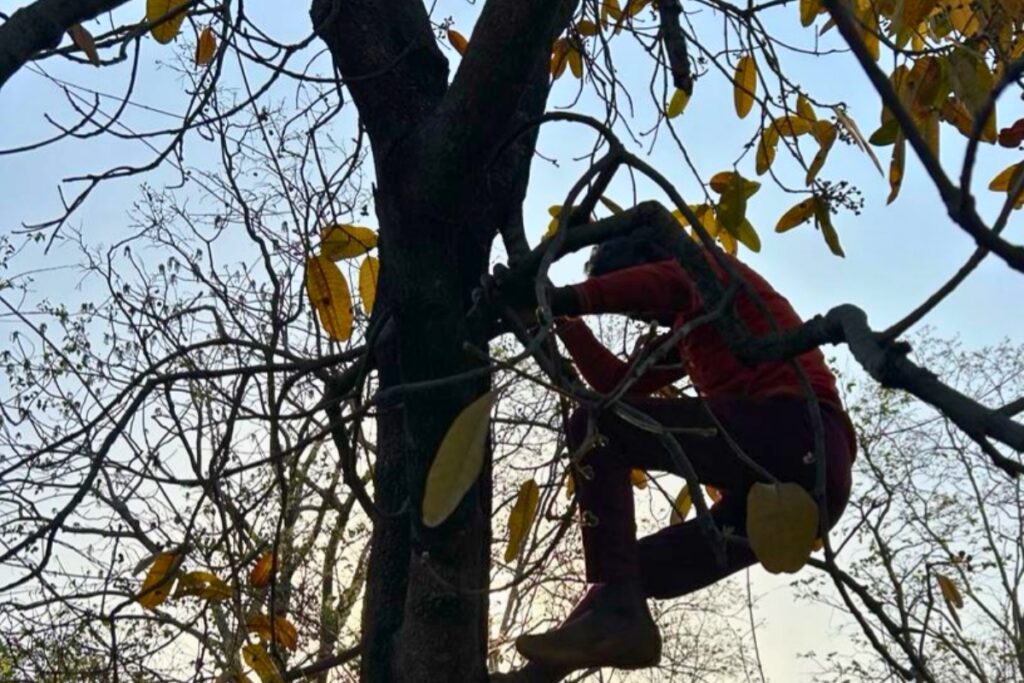
But the official site report by Singrauli’s Divisional Forest Officer (DFO), Akhil Bansal, states, “No tribal person has been identified in the proposed mine area, and recognition of forest rights is not required.”
The company had submitted a report to the Ministry of Environment seeking environmental clearance for the project. According to this document, the project falls within 5 kilometers of the mining lease (ML) area of the villages Budheri, Karwahi, Badhaura, Amiliya, Khairahi, Barwatola, and Balyatola.
In other words, the entire project is situated within the forested landscape surrounding these villages in Singrauli. This is precisely why concerns in the villages run deep. The claim also directly contradicts the presence of nearly 1,700 people at the public hearing who described livelihoods dependent on forests.
Deepa Mala, a researcher at the Centre for Financial Accountability, sees a pattern: “There is often a gap between what people say at public hearings and what ends up in official files. When community presence and rights are denied in documents, the validity of any consent or clearance becomes questionable.”
Kripanath and Jayarayan from Amalia Village, both associated with the Mahan Sangharsh Samiti, put it more bluntly: “If we don’t depend on this forest, why did 1,700 people show up? Why are our objections on record?”
What comes next
Stage-I approval does not mean mining can begin. JK Cement must deposit funds into the CAMPA (compensatory afforestation) pool, submit a compliance report meeting all conditions, and then receive Stage-II clearance from the central government. The state government must then formally transfer the forest land. The final decision remains pending.
Singrauli is already classified as a Critically Polluted Area by India’s pollution control authorities. The question now—as activists, officials, and villagers wait—is not simply whether coal will be extracted. It is who counts the cost and in what currency: tonnes of coal, or trees, water, and communities that have lived in this forest for generations.
Support Us To Sustain Independent Environmental Journalism In India.
Keep Reading
How Solar Solutions Are Helping Protect Crops from Wild Animals
Pench Tiger Reserve: How a Man Survived a Tiger Attack
Stay Connected With Ground Report For Underreported Environmental Stories.
Author
Support Ground Report to keep independent environmental journalism alive in India
We believe climate change should be the basis of current discourse, and our stories attempt to reflect the same.
Connect With Us
Send your feedback at greport2018@gmail.com
Newsletter
Subscribe our weekly free newsletter on Substack to get tailored content directly to your inbox.
When you pay, you ensure that we are able to produce on-ground underreported environmental stories and keep them free-to-read for those who can’t pay. In exchange, you get exclusive benefits.
Your support amplifies voices too often overlooked, thank you for being part of the movement.