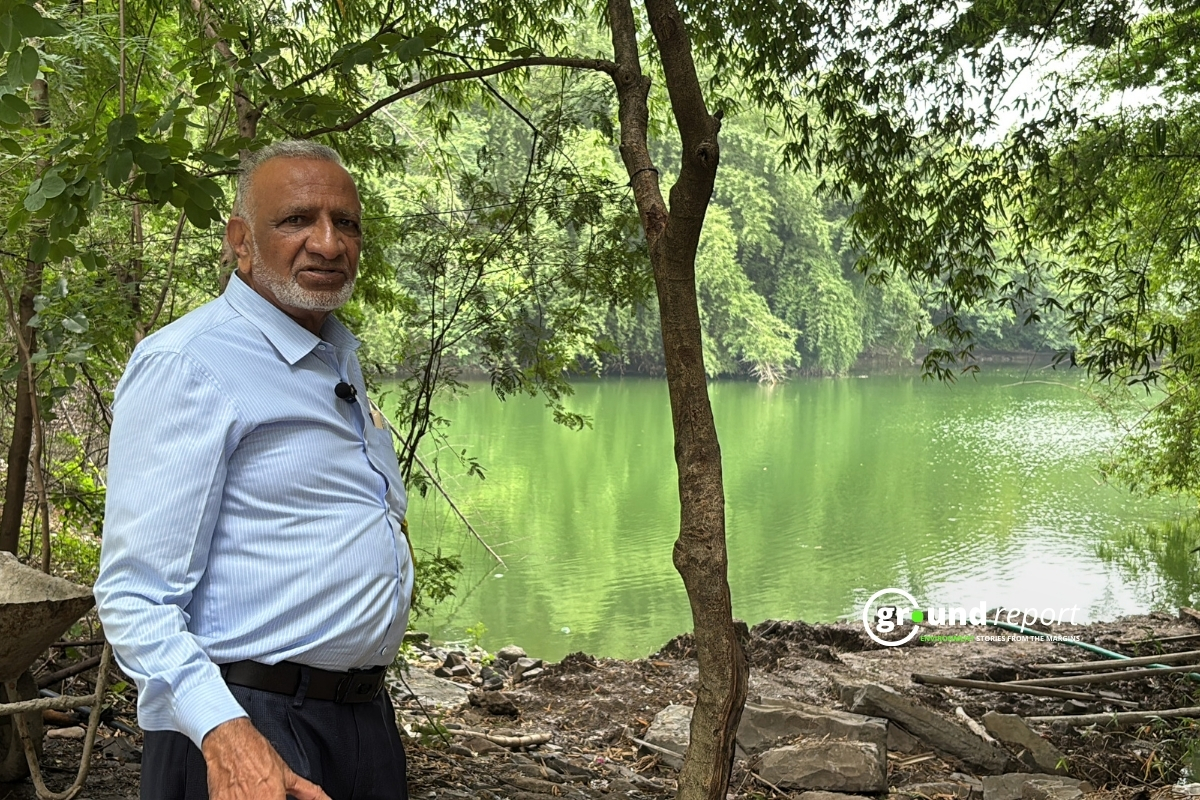
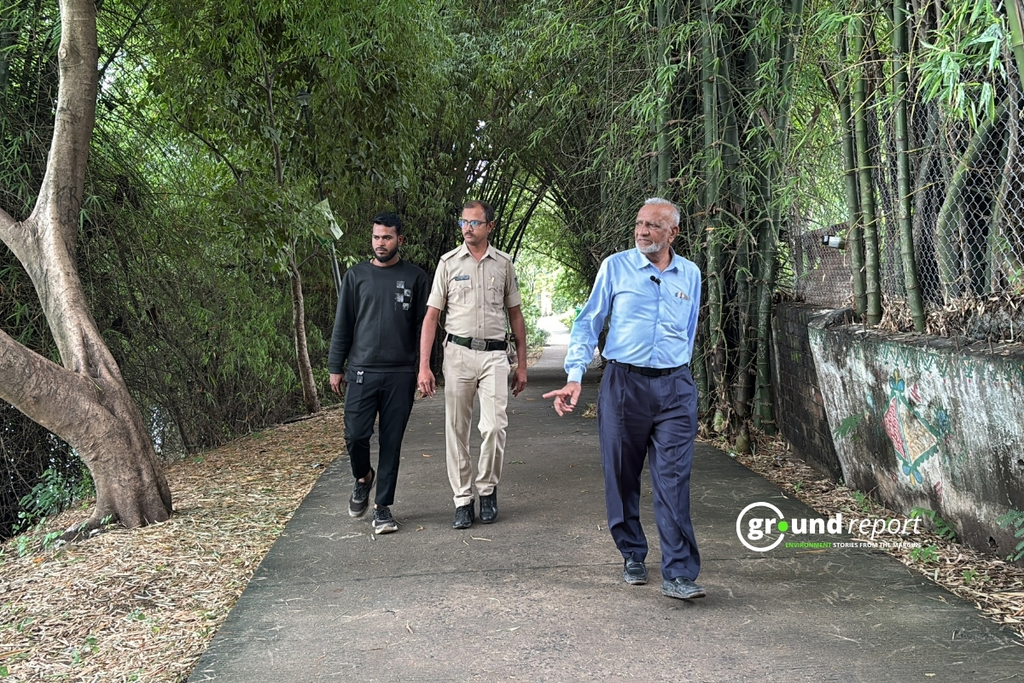
In the second week of August, Ujjain had already become crowded. It was the month of Sawan, when devotees following the Hindu faith come here to visit Shiva lingams. Kamri Marg is an old market in the city, and amid row of shops selling photo frames, motor-vehicle repair services, clothes and other goods, 71-year-old Baqir Ali Rangwala lives. Wearing a blue checked shirt and black trousers, he was waiting for me.
A guard in khaki uniform was with him, keeping an eye on my tripod bag. Before he could ask me what was inside, Rangwala introduced me. We then took a narrow lift, in which only two people could stand, to the fourth floor.
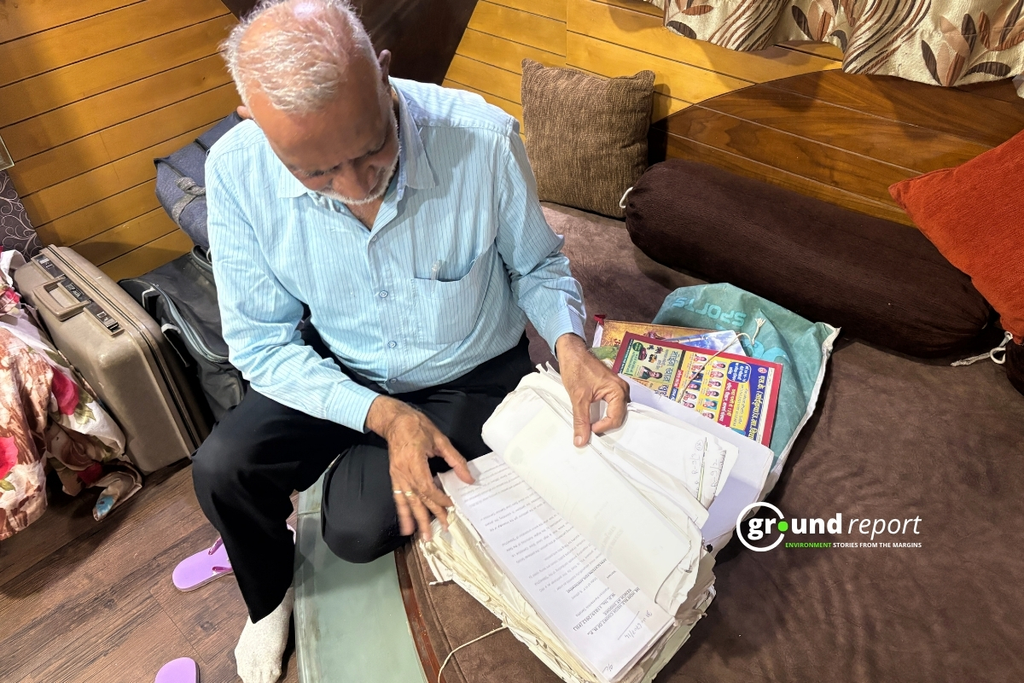
This was Rangwala’s home. Several bags and suitcases lay along the side of his drawing room, all filled with papers. These were copies of petitions he had filed over the past two decades.
“There is enough paperwork to fill another room in my office as well,” he said, separating some papers with trembling hands.
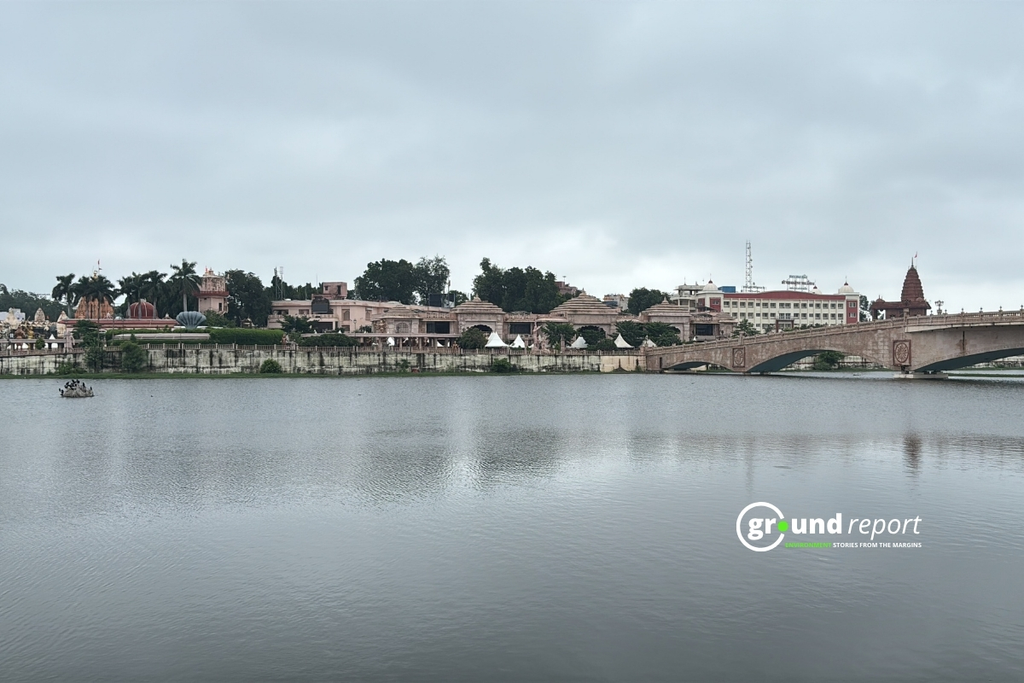
On January 23, 2026, acting on one of Rangwala’s petitions, the National Green Tribunal directed the district collector and municipal corporation to take action in mission mode to improve the city’s Govardhan Sagar pond. As a result of the same petition, on December 8, 2025, the pond was re-demarcated using modern surveying techniques under the direction of the Ujjain city tehsildar and the district superintendent of land records.
Rangwala has been fighting in court for more than two decades for the cleaning of the Shipra River. He has also been seen taking up several other issues concerning the city before courts and government offices.
Rangwala says he cannot stand by and watch something wrong happen, which is why he fights for “justice.” His friends consider him a bridge between the administration and ordinary people. If someone is troubled and does not know where to complain, they come to Rangwala.
A journey that began with an election complaint
Recalling how he began his activism, he says, “In 1994, OBC reservation was implemented in our ward during the Ujjain Municipal Corporation elections, even though the ward had the highest number of people from the general category.”
He demanded that a fresh survey of voters in the ward be conducted, after which irregularities in the voter list also came to light. After that, he continued raising his voice on various municipal issues through correspondence and court cases.
After completing his MSc in Mathematics in 1979, Rangwala enrolled for a PhD at Vikram University with a CSIR fellowship. However, he later entered the construction business for personal reasons.
Rangwala belongs to the Bohra Muslim community, originally associated with Gujarat, the community is a sect of Shia Ismaili Muslims. Rangwala said, “People from our community mainly choose business as their profession.”
I asked him whether fighting the government in court while running a business created difficulties. He replied, “It does, but I keep my paperwork strong.”
The legal battle for the Shipra
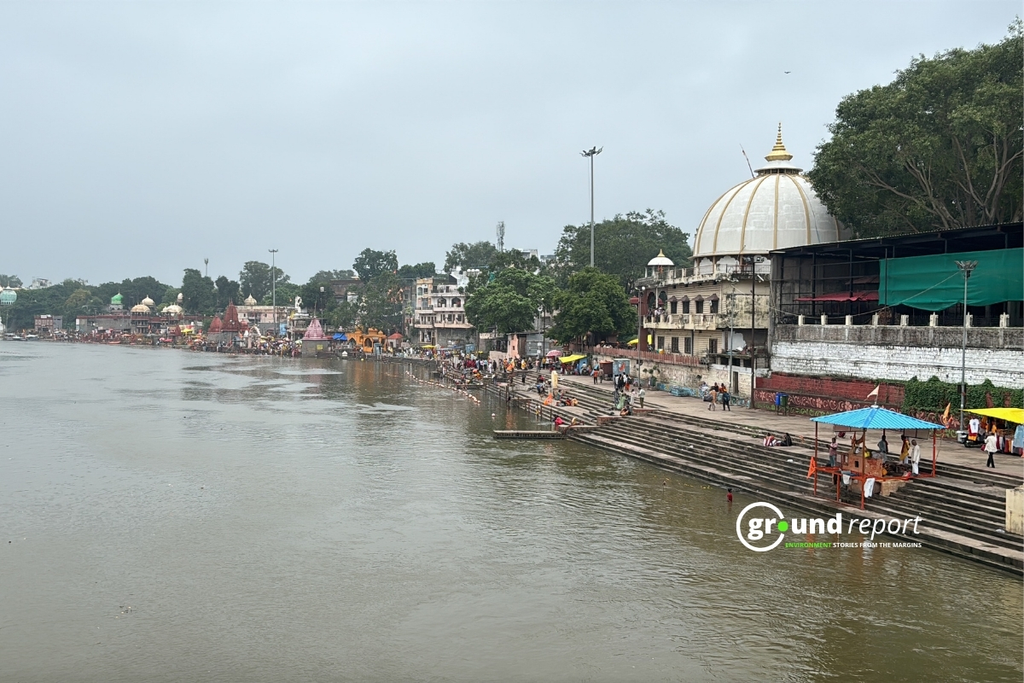
In 1999, some people known to Rangwala had come to Ujjain. They wanted to bathe in the Shipra River and visit the Mahakaleshwar Jyotirlinga. According to Hindu Shaivite belief, it is one of the country’s 12 Jyotirlingas and the only south-facing Jyotirlinga.
Rangwala recalled, “We went to Ramghat to bathe. I was standing at the ghat with the clothes. The river water was dirty and black. Seeing it, I felt that this was wrong — both for people’s faith and for the people of Ujjain.”
He subsequently filed a petition seeking to clean the Shipra. The National Green Tribunal (NGT) did not exist at the time, the petition was filed in the Madhya Pradesh High Court.
“We raised three issues: first, preventing 14 dirty drains from flowing into the Shipra, because they were carrying the city’s sewage and waste into the river. Second, ensuring that the city’s waste was disposed of properly so that it did not enter the river. Third, the brick kilns along the river. They were not only polluting the river, but the extraction of soil from the riverbank was also increasing erosion.”
The High Court had another bench in Indore, 54 km from Ujjain.
“We used to take a bus to Indore every day. There, Baqir bhai would meet lawyers and read the documents of each case one by one. We would often return home late at night,” said Nilesh Jain.
Jain, 47, studied up to BCom. His father had a financial dispute with the Housing Board. While trying to resolve it, Jain met Rangwala, whom he calls “Baqir bhai.” Jain later began working with Rangwala.
Regarding the cleaning of the Shipra, the Ujjain Municipal Corporation was directed to establish adequate sewage treatment plants and other sanitation arrangements by 2002. The High Court assigned the Madhya Pradesh Pollution Control Board responsibility for monitoring this and closed the case in July 2002.
However, brick kilns along the Shipra continued to operate. Jain says that “Baqir bhai” does not abandon a matter until it has been resolved. In 2006, he again filed a petition in the High Court against brick kilns operating along the river.
The petition stated that brick kilns operating within 50 metres of the river were extracting soil without valid permission. At the same time, according to the master plan, an area extending 200 metres on both sides of the river had been designated as a “green belt.”
The court directed the district administration to remove all kilns within 200 metres of the river and 50 metres of the highway. The administration later told the court that the kilns had been removed. But Rangwala challenged this claim by submitting photographs to the court, saying that more than 75 such kilns were still operating.
Most of these photographs were taken by Jain.
A deadly attack and opposition from the family
Jain said that action taken in this case led to several brick kilns being shut down. After this, several people held grudges against Rangwala. At one point, he was even subjected to a near-fatal attack.
Recalling the incident in 2012, Rangwala said, “I was going to Chhatri Chowk to buy fruit. A criminal approached me while talking and then pulled out a sickle from his bag. Before he could slash my neck, I pushed him away. He was drunk. I ran straight to the police station. There, I couldn’t even say anything.”
On the court’s orders, guards were deployed for Rangwala’s security. A guard is now stationed outside his home at all times.
Although getting the brick kilns removed from the banks of the Shipra may have been the most difficult task for Rangwala, he considers it the biggest success of his career. At the same time, he stresses that despite all the government spending, the Shipra has still not been completely cleaned. According to him, this is one of the major failures of his career.
Anjana sees this differently. He says that without judicial intervention, removing the brick kilns would not have been possible because there was also considerable political pressure behind them.
However, he also highlighted the limitations of Rangwala’s activism. Speaking to me, Anjana said, “Winning a case in court can ensure that the rules are followed, but it does not change people’s behaviour.”
He believes that changing people’s behaviour is essential to cleaning the Shipra.
Rangwala’s friends say that his social life has become quite limited over the past few years. He participates less frequently in public events. One reason is also his advancing age. But he wants the coming generation to continue fighting for justice.
He says, “The Shipra still needs to be cleaned, and there is still work left to be done in Govardhan.”
Support Us To Sustain Independent Environmental Journalism In India.
More Ground Reports
He Was Married as a Child, Now Manish Dangi Helps Stop It for Others
Despite The Ban, How Gutkha Became MP’s Most Common Household Habit