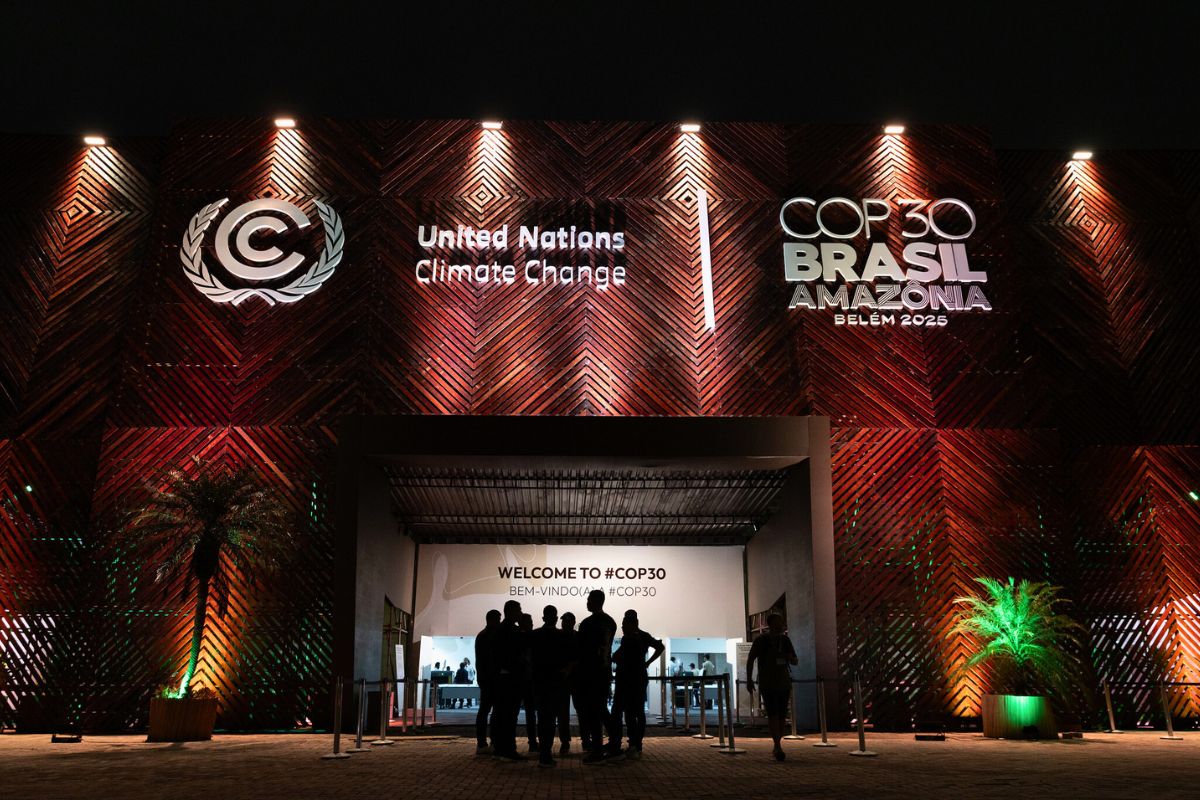
On Day 2 of COP30 the conference moved from setup to full activity. Hallways filled with delegates and staff. Side events and protests ran alongside formal sessions. Organizers opened more pavilions and attendees shifted from checking in to negotiating and networking.
The day began with a surge in online attention. Tracking by GSCC showed about 51,000 social media posts tied to COP30, an increase of roughly 85 percent from the previous day. COP President Andre Correa do Lago drew attention during the handover from Baku and in his opening remarks calling for stronger action on climate impacts.
Speakers at side events focused on debt and justice. Alistair Dutton, secretary-general of Caritas Internationalis, framed the issue as an “ecological debt.” He told attendees, “We who have created an ecological debt have also saddled the poorest in the world with a financial debt.” Brazil and other delegations flagged debt and debt reform as central topics for upcoming negotiations.
Deals, Protests, and Procedural Progress
Several policy moves and funding announcements punctuated the day. Brazil said it had up to 18 countries endorsing an open coalition on compliance carbon markets and planned a Nov. 15 event to discuss the initiative further. The European Investment Bank and Neoenergia announced a €300 million loan to modernize Bahia’s power grid and expand clean energy access to about 6 million people. Australia’s Minderoo Foundation pledged A$2.5 million ($1.6 million) to the Fossil Fuel Non-Proliferation Treaty Initiative.
Civil society action also marked the day. Protesters rallied against carbon markets with chants of “No carbon casino.” Tyrone Scott of War on Want told the crowd, “The UNFCCC has become a casino where the global north and polluting corporations gamble with our future.” Demonstrators argued that many carbon offset schemes fail to deliver measurable emissions cuts or community benefits. Organizers of later actions planned performance art and symbolic interventions to highlight those concerns.
Delegations debated procurement and development rules. Germany’s development minister, Reem Alabali Radovan, said the Federal Ministry for Economic Cooperation and Development plans to prioritize German and European firms in future projects. She told Devex the ministry would seek practical contributions to the Tropical Forest Forever Facility and said, “We do want to join and we want to make a contribution.” She did not give a start date for any change in contracting rules.
Negotiators reported procedural progress after a tense opening. Parties agreed a working agenda and moved into informal consultations on finance, NDC ambition gaps, transparency, and trade-related issues. Alden Meyer of E3G described the outcome as limited progress that avoided an open fight over the agenda. Presidency officials said they would update parties on the consultations in the coming days.
Main events on Day 2 of COP30
| Time (local GMT-3) | Event | Key fact or quote |
|---|---|---|
| 0900 | Social media surge | ~51,000 posts; 85% increase |
| Morning | Caritas side event | Alistair Dutton: “We who have created an ecological debt have also saddled the poorest in the world with a financial debt.” |
| 1000 | Brazil coalition on carbon markets | Up to 18 endorsing jurisdictions; Nov. 15 event planned |
| 1101 | Funding pledge | Minderoo Foundation A$2.5m ($1.6m) to Fossil Fuel Non-Proliferation Treaty Initiative |
| 1140 | EIB loan | €300m to modernize Bahia power grid; ~6 million people to benefit |
| Daytime | Protests | “No carbon casino” rallies; Tyrone Scott: “The UNFCCC has become a casino…” |
| Afternoon | PAS launch | Targets: 100 plans by 2028, 120 by 2030, train 6,000 officials |
| 1225 | UNFCCC contributions report | $12.1m owed by contributors; US ~$8m, China ~$2.1m |
| Evening (2000) | Security breach | Protesters entered site; one guard injured; temporary lockdown |
| Late day | Hosts and diplomacy | Ethiopia endorsed for COP32; Newsom signs Germany-California cooperation; said he came “in a state of humility.” |
Governance, Security, and Global Outlook
The day included announcements on capacity-building and local governance. Brazil launched the Plan to Accelerate the Solution (PAS) to institutionalize multilevel climate governance and said it would co-chair a framework for the Coalition for High Ambition Multilevel Partnerships with Germany through 2027. Brazil set targets for PAS to have 100 national climate plans include multilevel governance by 2028, expand to 120 by 2030, and train 6,000 public officials.
Security incidents closed Day 2 on a tense note. Protesters forced entry at about 20:00 local time, clashing with UN security and prompting a temporary lockdown. Reports said tables were used to barricade entrances and that at least one security guard suffered stomach injuries and required a wheelchair. Brazilian federal forces moved to restore order and the crowd dispersed shortly after.
The day ended with confirmations and forward-looking notes. Ethiopia emerged as the endorsed host for COP32, pending formal confirmation, and California Governor Gavin Newsom attended events and signed a statement on climate cooperation with German state partners. Newsom said he arrived “in a state of humility” and described California as a “stable and reliable partner.”
Support us to keep independent environmental journalism alive in India.
Keep Reading
Elephants Are Back in MP After a Century, But Can They Stay?
Solar Energy – A Paradigm Shift in Wildlife Conservation
Stay connected with Ground Report for underreported environmental stories.