Every one degree Celsius rise in summer temperature adds roughly 128 forest fires across the Western Himalaya. That single number, drawn from a decade of fire data, shows why researchers now rank temperature above every other factor driving the region’s wildfires.
Scientists at the Forest Research Institute, Dehradun, and the Indian Institute of Technology, Roorkee, led the study. They analyzed more than 18,000 fire locations recorded between 2013 and 2022 across Uttarakhand, Himachal Pradesh, Jammu, Kashmir and Ladakh. Researchers tested 39 climatic, topographic and human-related variables to find out what actually predicts fire.
Temperature Leads Every Other Factor
Fires rose sharply with increases in annual mean temperature, and with maximum and minimum temperatures during the hottest, coldest, wettest and driest months. The pattern held even in winter, when warmer-than-usual conditions still pushed fire counts higher months later.
March, April and May saw the most fires. Dry biomass left over from winter meets rising heat and low humidity during these months, while more people enter the forest for grazing and fuelwood collection.
Weak rainfall followed by a mild winter leaves less moisture on the forest floor, making it easier for fires to ignite and spread.
Roads Bring Fire Closer to Forests
Distance from roads and settlements also shaped where fires broke out. Fire locations clustered heavily within the first kilometer of roads, then dropped off sharply farther out. Roads improve mobility and give people greater access to forest areas, increasing the chances of accidental or deliberate ignition.
Most Himalayan forest fires start from human activity, not lightning or natural causes. Communities have long used fire to clear forest floors and grow fodder for cattle. Discarded cigarettes and bidis, and fires set intentionally by poachers, add to the toll.
Vanishing winter snow plays a less visible role. Shrinking glaciers and falling winter precipitation have steadily reduced moisture on the forest floor. The Indian Institute of Remote Sensing reported in January an “alarming decline” in winter precipitation, with deficits between 60% and 116% from October to December 2025.
A Warning Sign for Forest Health
The study also links frequent fires to a decline in floristic diversity in Uttarakhand, the most fire-prone state in India’s Western Himalaya, according to the Forest Survey of India. Fire-resistant species increasingly replace native vegetation in repeatedly burned areas.
The stakes extend beyond biodiversity. Himalayan forests, including the Eastern Himalaya, hold an estimated 3,273.1 million tonnes of carbon. Repeated fires threaten to release that stored carbon back into the atmosphere.
India released its National Action Plan on Forest Fires in 2018, recommending community fire drills, forest floor biomass management and better detection systems. Reviving fire lines and clearing biomass through controlled burns remain critical tools for containing fires before they spread.
In December 2025, the central government allowed Uttarakhand to fell trees to revive fire lines at elevations above 1,000 meters, reversing an earlier Supreme Court ban on tree felling at those heights.
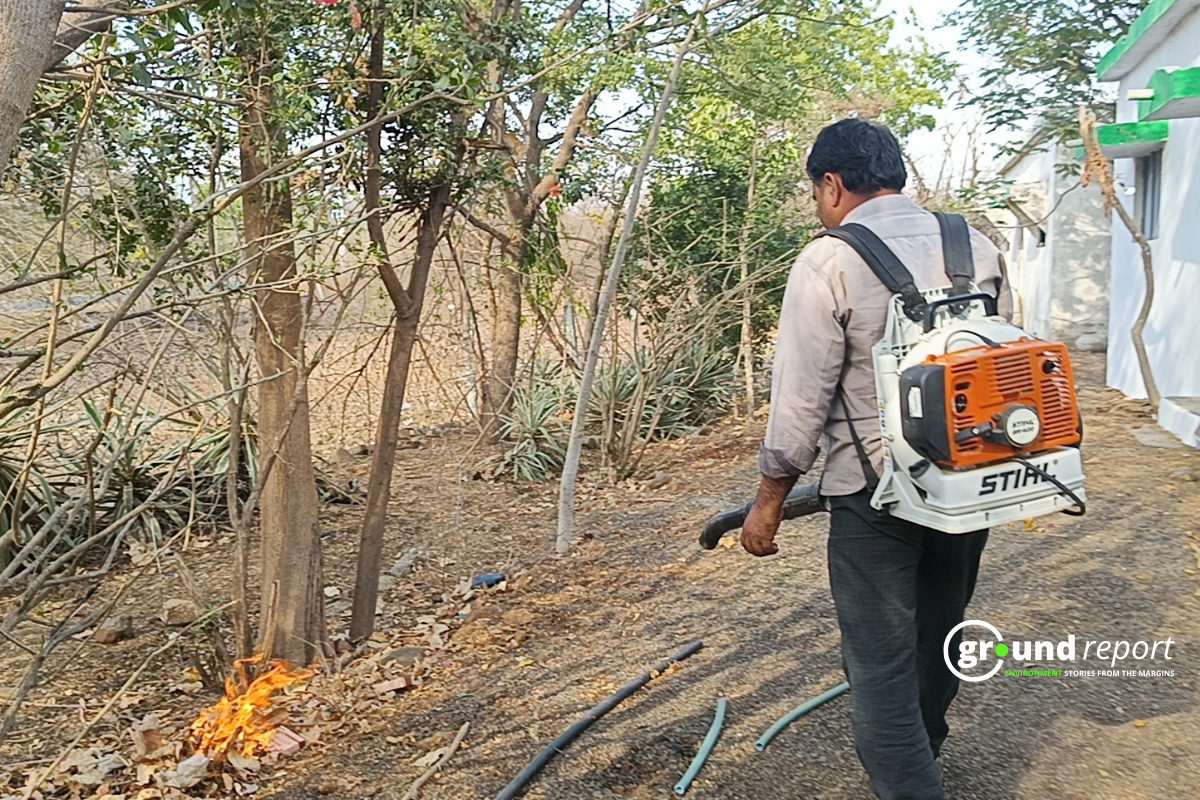
Clearing fuel from the forest floor ahead of fire season, through controlled burning along roads and fire lines, remains one of the most effective preventive measures. Compensating communities for cooperating with forest departments could strengthen those efforts further.
Accidental fires along roadsides remain one of the most common and most preventable causes of the season’s destruction.
Support Us To Sustain Independent Environmental Journalism In India.
More Ground Reports
He Was Married as a Child, Now Manish Dangi Helps Stop It for Others
Despite The Ban, How Gutkha Became MP’s Most Common Household Habit