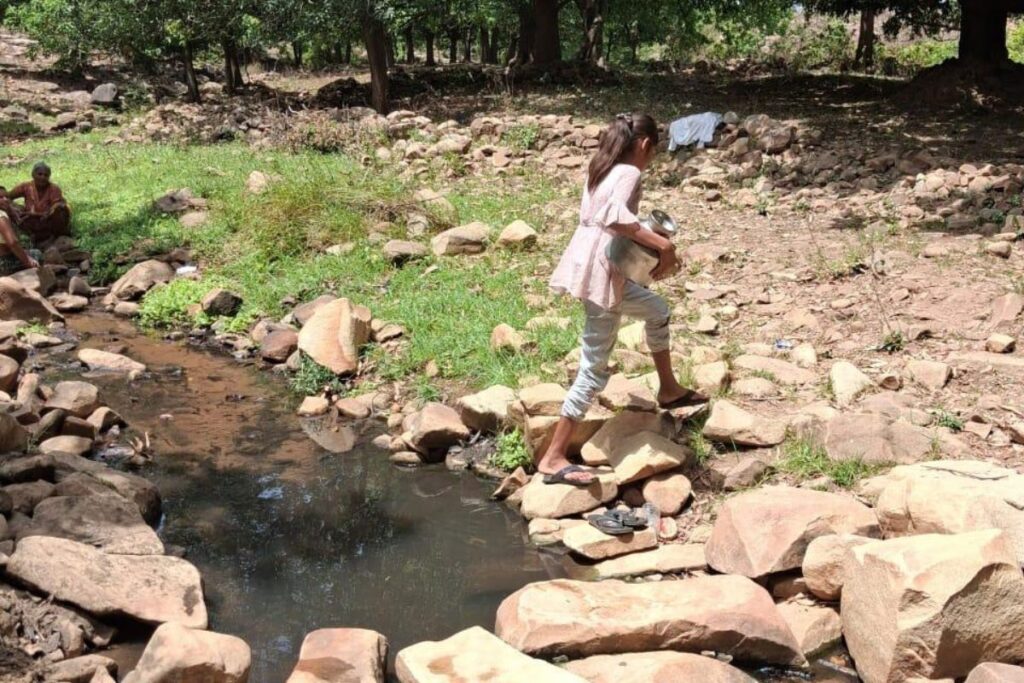
It is 45°C in Chitrakoot these days. The ground burns under bare feet, and walking even a few kilometres in this heat is draining. In this heat, 15-year-old Rekha (name changed), from the Kol tribal community, walks nearly two kilometres carrying a metal vessel through a dense forest.
She is not alone. Her mother, her sister-in-law, and other women from Ahiranpur in Khandeha village of Mau block walk with her every day. Their destination is a small spring emerging from a rocky terrain in an isolated forest. The water is muddy, visibly unclean, but it is all they have.
Rekha is on her period.
There are no sanitary pads at home. The nearest market is around 15 kilometres away, and access depends on whether someone in the family can bring them. Most of the time, she uses cloth. In peak summer, with constant sweating, it becomes damp within hours.
“We cannot change it many times,” she says, hesitantly. “There is not enough water at my home to wash it again and again. So, I mostly stay indoors – not by choice, but by compulsion.”
In this region affected with chronic water scarcity, this is routine. Girls and women walk kilometres in scorching heat, even during menstruation, to fetch water for drinking, bathing, and cleaning.
“There is a tap in our village, but it works only when there is electricity,” Rekha says. “There are power cuts most of the time.” A nearby handpump is there, but it is controlled by upper caste families. “They ask for ₹100 a day for water. We cannot afford it.”
Her family earns about ₹300 a day as agricultural labourers, and this work disappears for months in summer. Menstruation here is not just a health issue. It is shaped by caste, poverty, and the deepening crisis of water.
In neighbouring Sonbhadra, another teenage girl tells a similar story. “I sometimes use one cloth for eight hours. It leaks and spoils my clothes.” The nearest well is a kilometre away.
“In this heat, I cannot go again and again to bring water. Sometimes I have heavy bleeding, but I still have to carry water.”
There is no negotiation. “Being women of the family, this is our responsibility. Men do not fetch water.”
Heatwaves in India are usually talked about in terms of rising temperatures, heatstroke, and mortality. As heatwaves become more frequent and intense, these challenges are likely to deepen, particularly in the regions which are already water-stressed. But their gendered impact, especially on menstrual health, remains largely invisible. As water sources dry up and supply becomes erratic, households prioritise drinking water over everything else. Hygiene becomes secondary. For girls, this means fewer baths, infrequent changing of absorbents, and increased health risks.
In rural India, a significant proportion of households still rely on water sources outside their premises. A burden that falls disproportionately on women and girls of the families. Often, requiring them to walk long distances multiple times a day even in extreme weather conditions.
The National Family Health Survey 2023–24 (NFHS-6) shows that while the use of hygienic menstrual methods among women and girls aged 15–24 has risen to 79.2 per cent from 77.6 per cent in NFHS-5, many still lack access to safe, hygienic and dignified menstrual practices, especially in rural and climate-stressed regions.
The consequences are immediate – discomfort, infections, and fatigue. But the deeper cost is exclusion. Girls skip school, limit mobility, and quietly adjust their lives around this scarcity. For many girls, these health risks go beyond discomfort. Prolonged use of cloth or pads without frequent changing often leads to rashes and blisters. With limited access to basic treatment, some rely on home remedies like mustard oil, and at times even soil, to ease the irritation.
While menstrual leave is often debated, for many women and girls, rest is not even an option. Household responsibilities continue regardless of physical discomfort, making menstruation a period of continued labour rather than rest.
Earlier this year, the honorable Supreme Court recognised menstrual health as an integral to the right to life, dignity and education. Observing that no girl should be forced to give up schooling due to lack of sanitary napkins or functional, gender-segregated toilets. In a landmark ruling, the Court framed menstrual health not as a welfare measure but as a constitutional entitlement. Directing states to ensure access to menstrual products and hygiene facilities in schools.
But for girls like Rekha, the challenge begins even before access to pads or classrooms. Without reliable water at home or in the community, maintaining hygiene during menstruation becomes nearly impossible. A sanitary pad, without the ability to wash, change, or clean safely, is only a partial solution.
The gap is bigger than access to products, but in recognising that menstrual dignity is inseparable from water security, especially in regions where every drop has to be walked for.
Yet menstrual hygiene remains largely absent from conversations relating to the climate and health intersection. Heat action plans focus on survival. Water policies focus on supply. Neither addresses the basic reality that without water, menstrual hygiene becomes nearly impossible.
CRY -Child Rights and You and its partner organisations working in drought-prone areas say that rising temperatures and uneven rainfall are worsening access to water, sanitation and hygiene. “Our work goes beyond distributing sanitary pads,” says Mukesh Kumar from Doaba Vikas Evam Utthan Samiti (DVEUS) a partner working with the Kol community in Chitrakoot. “It is about ensuring that girls have the water, infrastructure and support needed to manage menstruation with dignity.”
Field experience from such organisations shows that without reliable access to water, sanitation and hygiene, menstrual health interventions remain incomplete. This has led to a greater focus on combining awareness with on ground efforts to improve access to basic infrastructure. Our partner organisations are constantly working with families and local institutions to ensure functional toilets, reliable water supply and affordable menstrual products. But community-level efforts cannot be replaced by much needed systemic change.
In heatwave-prone regions, ensuring reliable and unbiased water access must be non-negotiable. Water cannot depend on irregular electricity supply or caste-based control. Functional toilets with water and privacy must be available in both homes and schools. Menstrual products need to be affordable and locally accessible, not dependent on distant markets.
Also, shifting social norms is equally important. The burden of fetching water and managing menstruation cannot remain solely on girls and women. Families, especially men, must be part of it.
Finally, menstrual health must be integrated into climate and public health planning. Without this, policies will continue to overlook the everyday realities that determine whether girls can live with dignity.
As heatwaves intensify, the issue is not just about access to menstrual products or infrastructure, but whether these can actually be used. Unless water is prioritised, many girls will continue to be left behind.
Support Us To Sustain Independent Environmental Journalism In India.
More Ground Reports
He Was Married as a Child, Now Manish Dangi Helps Stop It for Others
Despite The Ban, How Gutkha Became MP’s Most Common Household Habit