Walk through almost any Malaysian oil palm estate and you will find boron deficiency hiding in plain sight. The signs are easy to miss in the first year. By the time the fronds curl visibly and the fruit bunches start coming in light, the yield damage has already been done.
Boron sits in an awkward place in palm nutrition. It is needed in trace amounts, the band between deficiency and toxicity is narrow, and the symptoms appear on new growth rather than old, which means a manager who walks the rows once a quarter looking at mature fronds will miss the problem entirely. Yet the cost of getting boron wrong is significant: published yield losses of 10 to 30 percent in severe cases, with measurable bunch weight reductions even at “marginal” boron levels (Yara Malaysia; U.S. Borax oil palm crop guide).
This guide covers the practical diagnostic framework I have used across Malaysian plantations from Sabah to Johor, with rates that work in real-world Tenera nutrition programs.
The visible symptoms, in order of appearance
Boron deficiency in oil palm follows a fairly consistent visual progression. Most plantation managers learn to recognise the late-stage symptoms first because they are dramatic. The earlier signs are subtler and far more useful.
Crinkle leaf. The earliest reliable visual sign. Young fronds emerge with leaflets that look creased or wavy along their length, as if the leaflet wanted to expand fully and could not. This shows up on Frond 1 to Frond 3 (the youngest fully unfurled fronds), and a manager looking at older fronds will see nothing wrong.
Hook leaf. Leaflets fail to open at the tip and curl back like a question mark. Often appears alongside crinkle leaf as the deficiency progresses.
Little leaf and fish bone leaf. The leaflets shorten dramatically while the rachis remains close to normal length, giving the frond a stunted appearance.
Blind leaf. The leaflet edges are jagged or the tip is necrotic and brown. The frond looks chewed even though no insect did the chewing.
Flat top. This is the late-stage symptom every manager already knows. The crown of the palm flattens out because new fronds are emerging shorter than the older ones underneath. By the time a palm has flat top, you are looking at chronic, severe boron deficiency, and the bunch yield has been compromised for months.
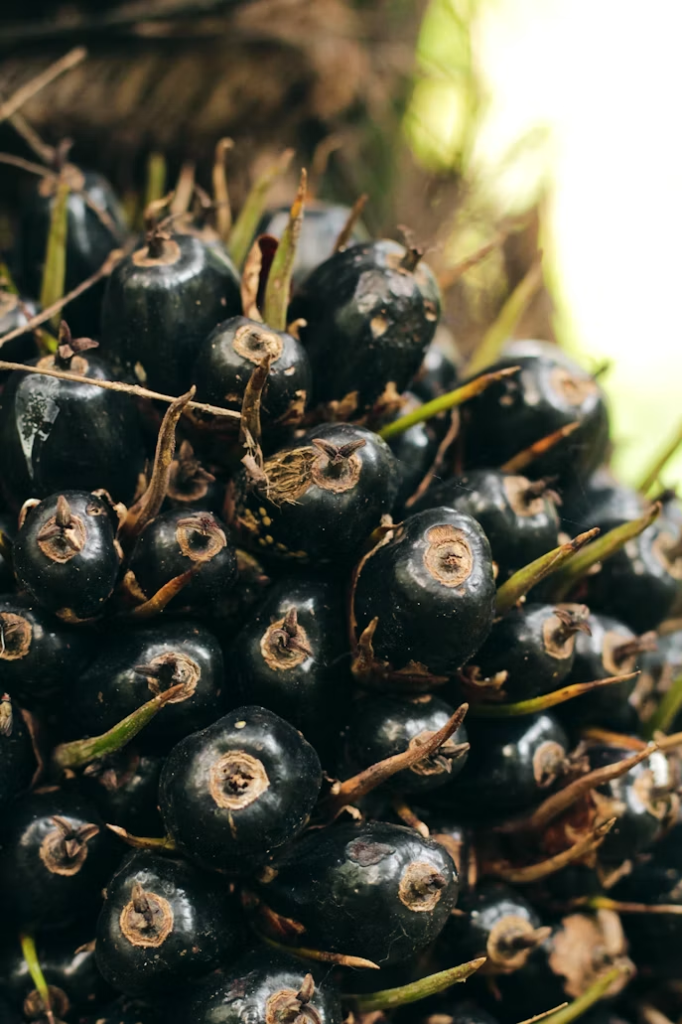
Parthenocarpic fruitlets. The signal that hits the bottom line. Fruitlets develop without kernels, often with thin shells, sometimes shrivelled. They look like fruitlets at first glance but produce no oil. A bunch with significant parthenocarpy weighs less and yields less even though it looks superficially normal at FFB collection.
A practical field protocol: walk the rows looking specifically at Frond 1 to Frond 3 across a sample of 50 palms in each block. If more than 10 percent of those young fronds show crinkle or hook leaf, you have a boron problem in that block, regardless of what the older fronds and the canopy look like.
Why boron deficiency happens, and where it concentrates
Boron is mobile in soil and immobile in the plant. Both halves of that fact matter.
Mobile in soil means boron leaches readily, especially under heavy rainfall and on coarse-textured soils. Sandy soils in coastal regions of Sabah and Sarawak see boron leaving the root zone faster than the palm can absorb it. The Malaysian rainfall pattern, with monsoonal peaks of 300 millimetres or more per month, accelerates this leaching considerably.
Immobile in the plant means once boron is taken up into a frond, it stays there. The palm cannot redistribute boron from older tissues to new growth. This is why deficiency symptoms appear on the youngest fronds first while older fronds look fine.
Three soil and management factors amplify the problem in Malaysia.
Soil pH outside the 5.0 to 6.5 range. Boron availability drops sharply when soil pH falls below 4.5, common in old palm soils after decades of acid-forming nitrogen fertilisation. Above pH 7.5, less common in Malaysia but possible in lime-corrected soils, boron forms insoluble compounds that the palm cannot absorb.
Peat soils. Sarawak and parts of Sabah have extensive peat plantations, and peat soils are characteristically low in plant-available boron. Standard boron rates calibrated for mineral soils undersupply peat-grown palms by roughly 30 to 50 percent.
Drought stress. Even on adequate-boron soils, root uptake slows during dry spells. The 2015 to 2016 El Niño drought triggered visible boron deficiency on plantations that had previously shown no symptoms, because dry soil meant the available boron was no longer reaching the roots.
Confirming with leaf analysis (do not rely on visual diagnosis alone)
Visual symptoms are useful for screening, not for prescribing. Two reasons.
First, the symptom pattern can overlap with deficiencies of other micronutrients (zinc, copper) and with herbicide damage. A manager who reaches for boron on every crinkled frond will sometimes overshoot and miss the real problem.
Second, the band between deficiency and toxicity in boron is narrow. Most macronutrients have wide tolerance ranges; boron does not. Leaf B at 8 parts per million is deficient, 15 to 25 parts per million is sufficient, and above 30 parts per million starts to cause toxicity symptoms (leaf tip burn, premature senescence). Blind correction without leaf analysis risks pushing palms from deficiency straight to toxicity.
Standard Malaysian protocol is Frond 17 sampling for adult palms, taking the central leaflets, washing, drying, and submitting to a certified lab. Critical interpretation:
- Below 8 ppm: deficient, immediate corrective application warranted
- 8 to 15 ppm: marginal, schedule corrective application within the next round
- 15 to 25 ppm: sufficient, maintain current program
- Above 25 ppm: hold off, recheck in six months
Soil testing for boron has supporting value but is less reliable than leaf analysis, because plant-available boron varies sharply with moisture conditions at the time of sampling.
Corrective and maintenance rates by palm age
The numbers below assume sodium borate or disodium octaborate tetrahydrate as the boron source, mineral soils, and standard Malaysian rainfall patterns. Adjust upward by 30 to 50 percent for peat soils.
Year 1 to 3 (immature palms). 50 grams per palm per year, applied in two splits during the wetter months (April to June and October to November). Broadcast in a circle 1 to 2 metres from the palm base, not at the base itself. Direct base application risks toxicity in the immediate root zone.
Year 4 to 6 (maturing palms entering production). 100 grams per palm per year, two splits as above, broadcast on the weeded palm circle.
Year 7 and older (mature palms). 100 to 200 grams per palm per year. Use the lower end of the range if leaf B is at 12 to 15 ppm and yield is normal. Use the upper end if leaf B is below 10 ppm or visible symptoms are present.
For acute correction of palms already showing visible symptoms, foliar spray of a 0.1 to 0.2 percent boric acid solution provides faster response than soil application, with results visible in 4 to 8 weeks. Foliar correction is supplementary, however, not a replacement for the soil program. Once the visible deficiency is corrected, return to the soil-applied schedule.
A note on boron source choice. Sodium borate (the cheapest commodity form) is what most Malaysian plantations use for routine maintenance. Disodium octaborate tetrahydrate, which Borochemie supplies as ETIDOT, releases boron more gradually and is preferred for sandy or peat soils where leaching loss is the main concern. Borochemie supplies boron sources used in Malaysian plantations, including sodium borate, disodium octaborate tetrahydrate, borax decahydrate, and boric acid for the foliar applications.
Integrating boron into a broader fertilizer program
Boron is not a stand-alone correction. The palms that respond best are the ones receiving balanced NPK at the right ratios for their growth phase, with boron added on top of, not in place of, the macronutrient program.
In practice, a Malaysian Tenera plantation needs three different fertilizer profiles across its 25-year economic life. A high-phosphorus establishment phase to build the root system. A balanced NPK with potassium emphasis as the palm enters production. And a high-potassium plus boron mature program to sustain bunch weight and oil-to-bunch ratio. A year-by-year oil palm fertilizer program that integrates boron at each phase alongside compound NPK 16-16-16 and NPK 12:12:17:2 is a useful reference for managers who want to benchmark their current schedule against a standardised framework.
The single most common mistake I see in audited plantations is treating boron as a “we will get to it next year” line item. Palms do not have next year. The boron applied in the current monsoon window is what supports the next 12 to 18 months of fruit set. Skipping a round costs yield two flowering cycles later, which is the kind of damage that does not show up on the manager’s quarterly report and gets blamed on weather instead.
What it costs to get this wrong
A 200-gram-per-palm-per-year boron application on mature palms at current Malaysian commodity prices runs roughly RM 0.80 to RM 1.20 per palm per year. On a 100-hectare plantation at 140 palms per hectare, that is RM 11,200 to RM 16,800 annually for the entire boron program.
A 15 percent FFB yield loss from chronic boron deficiency, on the same 100-hectare plantation producing 25 tonnes per hectare at RM 600 per tonne, costs RM 225,000 in lost revenue per year.
The maths is not subtle. Boron is the cheapest line item in the fertilizer budget and the one with the largest yield consequence when neglected. The plantations that consistently outperform their district averages in Sabah, Sarawak, and the Peninsula are not the ones spending more on NPK. They are the ones who never miss a boron round and confirm with annual leaf analysis.
Disclaimer: This content is branded and does not reflect the views or opinions of Ground Report. No journalist is involved in creating branded material and it does not imply any endorsement by the editorial team. Ground Report Digital LLP. takes no responsibility for the content that appears in branded articles and the consequences thereof, directly, indirectly or in any manner. Viewer discretion is advised.
Support us to keep independent environmental journalism alive in India.
Stay connected with Ground Report for underreported environmental stories.