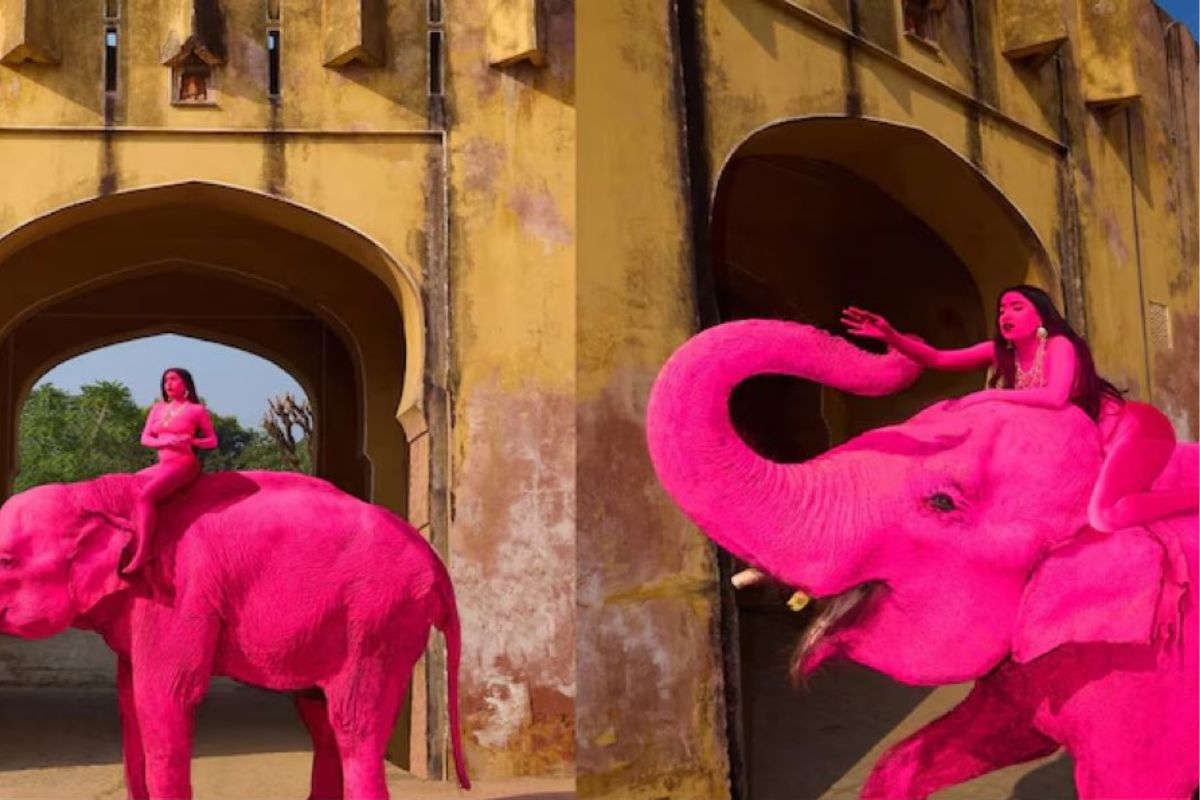
Images of a bright pink elephant at an abandoned Hindu temple in Jaipur began circulating on social media in March 2026, triggering widespread outrage and a formal investigation by Indian forest authorities.
The photographs, taken by Julia Buruleva, a Barcelona-based Russian conceptual photographer, show a partially unclothed model, also painted pink, seated atop the painted elephant. Buruleva had originally posted the images on her Instagram page in December 2025, but they went viral only this month, drawing thousands of reactions and accusations of animal cruelty.
The shoot took place in November 2025, during what Buruleva described as a six-week art expedition through India.
Who Is Julia Buruleva and What Was the Concept?
Buruleva said the project was inspired by Jaipur’s cultural landscape. “Elephants are everywhere there — streets, ornaments, architecture. Practically the main symbol of Rajasthan. I just couldn’t pass by without including one,” she wrote on Instagram.
She chose an abandoned temple dedicated to Lord Ganesha — the elephant-headed Hindu deity — as the location, calling it a “perfect” setting for the concept.
Buruleva defended the use of paint on the animal. “We used organic, locally-made paint, the same kind locals use for festivals, so it was absolutely safe for the animal,” she said. She added that the elephant showed no signs of distress and appeared “calm, relaxed and responsive” throughout the brief session.
“No harm was caused to the elephant at any point,” she said. “It was applied for a very short period of time and was easily washable. The entire session was brief and conducted under the supervision of the elephant’s handler, who is responsible for its daily care and well-being.”
What the Elephant’s Owner Said
Shadik Khan, the owner of the elephant named Chanchal, confirmed the animal was 65 years old at the time of the shoot and had not been used for rides. He told The New Indian Express that “kaccha gulal”, a natural powdered colour that washes off easily, was used to paint the elephant for a 10-minute shoot, after which it was washed off immediately.
Khan also confirmed that Chanchal died in February 2026. Buruleva said she was informed of the death and that Khan told her the elephant died of old age.
Rajasthan forest department officials confirmed they have taken cognisance of the incident and launched an inquiry. Authorities will examine whether appropriate permissions were secured before the shoot and whether animal welfare standards were maintained throughout.
It remains unclear whether any wildlife protection laws were violated.
Public Reaction
The backlash online was swift and intense. One of the most-liked comments on Buruleva’s Instagram post read: “This is not art, this is pure animal abuse and so not ok to glorify it.”
Critics also pointed to the cultural dimension of the shoot. One user wrote: “Turning an elephant into a pink prop for aesthetics is deeply inappropriate, both ethically and culturally. A city like Jaipur doesn’t need this kind of manufactured shock value.”
Others argued that technology made the use of a live animal unnecessary. “You could have easily done this in AI,” one commenter wrote.
Some users also challenged Buruleva’s claim that cultural precedent justified the shoot. “Even if something is cultural and rooted in heritage, it doesn’t make it okay and should be condemned — not celebrated or showcased as art,” wrote another.
Buruleva acknowledged the sensitivity of the debate. “I believe it is important to distinguish between situations where animals are genuinely harmed and those where assumptions may not fully reflect the actual conditions,” she said.
The investigation by Rajasthan’s forest department is ongoing. No charges have been filed at the time of publication.
Support Us To Sustain Independent Environmental Journalism In India.
Keep Reading
Highway Halt Puts Kashmir’s Fruit Economy at Risk
Railway line expansion plan put Kashmir’s apple orchards at risk
Warmer winters in Kashmir raise concerns over apple and crop yields
Stay Connected With Ground Report For Underreported Environmental Stories.