The Archaeological Survey of India’s ASI 100-day report of the disputed Bhojshala complex in Dhar, Madhya Pradesh has uncovered inscriptions spanning eight centuries from 12th-century Sanskrit texts to 20th-century Persian visitor records.
What Is Bhojshala?
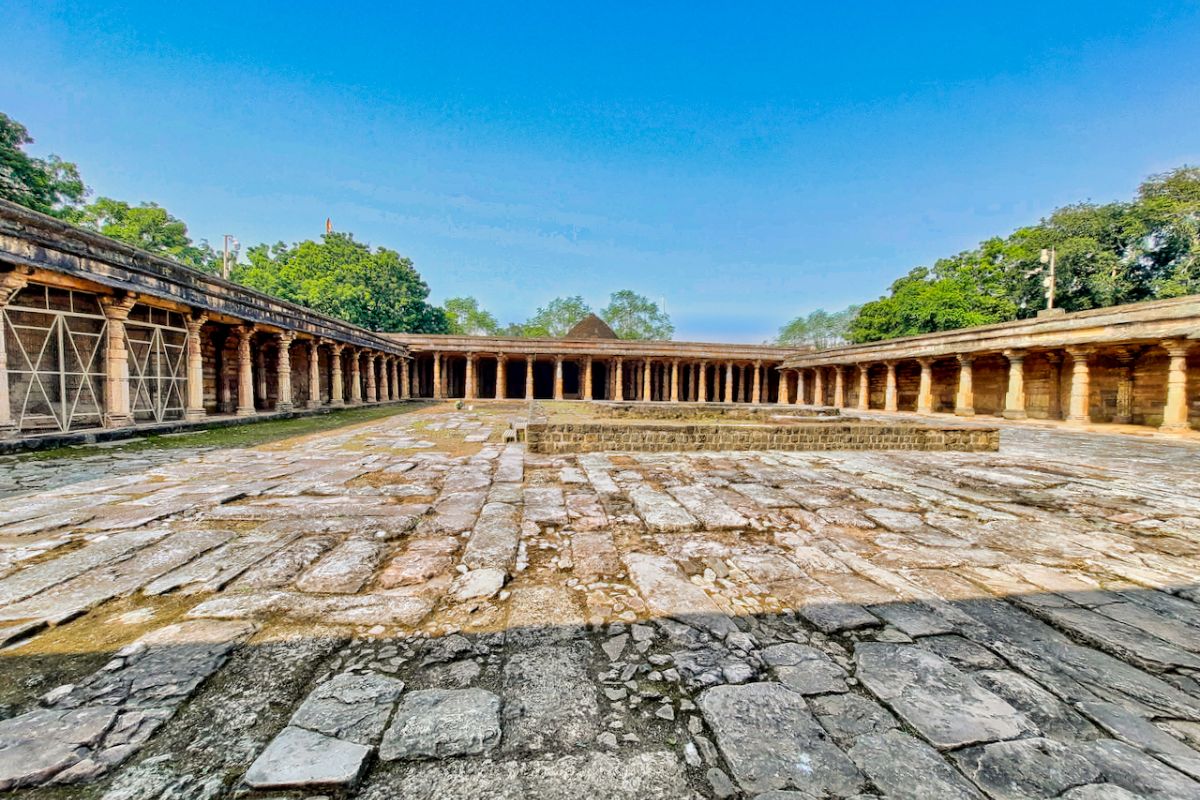
Bhojshala is a medieval structure in Dhar, Madhya Pradesh, claimed by Hindus as a temple dedicated to Goddess Saraswati and associated with the 11th-century ruler Raja Bhoj. Muslims have used the adjacent Kamal Maula Masjid for prayers. The site has been under Archaeological Survey of India (ASI) protection since 1909 and was declared a monument of national importance in 1951.
The Indore High Court ordered a fresh survey in 2024 to resolve the long-running legal dispute over the site’s religious and historical identity.
Where and When Did the Survey Happen?
The ASI began its investigation on March 22, 2024. The survey covered the entire Bhojshala-Kamal Maula complex and a 50-metre peripheral zone around its boundary. The fieldwork lasted approximately 100 days. The team included archaeologists, epigraphists, chemists, surveyors, photographers, and draftsmen.
What Did ASI Find?
The survey found inscriptions in Sanskrit, Prakrit, and Nagari script dating from the 12th to the 16th century. Among the key findings is a large inscription referencing the Parijatmanjari-natika, a play composed by Madan, the court guru of Parmar dynasty king Arjunvarman of Dhar. The inscription states that the play was first staged in the temple of Goddess Saraswati.
Another inscription references two Prakrit poems each containing 109 verses believed to have been composed by Maharaja Bhojdev. The Nagabandh inscriptions found on the western pillar indicate the site once functioned as a centre of learning, linked by tradition to Raja Bhoj.
The survey also recovered 50 inscription blocks from around the 13th century, along with a broken statue base. Notably, the handwriting on several plaques had been deliberately erased before the stones were reused in later construction work.
Arabic and Persian Inscriptions
ASI documented 56 Arabic and Persian inscriptions within the complex, including 43 ink-written articles. These contain Quranic verses carved on tombs in the Kamal Maula grave complex, Persian poetry, prayers, and visitor records.
One historically significant inscription references Sultan Mahmud Shah I of Malwa and details construction of a gallery, courtyard, chamber, well, and bathhouse within the dargah complex. This work was completed in 861 Hijri (1456–57 AD), and the inscription itself was engraved in 866 AH (1461–62 AD). A separate inscription references the reconstruction of old mosques in Dhar during the Tughlaq period.
Visitor Records
Forty-three ink-written visitor records from the 16th to 20th centuries were found across the structure. Among those mentioned are Qazi Jalaluddin, Azizuddin, Syed Anwar, and Kalander Bag. One record notes the 1905 visit of Syed Hussain, a sub-engineer from the state of Gwalior.
Timeline: Bhojshala — Key Events
| Year | Event |
|---|---|
| 1902–03 | ASI formulates conservation plan for Dhar and Mandu monuments; two inscriptions found on black stone slabs near the mihrab |
| 1909 | Dhar declared a protected monument under the Ancient Monuments Protection Act, 1904 |
| 1951 | Declared a monument of national importance under the 1951 Act |
| 1958–59 | Broken balconies of courtyard colonnades replaced; upper sections waterproofed |
| 1961–62 | Damaged mihrab masonry replaced; broken Sanskrit inscription found and installed near entrance |
| 1962–64 | Masonry joints strengthened; courtyard floor stones reset; western facade repaired |
| 1972–73 | Small-scale excavations on north, west, and east sides; numerous objects recovered |
| 1982–83 | Chemical conservation: vegetation removed, lime layers cleaned from exterior |
| 1984–86 | Damaged ceiling beams and plaques replaced with new limestone |
| 1989–92 | Prayer hall stone floor repaired |
| 2003 | Northern courtyard floor repaired and renovated |
| 2015–16 | CCTV cameras installed for security and surveillance |
| March 22, 2024 | ASI begins court-ordered survey and excavation of the full complex |
| 2024 | 100-day survey concludes; report compiled and submitted to Indore High Court |
| Feb 24, 2026 | High Court hears the case; parties given two weeks to respond to ASI report |
| March 16, 2026 | Next scheduled hearing at Indore High Court |
What Happens Next?
The Indore High Court heard the matter on February 24, 2026 and directed all petitioners and respondents to submit their objections, suggestions, and recommendations on the ASI report within two weeks. The next hearing is scheduled for March 16, 2026.
Support Us To Sustain Independent Environmental Journalism In India.
Keep Reading
Highway Halt Puts Kashmir’s Fruit Economy at Risk
Railway line expansion plan put Kashmir’s apple orchards at risk
Warmer winters in Kashmir raise concerns over apple and crop yields