
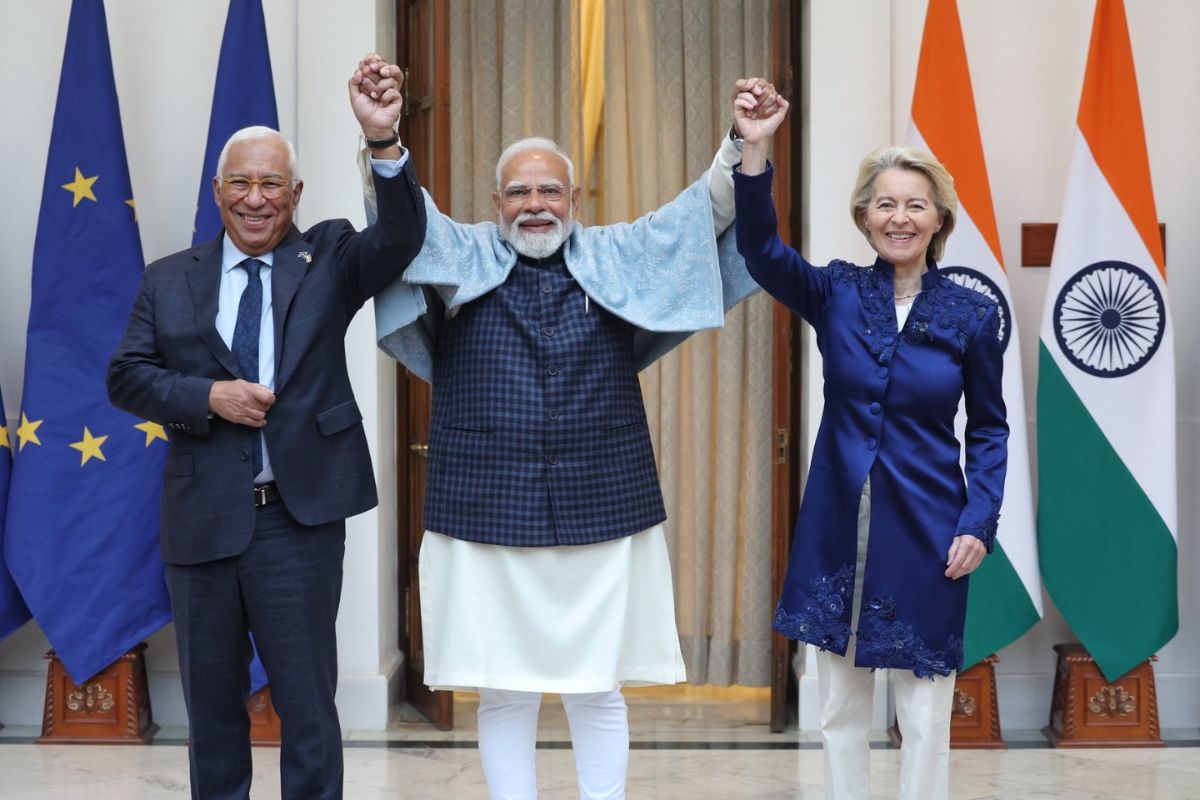
The India-European Union Free Trade Agreement was concluded on January 27, 2026, after almost twenty years of negotiations. India’s Prime Minister Narendra Modi called the agreement a “significant milestone.”
The agreement has made headlines because of the decreased import duty on automobiles and key industrial sectors such as machinery, electrical equipment & transport goods. Many experts feel that the deal is quite significant for climate action, too. The deal highlights Climate policy and clean energy cooperation.
“The deal reflects strategic alignment at a moment of high geopolitical uncertainty, particularly around climate goals and green industry,” said Aarti Khosla, founder-director of Climate Trends.
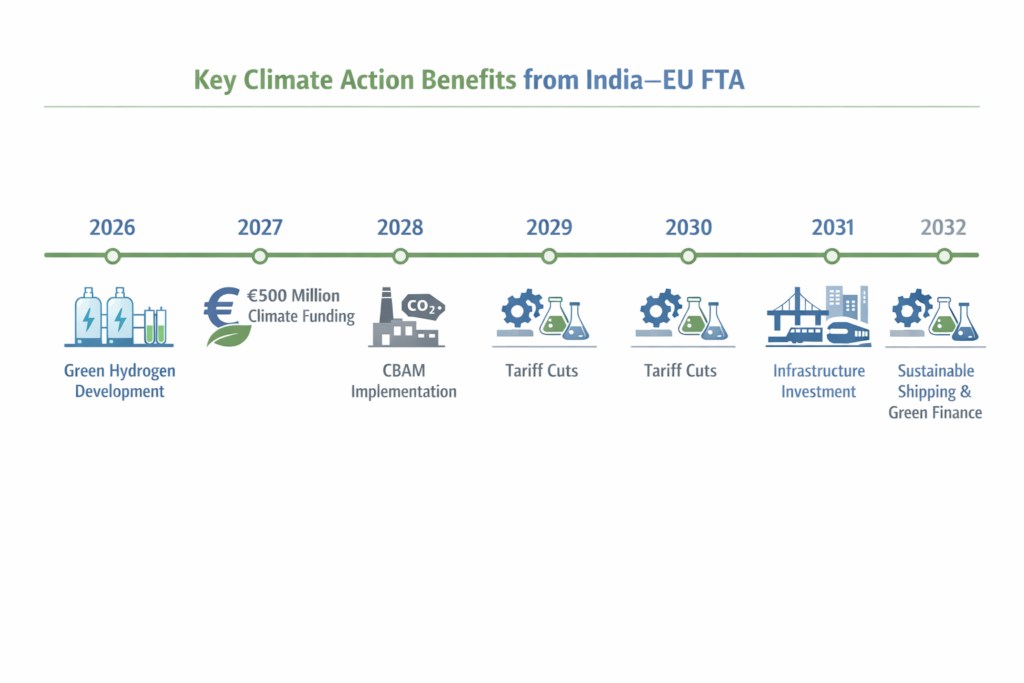
Green Hydrogen Takes Center Stage and Clean Energy Push
According to the agreement, both sides have operationalized an India-EU Task Force on Green Hydrogen to foster cooperation on production, storage, and distribution. The initiative aims to support efforts to decarbonize hard-to-abate sectors like steel, cement, and heavy transportation.
India participated prominently at European Hydrogen Week in Rotterdam last year, signaling its ambition to become a hydrogen exporter to Europe.
India’s National Green Hydrogen Mission aims to produce at least 5 million tonnes of green hydrogen annually by 2030, supported by incentives to scale up electrolyser manufacturing and attract investments of over ₹8 lakh crore.
“The EU is already India’s largest trading partner. The conclusion of the FTA, long in the making, is a landmark moment,” said Madhura Joshi, Programme Lead for Asia at E3G, a climate think tank, in a statement to Ground Report. “Both sides face a common challenge in building clean energy industries without concentrated dependencies. The complementarity is real, the opportunity is significant, and the timing is right.”
The European Union and India also signed a Memorandum of Understanding to establish an EU–India platform for cooperation on climate action, to be launched in the first half of 2026. The European Commission said that, subject to EU budgetary rules, €500 million in support over the next two years is envisaged to help India reduce greenhouse gas emissions and accelerate its long-term sustainable industrial transformation.
According to Global Gateway and the EU-India Connectivity Partnership, the European Investment Bank has already committed 2 billion euros toward climate-resilient infrastructure in India through the Coalition for Disaster Resilient Infrastructure.
The Clean Energy and Climate Partnership, signed in 2016, coordinates joint efforts on renewable energy and clean hydrogen. The EU-India Trade and Technology Council drives coordination on clean energy technologies.
The EU became a partner of the International Solar Alliance in 2018 and joined the Coalition for Disaster Resilient Infrastructure in 2021, as per official records.
Key Benefits Under the Deal
According to the agreement, the FTA delivers several climate-focused outcomes:
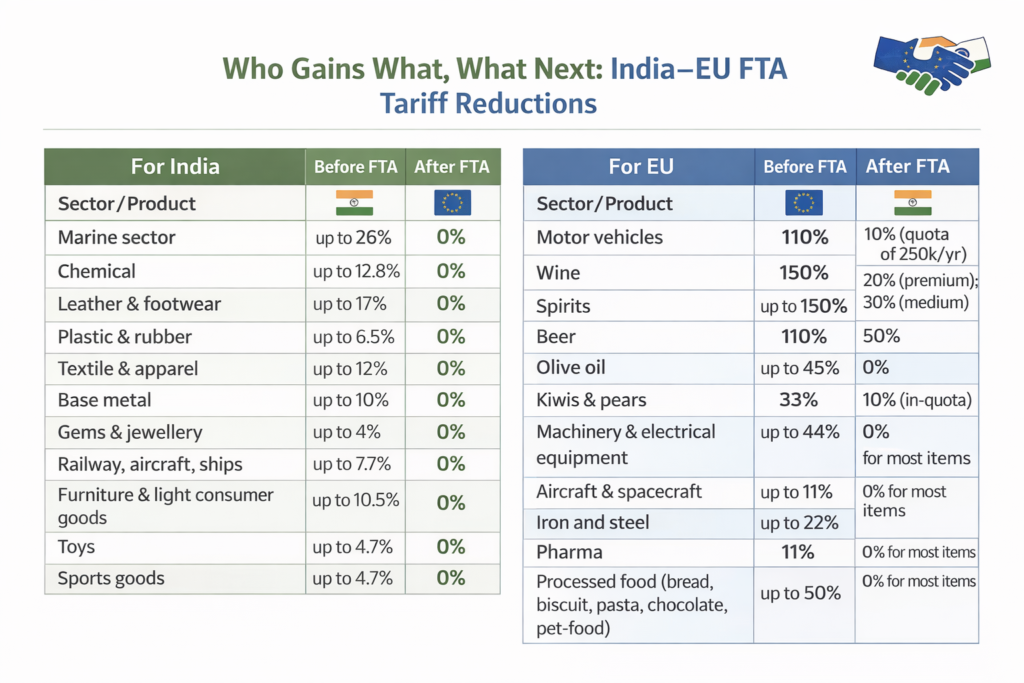
- Tariff elimination: Up to 44 percent on machinery, 22 percent on chemicals, and 11 percent on pharmaceuticals will be mostly eliminated.
- Medical equipment: Tariffs eliminated on 90 percent of EU optical, medical, and surgical equipment, as per EU documentation.
- Carbon market cooperation: Both sides are committed to sharing experiences on India’s Carbon Credit Trading Scheme and the EU’s Emissions Trading Scheme.
- Green finance: The FTA grants access for EU service providers in the financial and maritime sectors. India secured access across 144 EU service subsectors.
In a statement issued to Ground Report, Climate Trends said, “the FTA acts as a partial offset, potentially boosting exports by up to 50 billion dollars by 2031 through services and diversified markets”.
Carbon Border Tax Creates Dialogue
Separate from the India-EU Free Trade Agreement, the EU’s carbon border adjustment Mechanism is already in force and continues to pose challenges for Indian exporters.
CBAM, the world’s first carbon tariff on imports, began imposing fees on EU imports of steel, cement, and other high-carbon goods in January 2026, according to EU regulations. At a carbon price of 100 euros per tonne, CBAM could add an effective tariff burden of about 25 percent, according to the Centre for Science and Environment.
As per EU statements, the agreement does not eliminate CBAM requirements. However, India secured a most-favored-nation clause ensuring it will not be treated less favorably than other trading partners.
Long Road to Agreement
Negotiations for the Free Trade Agreement (FTA) first began on June 28, 2007. After fifteen rounds of talks between 2007 and 2013, negotiations stalled due to differences over market access levels and regulatory standards, according to the European Commission and European Parliament briefing notes. The talks remained suspended for nine years.
India and the EU formally restarted negotiations on June 17, 2022, with Commerce Minister Piyush Goyal and European Commission Executive Vice-President Valdis Dombrovskis leading the effort.
The 14th and final formal round took place in October 2025.
The agreement was announced at the 16th India-EU Summit in New Delhi by Prime Minister Narendra Modi, European Council President António Costa, and European Commission President Ursula von der Leyen.
“The agreement could become operational by 2027 after ratification,” EU Trade Commissioner Maros Sefcovic said. European Commission and government estimates project that the FTA will double bilateral trade, currently at around 124 billion euros, within five years, while unlocking about 4 billion euros in annual tariff savings.
The deal was concluded amid tensions evident at Davos, where US President Donald Trump threatened to sanction European firms over Arctic minerals.
Support us to keep independent environmental journalism alive in India.
Keep Reading
Small Wild Cats in Big Trouble: India’s First National Report Released
After Tragedy, Families Face Delays in Tiger Attack Compensation
Stay connected with Ground Report for underreported environmental stories.