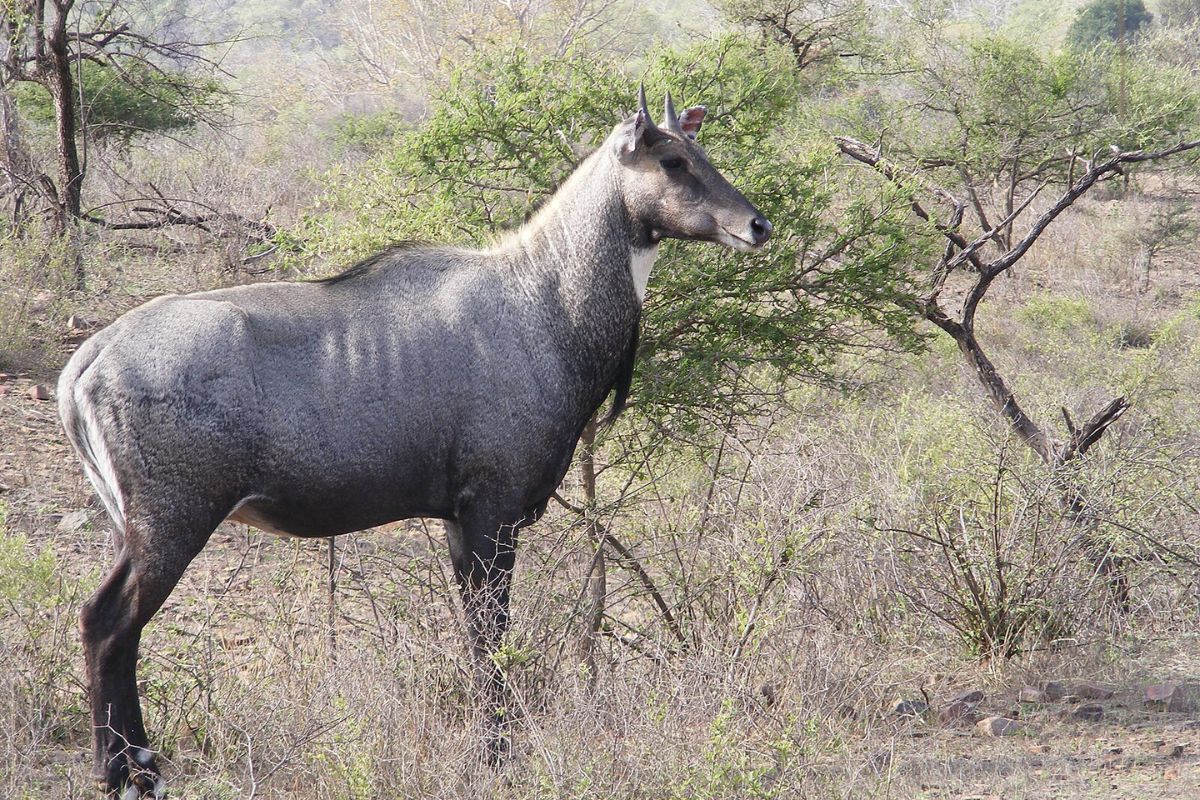
In a first for India, the Madhya Pradesh Forest Department used helicopters and South African “boma” technology to move 913 blackbuck and Nilgai from farmlands to forests in Shajapur district. The 11-day operation aimed to protect crops and reduce conflict between farmers and wildlife.
The department carried out the operation with help from a 15-member team from Conservation Solutions, a South Africa-based company that has experience relocating elephants, rhinos, and other large animals. The team trained Indian forest officers on the capture and release process before beginning the fieldwork.
Forest Divisional Officer Beerendra Kumar Patel led the campaign. He said the state had received many complaints from farmers about wild herbivores damaging crops. “There are more than 15,000 blackbuck and Nilgai living on revenue land instead of forests. Their movement across fields leads to heavy crop loss. The government decided to move them to protected areas,” he said.
The animals were herded using a Robinson-44 helicopter. The boma system, a funnel-shaped enclosure made of grass and green netting, was set up to guide the animals inside safely. Once inside, the blackbuck and Nilgai were transported to wildlife sanctuaries such as Kuno National Park, Gandhi Sagar Sanctuary, Nauradehi Sanctuary, and Rani Durgavati Tiger Reserve.
Patel explained that the method ensured minimal stress for the animals. “It is a non-contact operation. The animals are not touched by humans. Veterinarians also used remote techniques to give medicines when needed,” he said.
The plan was to continue the drive for 20 days, but technical limitations allowed operations for only 11 days. About 150 officers, veterinarians, and wildlife experts took part in the work across a dozen sites. Local villagers supported the forest department by sharing information on areas where large herds were found. Their cooperation helped officers conduct the mission in a targeted manner.
Patel said it was the first time India had used this technology on such a large scale. “This was a pilot project. Our officers received training from the South African experts and will be able to handle similar operations in other regions,” he said.
Chief Minister Mohan Yadav praised the effort. He called it a “historic step for wildlife conservation and farmers’ security.” He said the initiative showed how nature, animals, and farmers could all benefit from careful planning and coordination.
Shajapur MLA Arun Bhimawad also welcomed the move. He said the blackbuck and Nilgai had been a major concern for local farmers for many years. “This operation has brought relief to families who faced repeated crop damage,” he said.
Before the capture began, the Forest Department secured permission from the Revenue Department to ensure the process was lawful and safe. Officials said they were careful to avoid harm to both animals and people during the drives, which were conducted in areas with low human presence.
The relocation marks a new phase in managing human-wildlife conflict in Madhya Pradesh. With 913 animals safely moved to their natural habitats, officials believe the model can be used in other districts where farmers face similar problems.
Support us to keep independent environmental journalism alive in India.
Keep Reading
Elephants Are Back in MP After a Century, But Can They Stay?
Solar Energy – A Paradigm Shift in Wildlife Conservation
Stay connected with Ground Report for underreported environmental stories.