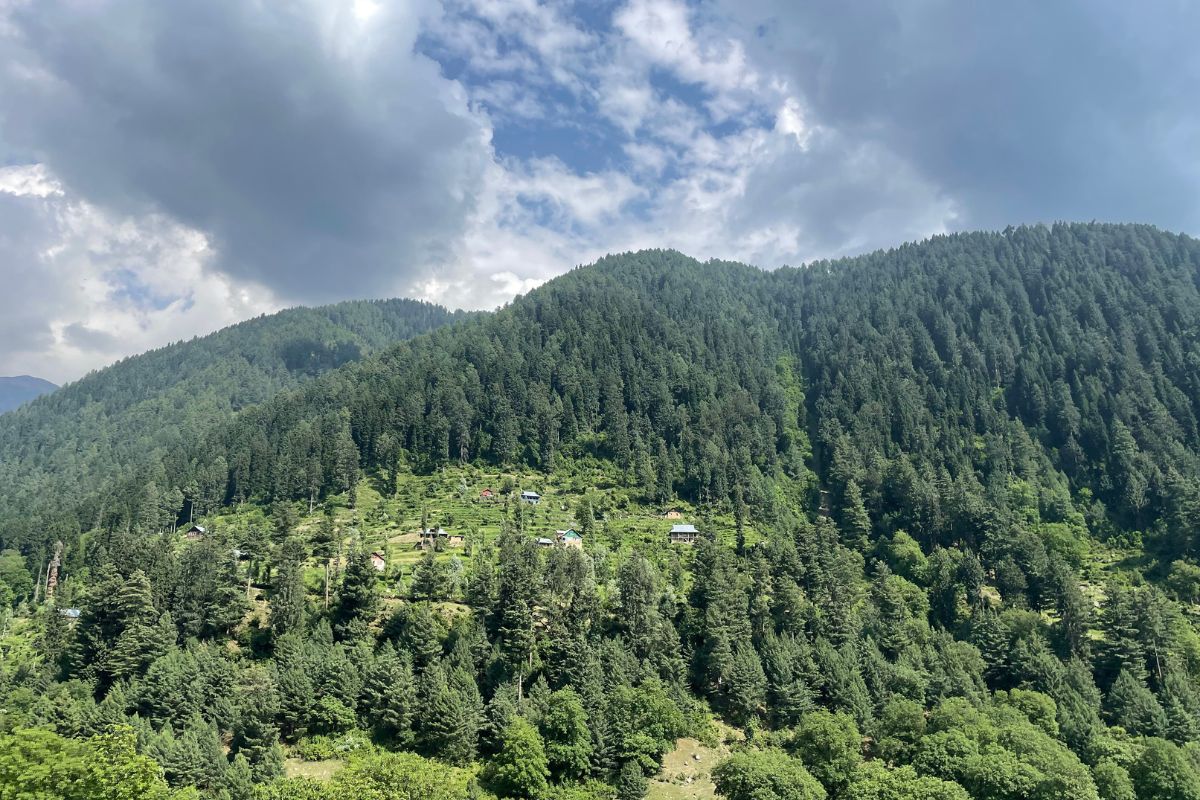
Tree cover in the Indian Himalayan Region fell from 15,427.11 square kilometres in 2021 to 15,075.5 square kilometres in 2023. The government shared the data in the Rajya Sabha on March 12, 2026, in response to a question by parliamentarian Sagarika Ghose.
Union Minister of State for Environment, Forest and Climate Change Kirti Vardhan Singh presented the figures, drawn from the India State of Forest Report (ISFR) 2023, published by the Forest Survey of India, Dehradun.
Thirteen states, one region
The Indian Himalayan Region covers 13 states and union territories, Jammu and Kashmir, Ladakh, Uttarakhand, Himachal Pradesh, Arunachal Pradesh, Manipur, Meghalaya, Mizoram, Nagaland, Sikkim, Tripura, Assam, and West Bengal.
Carbon stock in the region’s forests stood at 3,273.10 million tonnes in 2023, compared with 3,272.68 million tonnes in 2021, a marginal increase.
Ghose asked the government whether increased greenness in forest areas reflects the actual health of forests. Singh confirmed it does not. The government said forest health depends on multiple ecological and biophysical factors, including soil depth, humus, soil organic carbon, soil erosion, ground flora, canopy structure, and threats such as fire, invasive species, grazing, and illicit felling. These findings have been published in ISFR 2023.
Data gaps on soil and streams
Ghose also asked about soil moisture decline and the drying up of mountain streams since 2019. The government said its forest surveys do not include soil moisture assessment. It did not provide data on stream dryness.
The Forest Survey of India conducts a biennial assessment of forest and tree cover, carbon stock, and related indicators. Its findings are published in the India State of Forest Report every two years.
Support Us To Sustain Independent Environmental Journalism In India.
Keep Reading
Highway Halt Puts Kashmir’s Fruit Economy at Risk
Railway line expansion plan put Kashmir’s apple orchards at risk
Warmer winters in Kashmir raise concerns over apple and crop yields
Stay Connected With Ground Report For Underreported Environmental Stories.