An Israeli energy company is preparing to turn an underground salt cavern in Germany into what it says will be the world’s first commercial-scale air battery. If it works at the size planned, it could store enough renewable electricity to power tens of thousands of homes for weeks, without a single lithium cell.
Augwind Energy, based in Israel, is targeting a commissioning date of 2027 to 2028 for the facility, which will use its hydraulic compressed air energy storage system, known as AirBattery.
Technology That Runs on Air and Salt
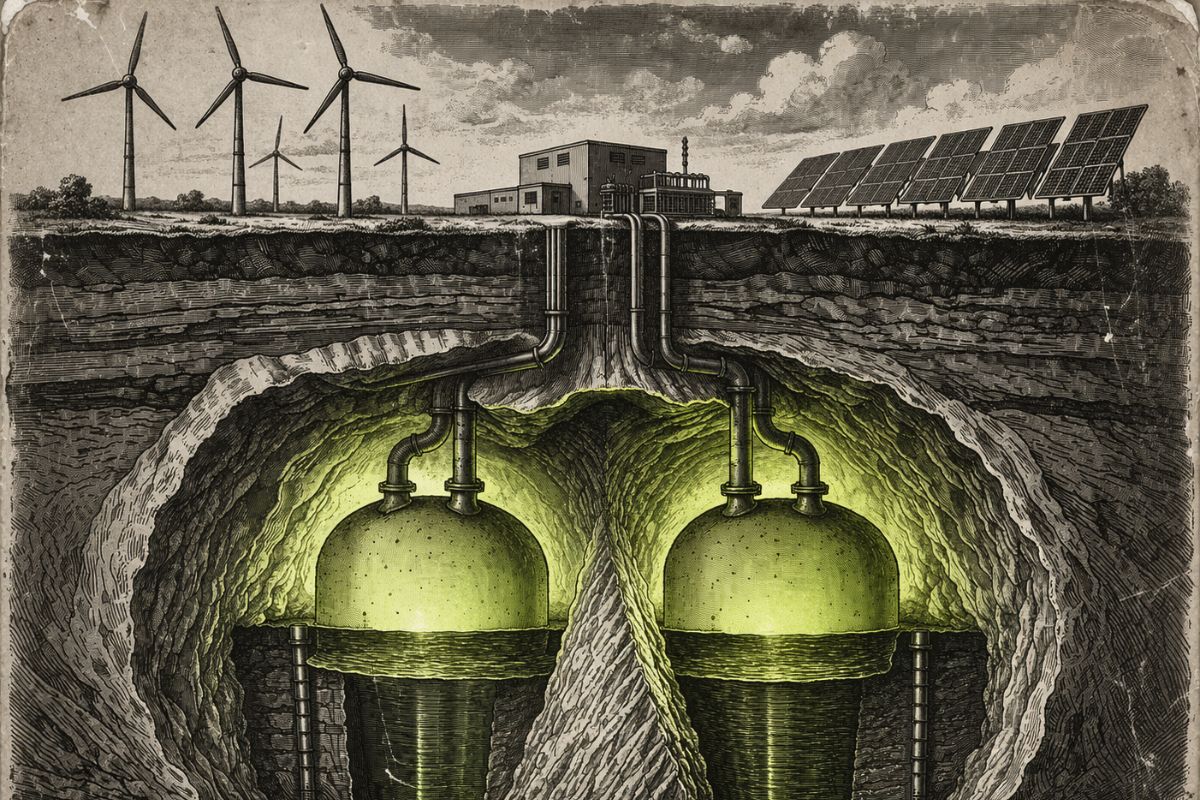
The AirBattery system works by using excess electricity, generated by wind or solar farms during periods of high output — to compress air and push it deep into sealed underground caverns at pressures between 50 and 200 bar. When electricity is needed, the process reverses. High-pressure air drives water through chambers, spinning a turbine to generate power.
The system combines two established technologies: pumped hydroelectric storage and compressed air storage. It requires no lithium, cobalt, or rare earth minerals. The core materials are salt, water, and air.
Or Yogev, founder and CEO of Augwind, said, “This is more than a project; it’s a milestone for achieving net zero. With the AirBattery, we’re introducing a storage solution that finally matches the scale and rhythm of renewable energy.”
Germany has more than 400 salt caverns considered geologically suitable for this type of storage. Augwind estimates the country’s total theoretical storage potential at 330 terawatt-hours, a figure that dwarfs current battery storage capacity across Europe.
The scale matters because Germany faces a recurring grid challenge known as Dunkelflaute, extended periods of low wind and weak sunlight that can last days or weeks. Conventional lithium-ion batteries store energy for hours, not weeks. The AirBattery is designed to bridge that gap.
A single cavern, depending on its size and pressure rating, can store between 3 and 8 gigawatt-hours of electricity. At the lower end, that is enough to supply a city of several thousand homes for multiple days.
What the Numbers Say So Far
Augwind has already operated a demonstration facility in Israel, where it recorded a 47 percent AC-to-AC round-trip efficiency, meaning 47 percent of the electricity used to compress the air is recovered when it is released. The company projects commercial installations will exceed 60 percent efficiency.
The projected cost is between 10 and 15 US dollars per kilowatt-hour of storage capacity. Augwind says the system carries almost no hardware degradation over a 40-year operational lifespan, which it says gives it a significant cost advantage over battery technologies that degrade and require replacement.
Germany is not new to compressed air storage. The Huntorf plant, commissioned in 1978 in Lower Saxony, remains one of the oldest commercial compressed air energy storage facilities in the world, rated at 320 megawatts. Huntorf compresses air into salt caverns during off-peak periods, then mixes it with natural gas and combusts it to generate electricity during peak demand.
The AirBattery system removes the combustion step entirely. It generates electricity without burning fuel, which Augwind says makes it suitable for a fully renewable grid.
What Happens Next
Augwind is currently working with cavern owners, utilities, energy traders, and industrial energy buyers in Germany to secure permits and finalise the system design. The company says the project is intended not only to prove the technology commercially, but to establish a template for deployment across Europe by 2030.
The German project will be the first test of whether a system that works at pilot scale can be built, operated, and financed at the level the energy transition requires.
Support Us To Sustain Independent Environmental Journalism In India.
Keep Reading
Highway Halt Puts Kashmir’s Fruit Economy at Risk
Railway line expansion plan put Kashmir’s apple orchards at risk
Warmer winters in Kashmir raise concerns over apple and crop yields
Stay Connected With Ground Report For Underreported Environmental Stories.