
Extreme weather events killed more than 832,000 people and caused economic losses exceeding $4.5 trillion worldwide between 1995 and 2024, according to a new report released at the UN climate summit in Brazil.
Extreme Weather’s Rising Global Toll
The Climate Risk Index 2026, published by Germanwatch on November 12, 2025, draws on data from international disaster databases, the International Monetary Fund, and the World Bank. The report tracks how storms, floods, heatwaves, and droughts have intensified over three decades, hitting poorer nations the hardest.
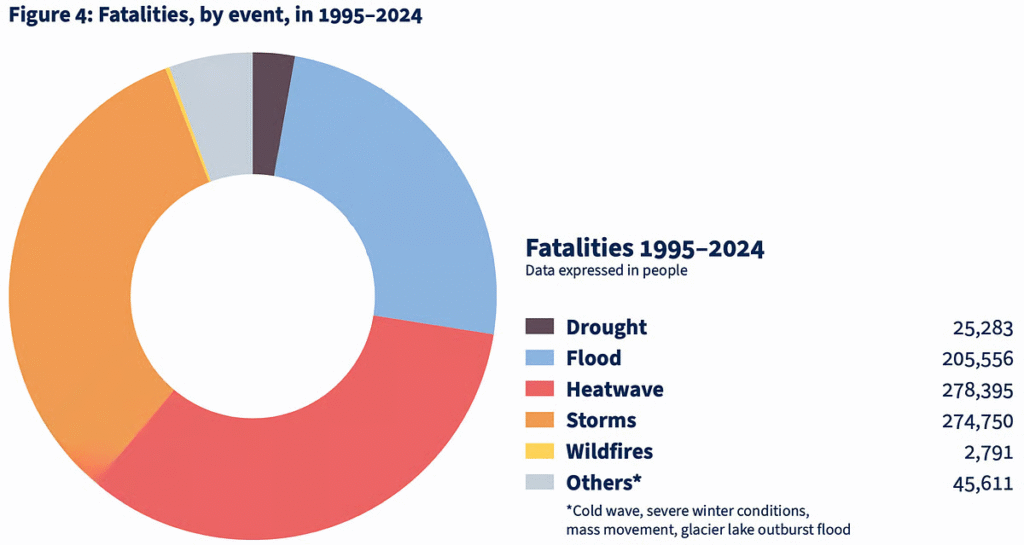
The world has endured more than 9,700 documented extreme weather events since 1995. Storms and heatwaves each caused roughly one-third of all deaths. Floods affected nearly half of those impacted. Storms alone accounted for 58 percent of economic losses, totaling about $2.64 trillion.

“Climate change is not a distant threat, it’s today’s defining reality,” said Laura Schäfer, one of the report’s authors and head of international climate policy at Germanwatch. “Heatwaves and storms now pose the greatest threat to human life, and we’re witnessing economic devastation on a scale that would have been unimaginable just a few decades ago.”
The year 2024 was the hottest on record. Global average temperatures exceeded 1.5 degrees Celsius above pre-industrial levels for the first time. Sea surface temperatures in the North Atlantic and Mediterranean hit unprecedented highs, fueling hurricanes and flash floods across continents.

India ranks ninth among countries most affected by extreme weather over the past three decades. The country recorded 80,000 deaths, 1.3 billion people affected, and economic losses of about $170 billion over 30 years. More than 400 extreme weather events struck India during this period, including deadly heatwaves, destructive floods, and powerful cyclones.
“India, along with Haiti and the Philippines, is hit by a range of climate extremes, from deadly heatwaves to destructive floods and cyclones, so regularly that recovery barely keeps pace with recurring damage,” said Vera Künzel, senior advisor on climate change adaptation and human rights at Germanwatch.
Poor Nations Face Deadly Disasters
Dominica tops the long-term ranking from 1995 to 2024, followed by Myanmar and Honduras. For 2024 alone, St. Vincent and the Grenadines, Grenada, and Chad were the most affected countries. Many of these are small island or low-income states.
Hurricane Maria struck Dominica in 2017, causing $1.8 billion in economic damage. This equaled 270 percent of the small island’s entire economic output. Cyclone Nargis devastated Myanmar in 2008, killing nearly 140,000 people and causing $5.8 billion in damage. In Honduras, Hurricane Mitch destroyed an estimated 70 percent of the country’s crops and infrastructure in 1998, causing more than 14,000 deaths.

The 2024 data reveals continued devastation. Hurricane Beryl struck St. Vincent and the Grenadines on July 1 with wind speeds reaching 260 kilometers per hour. The storm killed eight people, affected more than 40,000, and caused over $230 million in economic damage. This represented about 20 percent of the country’s economic output.
Chad experienced catastrophic flooding between August and September 2024. Heavy rains killed 576 people and affected nearly two million. The floods damaged 433,000 hectares of cropland and destroyed 218,000 homes. Economic losses totaled $380 million.
Six of the ten most affected countries in the long-term ranking come from lower-middle-income groups. These include Myanmar, Honduras, Haiti, the Philippines, Nicaragua, and India. None of the ten most affected countries over the past 30 years were high-income nations.

“The results of the CRI 2026 clearly demonstrate that COP30 must find effective ways to close the global ambition gap,” said David Eckstein, senior advisor on climate finance and investments at Germanwatch. “Global emissions have to be reduced immediately; otherwise, there is a risk of a rising number of deaths and economic disaster worldwide.”
Climate Change Fuels Deadlier Disasters
The report links climate disasters directly to global warming. A World Weather Attribution study found that human-induced climate change made extreme events far more likely and more intense than natural climate patterns alone would have caused.
The Philippines experienced an exceptionally destructive typhoon season in 2024. Multiple powerful storms struck between September and November, affecting more than 16 million people. The typhoons damaged or destroyed 480,000 houses and displaced 11 million people. Climate change increased the average intensity of these storms by about two meters per second, according to attribution studies.
Nepal faced severe floods and landslides in September 2024. Continuous heavy rainfall caused flash floods and river overflows across 44 districts. The disasters killed 268 people and affected nearly 2.6 million. Economic damage exceeded $338 million. Scientists found that climate change made the rainfall about 18 percent more intense and just over twice as likely.
Myanmar suffered flooding and Typhoon Yagi in 2024. The typhoon killed 460 people, affected more than one million, and caused $222 million in economic damage. Nearly 2.4 million people faced flood exposure. The country also experienced a severe heatwave from April to May, with temperatures reaching 47 degrees Celsius, resulting in 50 deaths.
Vietnam recorded major impacts from Typhoon Yagi in September. The storm made landfall with wind speeds reaching 280 kilometers per hour. It killed 345 people, affected more than 3.6 million, and caused $2 billion in economic damage. In northern Vietnam, nearly 3,300 homes sustained damage and more than 120,000 hectares of crops were lost.
World Off Track on Climate Action
The report references a landmark advisory opinion issued by the International Court of Justice earlier this year. The court affirmed that states have a legal duty to prevent and respond to harms caused by climate change. This finding added both moral and legal weight to demands for accountability from industrialised nations.
Germanwatch warns that the world remains dangerously off track. Current policies put the world on a path toward 2.6 to 3.1 degrees Celsius of warming by 2100, according to UN projections. Effective adaptation requires $215 to $387 billion annually. Climate finance needs to address loss and damage in developing countries are projected to reach $1.1 to $1.7 trillion annually by 2050.
“Countries such as Haiti, the Philippines, and India, all of which are among the ten most affected countries in the CRI, face particular challenges,” Künzel said. “They are hit by floods, heatwaves, or storms so regularly that entire regions can hardly recover from the impacts until the next event strikes.”
The escalating climate crisis occurs amid a challenging geopolitical backdrop. Escalating conflicts and security crises divert political attention and financial resources. Deep cuts to official development assistance have weakened many developing countries’ abilities to respond to climate impacts. Official development assistance is projected to drop by nine to 17 percent in 2025, representing a $31.1 billion decline from 2023.
“We are entering a new normal of continuous climate shocks,” Schäfer said. “Without stronger global cooperation and long-term support for vulnerable countries, we risk locking billions into a cycle of destruction and recovery that never ends.”
The Climate Risk Index examines extreme weather impacts based on six indicators. These include fatalities, people affected, and economic losses, presented in both absolute and relative terms. The index uses data from the international disaster database, World Bank statistics, and International Monetary Fund economic data.
Keep Reading
Elephants Are Back in MP After a Century, But Can They Stay?
Solar Energy – A Paradigm Shift in Wildlife Conservation
Stay connected with Ground Report for underreported environmental stories.