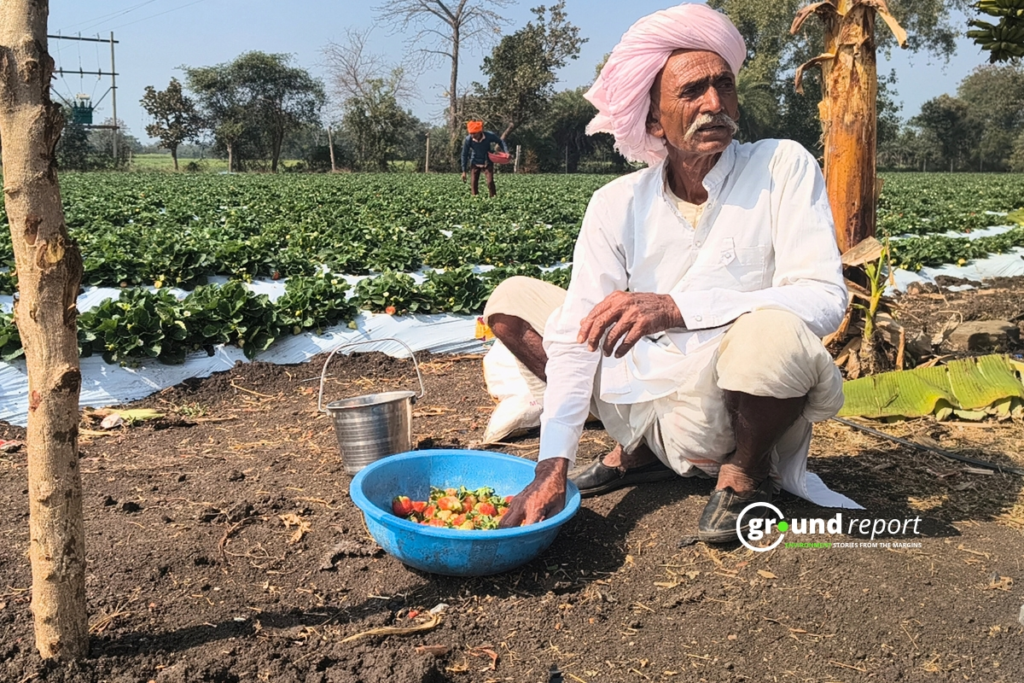
In Khajla village of Rajgarh district in Madhya Pradesh, farmer Shrilal Saundhiya has quietly rewritten the script of what farming can look like in a region long dominated by wheat, gram, and soybean.
For years, like most farmers around him, Shrilal cultivated traditional crops. But returns remained modest, and every few years, erratic weather or natural calamities would wipe out much of the harvest, pushing families into deeper financial stress. “Income from conventional crops is limited,” he says. “And when disasters strike, the losses can be devastating.”
Determined to find a more sustainable and profitable path, Shrilal began regularly consulting the horticulture department and exploring new techniques. Drip irrigation became his first major shift, a move that would set the foundation for his transition to horticulture.
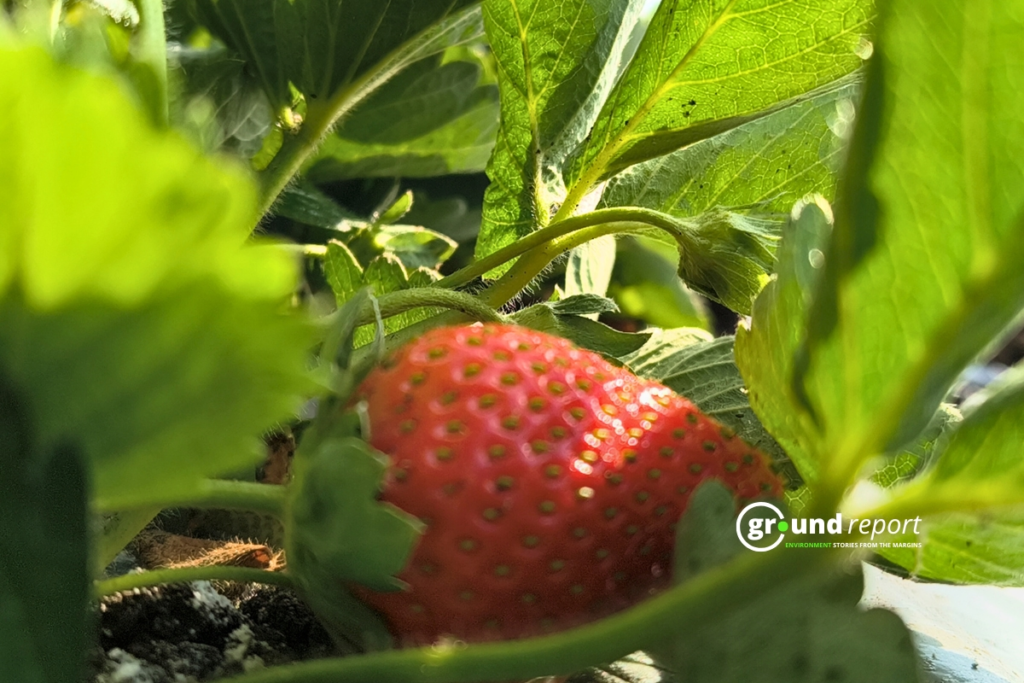
Betting on Strawberries
Shrilal owns about 30 bighas (18.60 acres) of land. Earlier, he grew conventional crops, but he always believed farming could be turned into a profitable enterprise. “Whenever I pick up my phone, I keep thinking about one question: how can farming become more profitable?” he says. He searched for new crops and modern methods on YouTube, and that became a constant habit.
Though his success wasn’t instant. Initially, with guidance from the horticulture department, he experimented with fruits like papaya, banana, and eventually strawberries. He installed drip irrigation and planted 10,000 strawberry saplings. The initial investment was about ₹2 lakh. In the very first year, the crop generated around ₹4 lakh in income, enough to convince him he was on the right track.
Today, Shrilal cultivates nearly 50,000 strawberry plants across two and a half acres. Including plants, drip systems, and mulching sheets, the total investment stands at around ₹7 lakh. At present, he earns approximately ₹15,000 per day from sales, with expectations that daily revenue could rise to ₹30,000 during peak season.
The harvest cycle for strawberries will continue until early April.
Sachin Kumar Jain, Deputy Director of the Agriculture Department, says the government provides subsidies for drip irrigation and soil testing to reduce farmers’ financial burden. “Regular crop inspections and technical guidance are also provided so that farmers do not face difficulties,” he explains.
From Farm to Market
Shrilal manages the marketing himself to ensure market linkage for his harvest. “Unless a farmer actively participates in selling his produce, profits will remain limited,” he says. He sends produce to whichever market offers the best price.
After the strawberry season ends, he shifts to sweet corn, which fetches ₹20–22 per kilogram in the market. He is now planning to experiment with blueberriestoo; if successful, he intends to scale it up too.
He continues traditional crops on about three hectares, where he grows wheat, but with modern systems. A mini-sprinkler irrigation setup ensures efficient water use, and instead of waking up at night to irrigate fields. Fertilizer and water application are guided by scientific advice and personal experience to minimise input costs.
He speaks with quiet pride about employing ten local workers, creating steady livelihoods within the village.
Recognition and Ripple Effects
Shrilal’s innovation has not gone unnoticed. On Republic Day, the district administration honored him for his efforts. On January 30, he was also felicitated at a state-level event in Bhopal.
The impact of his work is visible across Rajgarh. Last year, only 15,000 strawberry saplings were traded in the district. This year, the number has risen to 90,000 as more farmers shift toward horticulture. He says that everyone now eats strawberries in his village. Even Shrilal himself had never tasted a strawberry before he began cultivating it. “I knew what it looked like. I tasted it for the first time here.”
Investing in the Next Generation
Shrilal, who studied until Class 10, hopes his son, who has studied agriculture, will take his experiments forward. He believes educated youth must engage with farming to strengthen its future and make agriculture truly self-reliant.
By translating knowledge gathered from a mobile screen into action in the soil, Shrilal has demonstrated that when technology and curiosity meet experience, farming can become more than subsistence; it can be a pathway to resilience and prosperity.
Support Us To Sustain Independent Environmental Journalism In India.
More Video Reports
Rail Projects Halted in Kashmir After Apple Farmers Protest, Uncertainty Remains
After Indore, 22 Fall sick in Mhow Due To Drinking Contaminated Water