On January 18, 2026, Prime Minister Narendra Modi laid the foundation stone of the Kaziranga Elevated Corridor, a ₹ 6,950-crore infrastructure project.
“During floods, wildlife has to cross the National Highway and often gets trapped. Our effort is to ensure smooth traffic while keeping the forest safe.” Addressing the gathering in Kaliabor, Assam, Modi said, “Vehicles will pass above, and wildlife movement below will remain unhindered.”
Wild animals cross National Highway 715 to reach higher ground in the Karbi Anglong hills. Many animals die because fast and heavy vehicles move on the highway day and night, the National Board for Wildlife (NBW) said in a forestsclearance.nic.in.
A 2022 Gauhati University study documented 6,036 animal deaths between 2016 and 2017 on the boundary of Kaziranga National Park on the north and the North Karbi Anglong Wildlife Sanctuary on the south. Nearly 60 percent of these deaths occurred during flood season. The National Tiger Conservation Authority (NTCA) counted 1,176 wildlife deaths in 2019, which included 49 large mammals.
PM Modi said a “90-kilometre corridor from Kaliabor to Numaligarh is being developed, including a 35-kilometre elevated wildlife corridor,” adding that Modi said the project design has been prepared “keeping in mind the traditional movement routes of rhinos, elephants, and tigers.”
The NBW said flyovers, underpasses, and tunnels at key points will help animals cross the road safely during normal days and floods. These steps aim to reduce wildlife deaths on the highway.
The Assam-based science group Ellora Vigyan Mancha said authorities pushed the project ahead without conducting a proper Environmental Impact Assessment, which is required by law for UNESCO World Heritage Sites.
“Construction will take at least four to five years. Animal corridors will remain blocked during this time,” said Bhupen Sarmah of Ellora Vigyan Mancha to Ground Report.
Why an Elevated Corridor Was Needed
Kaziranga, designated a UNESCO World Heritage Site for its exceptional natural value, sits on the Brahmaputra floodplains and has the world’s largest population of one-horned rhinos.
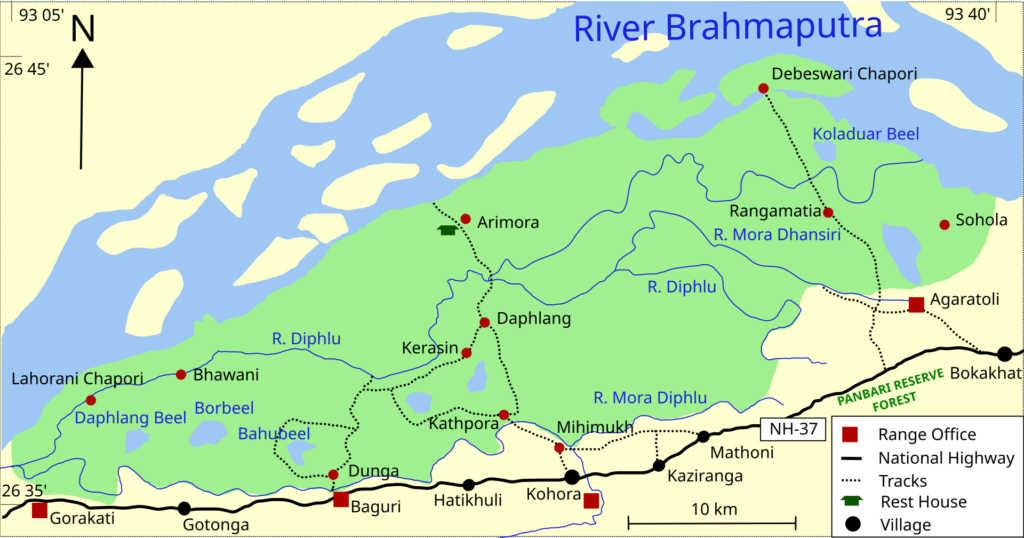
National Highway 715, earlier known as NH-37, connects Tezpur on the north bank of the Brahmaputra to towns in eastern Assam. The Karbi Anglong hills lie across the highway. The Karbi Anglong hills provide food, shelter, and high ground when Kaziranga’s grasslands flood every year.
In October last year, the Union government approved widening an 86.675-km stretch of National Highway 715 from two lanes to four lanes. Most of this stretch runs along the southern boundary of Kaziranga National Park and cuts through its eco-sensitive zone and designated animal corridors.
The approved project includes building a 34.5-km elevated corridor. This leaves space underneath for animals to move between the park and the Karbi Anglong Hills, particularly during floods.
Local People Raise Concerns
In 2015, Kaziranga-based activist Rohit Choudhary filed a complaint before the National Green Tribunal’s Eastern Zone Bench in Kolkata over rising wildlife deaths on the highway cutting through the park.
“Kaziranga has UNESCO and IUCN recognition. It needs careful handling. Big infrastructure projects and tourism together will harm both biodiversity and local communities,” Pranab Doley, convenor of the Greater Kaziranga Human and Land Rights Protection Committee, opposes the project told Down to Earth.
“Wild animals from Kaziranga move back and forth to the Karbi Hills every day and in large numbers during monsoon floods. Construction will take at least four to five years. Animal corridors will remain blocked during this time,” Bhupen Sarmah said to Ground Report.
Sarmah warned that even if construction stops during the monsoon, physical obstacles will remain on the ground. “Trenches, pits, and structures can injure or kill wild animals.” Blocked corridors, as Down To Earth reported, at least 35,000 people live across over 1000 villages and hamlets, and can “face increased human-wildlife conflict”, Sarmah warned.
In some of the reported villages, ten villages, residents have demanded a 1.5-kilometre stretch as a ground-level road for better access to schools, hospitals, and markets. They are not against the elevated road project.
34 Conditions Imposed
The National Board for Wildlife has laid down strict safeguards to protect animals during construction:
No work on wildlife corridors from June to September (flood season)
No construction between sunset and sunrise inside protected areas
Construction at least 15-20 meters away from hill slopes
No labor camps or storage yards inside the reserve
Materials must be prepared outside the project area
Elevated sections at least 9 meters high
Light and sound barriers on all elevated stretches
No street lights on elevated roads
Pillars must be camouflaged
Pre-fabricated structures only
Box culverts (5×5 meters) every 300-500 meters
Median is only 0.15-0.25 meters high with grass
The existing road below the elevated sections is to be closed
24-hour CCTV-equipped forest check posts
Heavy vehicles diverted during floods
Annual compliance reports to the central government
Dr Sonali Ghosh, Field Director of Kaziranga National Park and Tiger Reserve, did not respond to a request for comment on the project.
Banner image: One horn Rhino are seen at the Kaziranga National Park in Assam Photo credit: commons.wikimedia/Diganta Talukdar
Support us to keep independent environmental journalism alive in India.
Keep Reading
Small Wild Cats in Big Trouble: India’s First National Report Released
After Tragedy, Families Face Delays in Tiger Attack Compensation
Stay connected with Ground Report for underreported environmental stories.
Author
Support Ground Report to keep independent environmental journalism alive in India
We believe climate change should be the basis of current discourse, and our stories attempt to reflect the same.
Connect With Us
Send your feedback at greport2018@gmail.com
Newsletter
Subscribe our weekly free newsletter on Substack to get tailored content directly to your inbox.
When you pay, you ensure that we are able to produce on-ground underreported environmental stories and keep them free-to-read for those who can’t pay. In exchange, you get exclusive benefits.
Your support amplifies voices too often overlooked, thank you for being part of the movement.